EASLiver Updates
European Association for the Study of the Liver Berlin. Germany - March 30 - April 3, 2011
The effect of antiviral therapy in chronic hepatitis B (CHB) on reducing the risk of long-term complications (LTCs) remains unclear so far. This research aimed to study whether long-term nucleos(t)ide analogues therapy can reduce the risk of long-term complications.
MEDLINE, EMBASE, OVID, the Cochrane Central Register of Controlled Trials was searched for relevant data. Relative risks (RRs) of long-term complications with or without treatment and subgroup analyses including the status of drug-resistance, HBeAg and pre-existing compensated cirrhosis were done using relative risks of long-term complications either with or without treatment or among nucleos(t)ide analogues treatment groups. Six eligible studies (3644 patients in all) were included.
- Incidence of long-term complications in treatment groups was reduced by 74% (RR: 0.26, 95% CI: 0.15- 0.47) compared with no treatment.
- The incidence of long-term complications was still significantly reduced respectively by 45% in drug resistant cases (RR: 0.55, 95% CI: 0.40-0.76) and 78% in cases without drug resistance (RR: 0.22; 95% CI: 0.13- 0.36) during the long-term therapy.
- In the NA treatment groups, patients with drug-resistance had 2.64 times (RR: 2.64, 95% CI: 1.58-4.41) and those with pre-existing compensated cirrhosis had 3.07 times (RR: 3.07, 95% CI: 1.04-9.11) higher chance of developing long-term complications.
- For both HBeAg status and pre-existing compensated cirrhosis, there was significant lower incidence of long-term complications in treatment groups compared with no treatment.
Long-term nucleos(t)ide analogue therapy for adults with CHB prevents or delays the development of long-term complications like decompensated cirrhosis, CHB- related death or CHB-related liver cancer thereby justifying the early and judicious use of antiviral therapy
Q.-Q. Zhang, P. Hu, H. Ren. Poster Presentation no. 717 presented at EASL 2011.
Osteoporosis is the predominant component of hepatic osteodystrophy and is present in 20-50% of patients with Chronic Liver Disease, based on BMD measurements. Tenofovir Disoproxil Fumarate (TDF) is recommended as a first line therapy, in Chronic Hepatitis B (CHB) patients, by most guidelines. There have been reports of bone density loss in HIV patients on tenofovir treatment, but limited data exist in HBV treated patients. The aim of this study was to determine the impact of TDF on BMD in an ethnically diverse HBV infected population undergoing long-term treatment with this agent.
In a single center, 83 consecutive CHB patients, majority males, median age 45 (range 26-64) were treated with TDF for a minimum of 12 months and prospectively offered a dual X-ray absorptiometry scan. BMD loss was defined by WHO criteria; T-score < -2.5 (osteoporosis) and between -1&-2.5 (osteopenia).
A control group, 27 patients with CHB (19 males), median age 32 (range 20-61), with no TDF exposure were also examined. Data on ethnicity, BMI, gender, fibrosis stage, co-morbidities and drug history were recorded in all subjects.
- There was no difference in BMD loss when comparing both groups (p=0.45).

- In the ethnically diverse population studied, there was increased BMD loss in the non-white population (48%, treated group; 50%, controls) compared with the white population (33%, treated group; 40%, controls).
- By univariate analysis age, gender, fibrosis stage, co-morbidities were all significant (p=< 0.05), but particularly ethnicity (p=0.009).
- At multivariate analysis only ethnicity, BMI and male gender met statistical significance (p< 0.015, < 0.017, and < 0.018 respectively), but not tenofovir.
Hence this cross-sectional study does not exclude the potential for BMD loss with TDF and further studies are required to determine its effect on bone over time.
Prevalence of reduced BMD in CHB patients of diverse ethnicity is independent of tenofovir treatment. Factors such as ethnicity and BMI also contribute to BMD loss and should be considered when selecting treatment options
U.S. Gill, S. Al-Shamma, K. Burke, et al. Poster Presentation no. 713 presented at EASL 2011.
Many studies have attested that not only does HBV genotype influence the outcome of the disease but it also influences the outcome of therapy with interferons and pegylated interferons, with genotype A doing better than genotype D in Caucasians and genotype B better than genotype C in Asians. However not much information is available on this aspect with oral nucleos(t)ides. Among the principal trials of tenofovir, Study 103 in HBeAg positive patients with chronic hepatitis B (CHB), treatment with tenofovir disoproxil fumarate (TDF) resulted in HBeAg seroconversion in 31% of patients at week 192 (on-treatment analysis). The current analysis identifies the baseline characteristics associated with HBeAg seroconversion for HBeAg+ patients who have been treated with TDF for up to 4 years. A multivariate stepwise logistic regression analysis was performed to screen for baseline factors associated with HBeAg seroconversion.
- Overall 40% (104) of patients (72 TDF-TDF and 32 ADV-TDF) experienced one event of HBeAg seroconversion during the 192 weeks
- The median (quartiles 1, 3) time to achieve HBeAg seroconversion was 48 weeks (24,108)
- HBeAg seroconversion rate was 31% among Asians; 50% in patients with high baseline Knodell necroinflammatory categories ( 10 to 14)
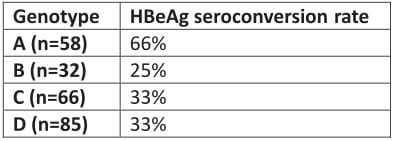
- In the multivariate stepwise analysis, baseline genotype (p< 0.001) and HBsAg levels (p< 0.01) were associated with HBeAg seroconversion.
- No association was found with other baseline characteristics including race, gender, HBV DNA levels, ALT levels and Knodell score
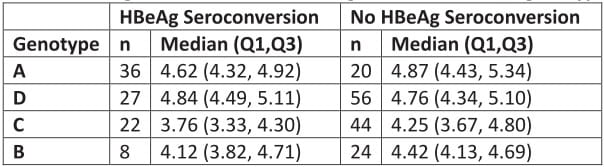
HBeAg seroconversion was found in all genotypes, and occurred most frequently in genotype A patients and in patients with lower baseline HBsAg levels EXCEPT patients infected with genotype D
J. Heath cote, M. Manns, P. Mathurin, et al. Poster Presentation no. 715 presented at EASL 2011.
Tenofovir (TDF) to be an effective therapy for NUC-na?ve patients with chronic hepatitis B up to 4 years. 302 patients on TDF monotherapy were enrolled in a retrospective/ prospective cohort study from 19 European centers.
- NUC-na?ve patients with chronic hepatitis B starting TDF in each center (HIV co-infected excluded). 79% of patients were HBeAg negative, 35% with cirrhosis, 45% with concomitant disease/medications.

Virological response was undetectable HBV DNA by sensitive assays; safety analysis focused on glomerular and tubular renal function.
Efficacy
- Undetectable HBV DNA was 66%, 84% and 89% at 24, 48, 72 weeks, with time to HBV DNA clearance being significantly dependent on baseline viral load.
- The 48-week estimated probability of HBV DNA undetectability was 100%, 90% and 65% in low, intermediate and high viral load patients respectively (p< 0.001).
- Primary non response at week 12 was observed in 2.5% of the patients, partial virological response at week 48 in 15% [residual viremia: 46 lU/ml (10-264.000)], virological breakthrough in 2%.
- Two patients cleared HBsAg and discontinued tenofovir successfully.
Safety
- Serum creatinine rose from 0.90 (0.4-5.2) to 0.95 (0.4-6.5); a greater than 0.3 or 0.5 mg/dl increase of serum creatinine versus baseline occurred in 7% and 2.4% of the patients, respectively.
- The proportion of patients with MDRD < 50 ml/min and between 50-60 doubled from baseline (2.5% and 3%) compared to last visit (6% and 6%).
- Approximately 1% of the patients had < 2.0 mg/dl blood phosphorus levels at both baseline and last visit assessment, but 28% had reduced urinary phosphate absorption, as assessed by estimated TmPI/GFR
- Overall, tenofovir dosing was reduced or discontinued in 3.3% of the patients because of renal toxicity or other adverse events.
Tenofovir suppressed HBV replication in most NUC-na?ve patients in clinical practice (up to 21 months) with few patients showing an impairment of renal function
P. Lampertico et al. Poster Presentation no. 731 presented at EASL 2011.
Levrero and colleagues presented results from the OptiB trial, a multicenter, prospective, open-label study evaluating the safety and efficacy of TDF in patients with CHB mono infection with suboptimal responses to adefovir (ADV) or ADV/lamivudine (LAM). 85 HBV mono-infected patients with HBV-DNA >103cp after 48 weeks of ADV±LAM were enrolled and switched to TDF 300 mg daily±LAM, majority being male.
- HBV suppression (24 weeks, primary), early (4-12 weeks) and long term HBV suppression, HBsAg and HBeAg seroconversion, viral resistance and safety surveillance.
- Genotypic analysis by direct sequencing and reverse hybridization performed at baseline and in all viremic samples at follow-up.
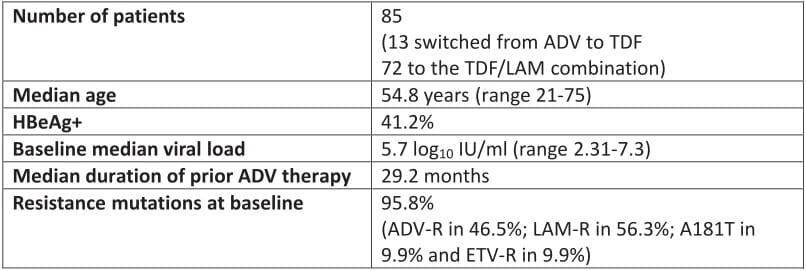
Efficacy
- 2 (2.5%) patients had a Primary Non Response at week 12.
Virological response at different time points is mentioned below
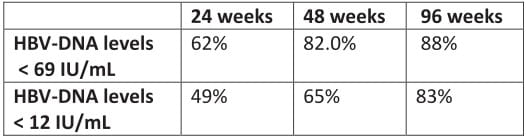
- Virological response was not correlated with HBeAg status or ADV resistance mutations at baseline.
Safety
- Disease related events included 6 HCC (3 deaths), 4 OLTs (1 HCC, 3 ESLD) and 6 deaths (3HCC and 3 ESLD).
- Median creatinine levels were 0.89+0.23 mg/dl at baseline and 1.03+0.82 at 48 weeks. 1 patient showed a sharp rise in creatinine levels at week 24 (NSAIDs use) that resolved.
- 4 patients had MDRD < 50 and 2 patients had an MDRD < 60 with grade 1/2 hypophosphotemia. All are on treatment with adjusted TDF dosage. None of the remaining patients showed creatinine levels > 1.5 mg/dl or creatinine elevation > 0.5 mg/dl or MDRD < 50.
Tenofovir shows significant and sustained antiviral activity against HBV in patients who have failed lamivudine and are sub-optimal responders to adefovir
M. Levrero: et al. Poster Presentation no. 732 presented at EASL 2011.
Tenofovir is already an established firstline drug in both HIV and HBV management. Its antiviral efficacy in chronic hepatitis B is well documented; however some concerns exist on the renal safety based on prior reports from HIV patients on renal toxicity. This study analyzed effect of tenofovir on renal function in patients with CHB in three principal large randomized clinical trials in patients mono-infected with HBV.
Changes in renal parameters were evaluated in all patients in studies 102, 103 and 106 receiving tenofovir through 144 weeks. Baseline and on-treatment renal function was evaluated based on serum creatinine and estimated glomerular filtration rate (eGFR) by Cockcroft-Gault (CG).
Renal events were defined as either a confirmed increase in serum creatinine by ≥0.5 mg/dL from baseline, or a confirmed eGFR< 50 mL/min. Subgroup analysis was performed comparing the incidence of renal events over time between patients with and without baseline co-morbidities (compensated cirrhosis, hypertension and diabetes mellitus) and between treatment-na?ve and treatment experienced-patients.
The table below shows baseline renal parameters and incidence of renal events for 426 treatment-na?ve patients receiving tenofovir.
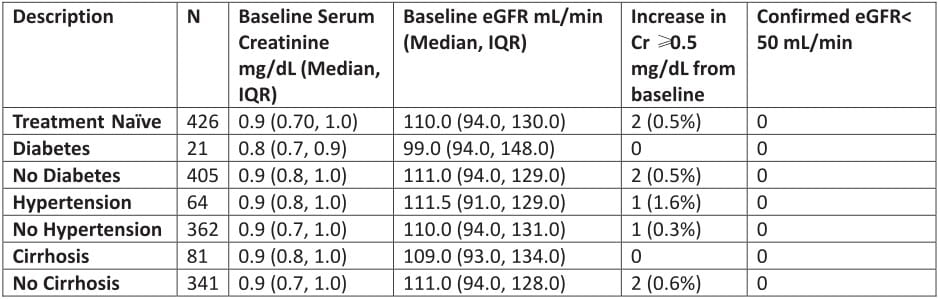
Good Renal Safety Was Seen Through 144 Weeks Of Treatment. No Treatment-Na?ve Patient Had A Confirmed Egfr < 50 Ml/Min With Similar Results Seen In The Treatment-Experienced Population As Well.
Tenofovir monotherapy was safe and well tolerated without clinically relevant changes in renal function over 144 weeks across varied patient populations including those with co-morbidities commonly associated with renal impairment
P. Marcellin et al. Poster Presentation no. 739 presented at EASL 2011.
In studies 102 and 103, CHB patients were randomized to TDF or adefovir dipivoxil (ADV) for 48 weeks (W), and eligible patients (with W48 biopsy) subsequently rolled-over to open-label tenofovir (TDF) for 7 additional years. HBsAg was quantified every 12 weeks. HBsAg kinetics was analyzed by genotype and HBeAg status.
Tenofovir principal studies (study 102 lnd 103) showed 23 HBeAg (+) and 0 HBeAg (-) patients with loss of HBsAg with up to 4 years of TDF treatment.
Key baseline characteristics of HBeAg(+) patients who experienced HBsAg loss included genotype (Genotype) A or D, HBsAg ≥4.5 log10 lU/mL, HBV-DNA>=9 log10 copies/mL; and Knodell Necro-inflammatory Score ≥9.
- HBsAg levels were 4 to 12-fold higher in HBeAg(+) patients) in study 103 than the corresponding genotype A to D patients among HBeAg(-) participants in study 102 ( see tables below)
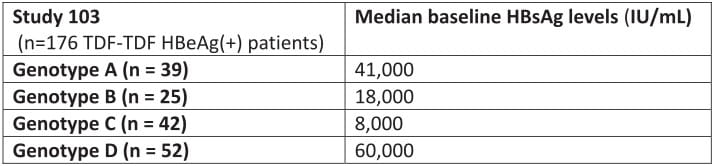
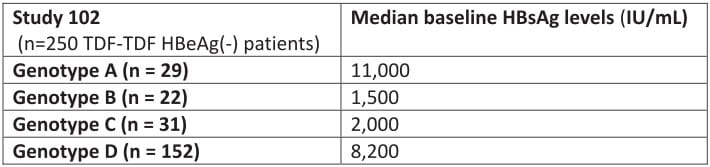
- HBsAg decline was most rapid during the first 12 weeks (W12) of TDF treatment, more rapid in the HBeAg (+) patients than HBeAg(-) regardless of genotype and continued to decline past Week 24.
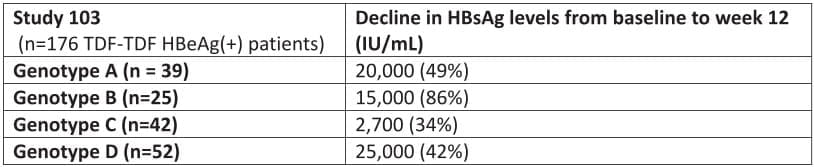
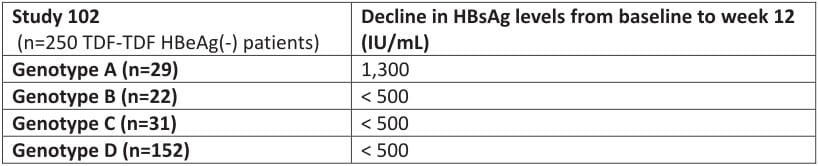
- HBsAg decline in HBeAg(-) patients was less than that in HBeAg(+) from baseline to Week 12.
- Genotype A-D HBeAg (-) patients had lower baseline HBsAg levels and slower decline of HBsAg compared to HBeAg(+) of the same genotypes. Regardless of HBeAg status, Genotype A/D patients had higher baseline HBsAg and more continuous decline than Genotype B/C.
Higher baseline HBsAg and larger decline with tenofovir treatment may both contribute towards eventual loss of HBsAg
P. Marcellin et al. Poster Presentation no. 740 presented at EASL 2011.