

Mind Matters (Issue 1) – Escitalopram: Depression associated with Stroke

Introduction
Stroke is a major public health problem. Patients who survive acute stroke remain at high risk of developing depression. It has been estimated that approximately 14% patients develop major depression and another 23% patients develop minor depression during the first 2 years following stroke. Thus, post-stroke depression is a significant concern, which occurs in approximately 37% of stroke survivor patients.1Although the pathophysiological mechanisms of post-stroke depression are not yet fullyunderstood, several biological, behavioral, and social factors are considered to be involved in its development. Thus, post-stoke depression a multifactorialprocess.In these patients, depression may impair functional outcomes, physical and cognitive recovery after stroke, daily life activities, social and interpersonal activities, and quality of life.2In addition, depression may increase morbidity and mortality in post-stroke patients.3According to an estimate, risk of mortality remains up to 10 times higher in patients with post-stroke depression than in patients without post-stroke depression.Despite high incidenceand prevalence of post-stroke depression, it is frequently underestimated in clinical practice as the depressive symptoms are rarely identified. Many antidepressant drugs have proved to improve cognitive skills and functional recovery in patients with post stroke depression.2
Escitalopram: A Choice of Drug for Patients with Post-stroke Depression
It is evident that early treatment with antidepressants is associated with significant improvement in activities of daily living and cognitive functioning, motor functions, and greater long-term survival rates among patients with post-stroke depression.4Among two classes of anti-depressant drugs, TCAs possess strong affinity for muscarinic, cholinergic and histaminergic receptors, which might be associated with adverse effects including cardiovascular or sedative effects. On the other hand, SSRIs have no af?nity for cholinergic or histaminergic receptor and thus are generally well tolerated. Hence, SSRIs are the recommended ?rst-line choice for post-stroke depression.5Among SSRIs, escitalopram has shown to have greater efficacy, faster onset of action, and successful patient tolerance over a 12-month administrationin patients with major depressive disorder as compared to other SSRI, citalopram.6In addition, it has been demonstrated thatescitalopram oxalate, a widely prescribed SSRI, prevents the onset of depressive disordersamong patients with an index stroke.1Thus, escitalopram can be considered as a choice of drug for patients with post-stroke depression.
Escitalopram: Safe and Effective in Post-stroke Depression
Havle et al. determined the efficacy and safety of escitalopram in post-stroke depression treatment. In this open-label study, patients with depressive symptoms within 6 months of a cerebrovascular event (n=35; age: 67±6 years) were treated with escitalopram 10 mg/day for 3 months. After treatment initiation, significant improvements were observed in Hamilton Rating Scale for Depression (HAM-D) scores at each follow-up visits (i.e. days 15, 30, 45 and 90; Figure 1). Overall, the mean HAM-D score decreased from 27.5±4.7 at baseline to 4.65±2.47 at day 90 (p<0.0001). In addition, escitalopram was well tolerated with side effects related to nausea, anxiety, drowsiness and dyspepsia being reported in 9 (26%) patients. Findings of the study indicated that escitalopram is safe and effective in the management of patients with post-stroke depression.3

HAM-D: Hamilton Rating Scale for Depression
Escitalopram: Effective in Preventing Post-stroke Depression
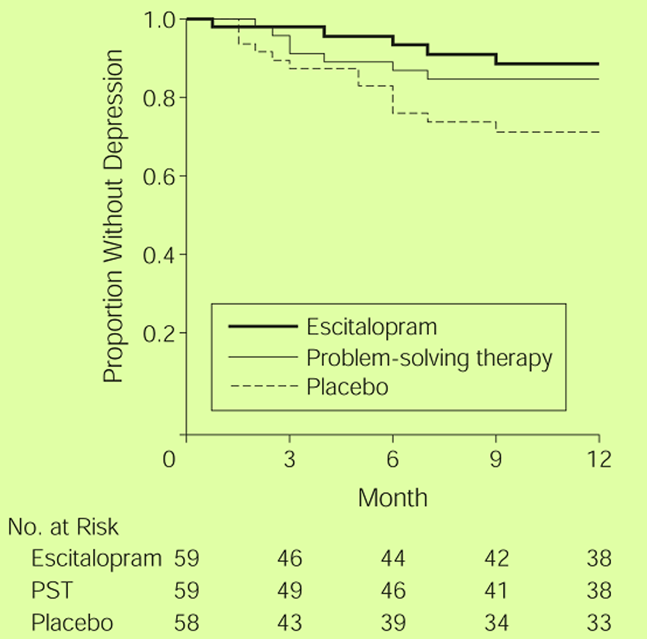
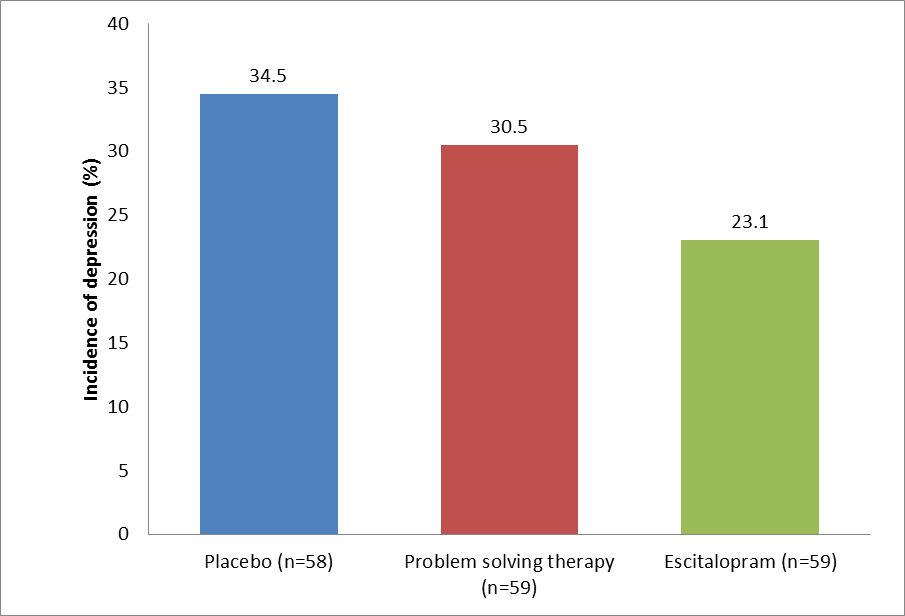
Robinson et al. conducted a randomized multi-center studyto evaluate the efficacy of escitalopram and problem-solving therapy in preventing depression in non-depressed patients with recent stroke (n=176). The enrolled patients were assigned to receive either escitalopram (n=59), problem-solving therapy (n=59), or placebo (n=58). Diagnosis of major or minor depression during 12-month follow-up period was evaluated as the primary outcome measure. The study demonstrated that use of escitalopram or problem-solving therapy resulted in a significantly lower incidence of depression as compared with placebo in non-depressed patients with recent stroke (Figure 2). The risk comparison analysis (Figure 3) revealed that patients who received placebo were4.5 times more likely to develop depression than those who received escitalopram (adjusted hazard ratio: 4.5; 95% confidence interval: 2.4–8.2; p<0.001) and 2.2 times more likelythan those who received problem-solving therapy (adjusted hazard ratio: 2.2; 95%confidence interval: 1.4–3.5; p<0.001). However, the intention-to-treat method of analysis(Figure 4) showed that problem-solving therapy did not achieve significant results over placebo (hazard ratio: 1.1 [0.8–1.5]; p=0.51), while escitalopram was superior to placebo (hazard ratio: 2.2 [1.2–3.9]; p=0.007).No significant difference was observed with regard to adverse events, including all-cause hospitalizations, between three treatment groups.1

Escitalopram: Improves Cognitive Function in Post-stroke Patients
Jorge et al. reported a beneficial effect of escitalopram on cognitiveoutcomes, which was independent of its effect on depression, in post-stroke patients. In this randomized placebo-controlled study, 129 patients with recent stroke were treated for 12 months with either escitalopram (n=43), problem solving therapy (n=41), or placebo (n=45). Change in RBANS scores (Repeatable Battery for the Assessment of Neuropsychological Status) was assessed for all patients. Findings revealed a significant difference among the three treatment groups for change in RBANS total score (p<0.01), RBANS delayed memory score (p=0.001), and RBANS immediate memory score (p=0.01), with escitalopram group displaying a higher change in score as compared to other two groups (Table 1). In addition, the effect of escitalopram on the longitudinal course of cognitive variables was determined by comparing escitalopram group with non-escitalopram group (i.e. merging the placebo and problem solving therapy groups into a single group). After adjusting for possible confounders, there was a significant effect of escitalopram treatment, as compared to non-escitalopram group, on mean change in RBANS total score (10.0 vs. 3.1; p<0.01; Figure 5A), on mean change in RBANS delayed memory score (11.3 vs. 2.5; p<0.01; Figure 5B), and on mean change in RBANS immediate memory score (13.5 vs. 5.3; p=0.01; Figure 5C). Overall, the findings of the study indicated that escitalopram offers significant improvement in global cognitive functioning, specifically in verbal and visual memory functions, in stroke patients.4
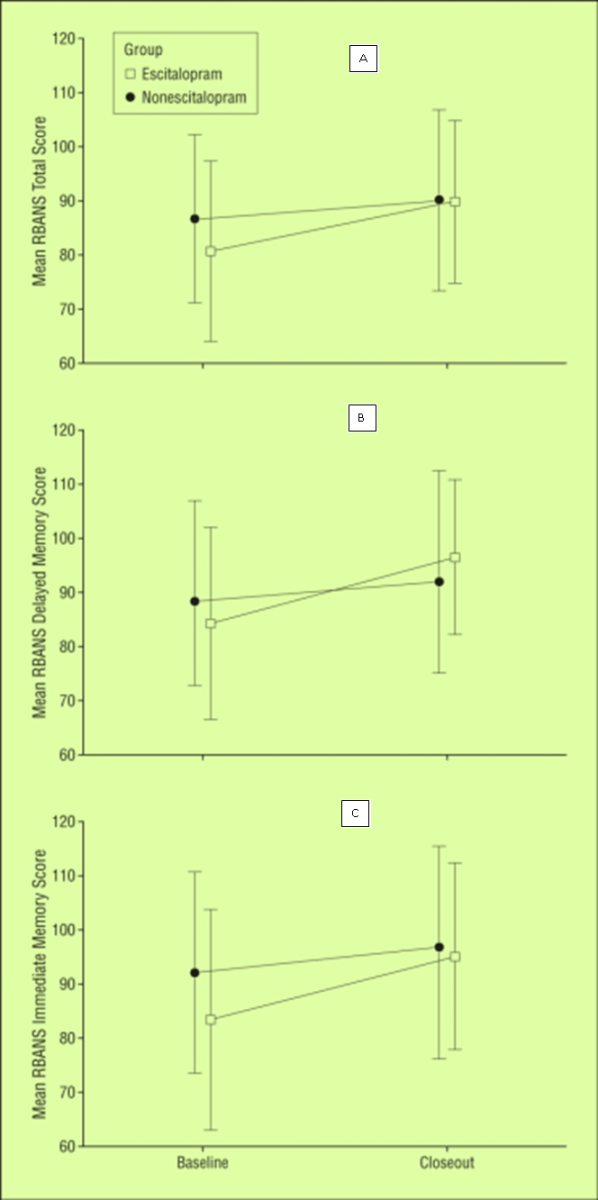
RBANS: Repeatable Battery for the Assessment of Neuropsychological Status
|
Efficacy parameter |
Assessment period |
Mean score |
| ||
|
Placebo |
Escitalopram (n=43) |
Problem solving therapy (n=41) |
P value | ||
|
RBANS total score |
Baseline |
85.3 |
80.7 |
88.2 |
<0.01 |
|
Closeout |
91.0 |
89.8 |
89.1 | ||
|
RBANS delayed memory score |
Baseline |
88.1 |
84.2 |
88.6 |
0.001 |
|
Closeout |
94.2 |
96.6 |
89.1 | ||
|
RBANS immediate memory score |
Baseline |
91.1 |
83.4 |
93.2 |
0.01 |
|
Closeout |
98.5 |
95.1 |
94.9 | ||
|
RBANS: Repeatable Battery for the Assessment of Neuropsychological Status | |||||
Summary
- Post-stoke depression occurs in more than one-third of stroke survivor patients. It is a significant medical concern associated with impaired functional outcomes, quality of life, and physical and cognitive recovery after stroke as well as increased disability and mortality.
- The SSRIs are considered as the first-line choice of therapy for the management of post-stokes depression, mainly because of their favorable tolerability pro?le as compared to TCAs.
- Among SSRIs, escitalopram has shown to have greater efficacy, faster onset of action, and successful patient tolerance over a 12-month administration in patients with major depressive disorder as compared to other SSRI, citalopram. In addition, escitalopram is a well-established and widely-prescribed medication for post-stroke depression.
- Havle et al. reported the safety and efficacy of escitalopram in reducing the depressive symptoms in patients with post-stroke depression.
- Robinson et al. reported that escitalopram is significantly effective in preventing depression among non-depressed patients with recent stroke.
- Jorge et al .reported that escitalopram offers significant improvement in cognitive functioning, specifically in verbal and visual memory functions, in post-stroke patients.
References
- Robinson RG, Jorge RE, Moser DJ, et al. Escitalopram and problem-solving therapy for prevention of post-stroke depression: a randomized controlled trial. JAMA. 2008; 299(20):2391-2400.
- Esp?rragoLlorca G, Castilla-Guerra L, Fern?ndez Moreno MC, et al. Post-stroke depression: an update. Neurologia. 2015; 30(1):23-31.
- Havle N, Altunkaynak Y, Dayan C, et al. Escitalopram in treatment of post-stroke depression. KlinikPsikofarmakolojiBulteni (Bulletin of Clinical Psychopharmacology). 2010; 20(1):74-8.
- Jorge RE, Acion L, Moser D, et al. Escitalopram and enhancement of cognitive recovery following stroke. Arch Gen Psychiatry. 2010; 67(2):187-96.
- Paolucci S.Epidemiology and treatment of post-stroke depression.Neuropsychiatr Dis Treat. 2008; 4(1):145-54.
- Moore N, Verdoux H, Fantino B. Prospective, multicentre, randomized, double-blind study of the efficacy of escitalopram versus citalopram in outpatient treatment of major depressive disorder. Int Clin Psychopharmacol 2005; 20(3):131-7.
- Mikami K, Jorge RE, Moser DJ, et al. Prevention of poststroke apathy using escitalopram or problem-solving therapy. Am J Geriatr Psychiatry. 2013; 21(9):855-62.