




Bright Times: Issue 4


Clinical Focus
Acute Phase Treatment of Major Depression: Escitalopram vs. Other Antidepressants
Major depression is a mental disorder associated with loss of interest and pleasure as well as persistent and unreactive low mood. This condition is associated with personal, social and economic morbidity, loss of productivity and functioning. Although psychological treatments and medications are reported to be effective for treating major depression, the mainstay of treatment are antidepressant drugs in moderate to severe major depression.1,2
Various classes of antidepressants such as tricyclics (TCAs), monoamine oxidase inhibitors (MAOIs), selective serotonin re-uptake inhibitors (SSRIs), serotonin-noradrenaline reuptake inhibitors (SNRIs) and the newer ones are available for the treatment of major depression. SSRIs and newer antidepressants are the most commonly prescribed antidepressants recently. Evidence has also suggested that SSRIs have similar efficacy and are generally better tolerated than TCAs. Escitalopram is an SSRI and a pure S-enantiomer of the racemic citalopram. It is about 100 fold more potent than the R-enantiomer with respect to inhibition of 5-HT reuptake and inhibition of 5-HT neuronal firing rate.1
Escitalopram is a Suitable First-Line Antidepressant for Moderate to Severe Major Depression vs. Other Antidepressants1
Researchers within the Cochrane Collaboration Depression, Anxiety and Neurosis Group conducted a systematic review of the evidences to assess for the efficacy and tolerability of escitalopram compared with other antidepressants in the acute-phase treatment of major depression. Randomized controlled trials were included in this analysis. Evidences with patients aged 18 or older with a primary diagnosis of major depression were included.
Results Revealed:
- Fourteen trials compared escitalopram with another SSRI and eight compared escitalopram with a newer antidepressive agent (venlafaxine, bupropion and duloxetine).
- Statistically significant differences that favored escitalopram over other antidepressants were observed in terms of efficacy (citalopram and fluoxetine) and acceptability (duloxetine) for the acute phase treatment of major depression.
Escitalopram versus Other SSRIs
Escitalopram vs. Citalopram
- Acute phase treatment (6 to 12 weeks): A statistically significant difference was observed with escitalopram being more effective than citalopram (p=0.006; 6 studies, 1823 participants; Figure 1).
- There was a statistically significant difference with escitalopram being more effective than citalopram (p=0.02; 6 studies, 1823 participants) in terms of achieving remission.
- Follow-up response (16 to 24 weeks): No statistically significant difference was observed between escitalopram and citalopram (OR: 0.96, 95% CI: 0.60 to 1.56, p=0.88; 1 study, 357 participants).
- Acceptability: No statistically significant difference was found in terms of discontinuation due to any cause (OR: 0.78, 95% CI: 0.56 to 1.10, p=0.16; 6 studies, 1823 participants).
- Escitalopram was not associated with a smaller or higher rate of adverse events than citalopram (OR: 0.79, 95% CI: 0.58 to 1.07, p=0.12; 6 studies, 1802 participants)
Escitalopram vs. Fluoxetine, Paroxetine Sertraline
- Acute phase treatment (6 to 12 weeks): There was no evidence that escitalopram was more or less efficacious than fluoxetine in the acute phase of treatment (p=0.17; 3 studies, 783 participants; Figure 1)
- There was no evidence that escitalopram was more or less efficacious than paroxetine in reduction of depressive symptoms or in terms of remission of symptoms (Figure 1).
- There was no evidence that escitalopram was less or more efficacious than sertraline in terms of remission of symptoms and in terms of response to treatment in the acute phase (Figure 1).
- Acceptability: No statistically significant difference was found in terms of discontinuation due to any cause.
- There was no evidence that escitalopram was associated with a less or higher rate of adverse events than fluoxetine, paroxetine or sertraline
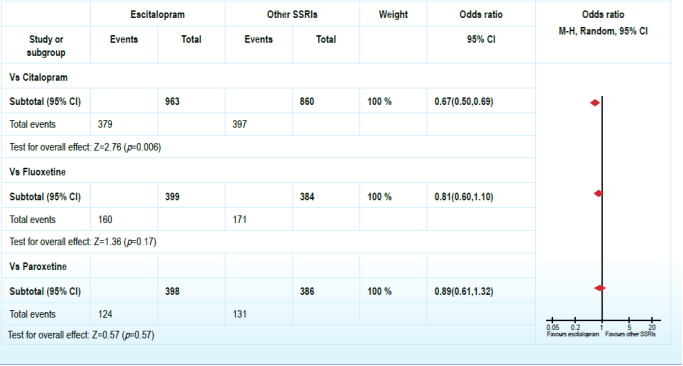
Escitalopram vs. Newer Antidepressants
- Acute phase treatment (6 to 12 weeks): There was no evidence that escitalopram was more efficacious than bupropion in terms of response to treatment in the acute phase and in terms of remission of depressive symptoms.
- Significantly fewer patients in the escitalopram group withdrew from trials compared with patients treated with duloxetine, for discontinuation due to any cause (OR 0.62, 95% CI 0.38 to 0.99).
Sensitivity Analysis: Escitalopram vs. Citalopram
A statistically significant difference was observed in favor of escitalopram, not only when trials whose dropout rate was greater than 20% in both arms were excluded (OR 0.56, 95% CI 0.40 to 0.79, p=0.0009; 4 studies, 1187 participants) but also when trials whose dropout rate was >20% in only one arm were additionally excluded (OR 0.49, 95% CI 0.34 to 0.72, p=0.0002; 3 studies, 830 participants).
Summary
Antidepressants are the mainstay of treatment for moderate to severe major depression. Escitalopram has shown to have a 100-fold more potent effect than its R-enantiomer. Researchers conducting the Cochrane systematic review have shown that escitalopram is more superior to citalopram in terms of acute phase treatment of depression and in achieving remission. Therefore, escitalopram appears to be suitable as first-line antidepressant treatment for people with moderate to severe major depression. It was observed to perform better than citalopram when the results of six studies in nearly two thousand patients were analyzed.
References
- Cipriani A, Santilli C, Furukawa TA, et al. Escitalopram versus other antidepressive agents for depression. Cochrane Database Syst Rev. 2009; (2):CD006532.
- Purgato M, Papola D, Gastaldon C, et al. Paroxetine versus other anti-depressive agents for depression. Cochrane Database Syst Rev. 2014; (4):CD006531.
Challenges in Treatment of Depression
Predictors of First-Episode Unipolar Major Depression in Individuals with and without Sub-Threshold Depressive Symptoms
Major depressive disorder (MDD) is the most common public health issue that is associated with significant impairment across various areas of functioning. Data has suggested that disorder-related functional impairment is experienced by nearly all depressed individuals and around two-thirds experience severe impairment.1 Reports have suggested a growing recognition of the negative impact of sub-threshold depression, the estimates of which are likely to be much wider than those of full syndromal MDD. The symptoms of sub-threshold depression indicate significant impairment in functioning. Therefore, it is necessary to identify factors that predict the risk for developing MDD. This can help in improving the accuracy and efficiency of screening procedures, prevention and can reduce the risk of symptom escalations.2
Sub-Threshold Depressive Disorder: Is It a Major Risk Factor for the Onset of MDD in All Patients?
Researchers conducted a study to examine predictors of first episode MDD with and without sub-threshold depression over a three-year follow up period. Data for this study was sourced from the Waves 1 and 2 of the National Epidemiological Survey on Alcohol and Related Conditions (NESARC). Patients reporting lifetime depressed mood/loss of interest lasting at least two weeks and at least two of the seven other DSM-IV symptoms of MDD met the criteria for a sub-threshold depressive episode (sMDE; n=3901). Predictors of major depressive episode (MDE) 3 years later were compared in those with and without (n=31022) sub-threshold MDE (sMDE). 2
Results Showed: 2
Risk of Escalation
- Of the 3,901 patients with sMDE by Wave 1, 4.72% developed MDD by Wave 2.
- Of the 31,022 without sMDE by Wave 1, 3.24% developed MDD at Wave 2.
- Sub-threshold depression at Wave 1 was associated with significantly greater risk of developing MDD (p<.001, odds ratio [OR] =1.49, confidence interval [CI]: 1.36–1.62).
Predictors of First Episode MDD
- Around 9 of 10 variables predicted the development of MDD at Wave 2 in univariate models.
- Higher risk of developing MDD included younger age (p<.001, OR=0.99), female gender (p<0.001, OR=2.13), fewer years of education (p<0.001, OR=.98), and non-white race (p=0.003, OR=1.16).
- Other variables included:
- A lifetime anxiety disorder (p<0.001, OR=2,01)
- A lifetime drug use disorder (p<0.001, OR=1.33)
- Lifetime alcohol use disorder (p=0.008, OR=1.11)
- History of child abuse (p<0.001, OR=3.58)
- Any 1st degree family history of depression (p<0.001, OR=1.62)
Predictors of First Episode MDD in Individuals with and without Sub-Threshold Depression
- Sex was the only demographic predictor that differed in magnitude between individuals with and without sMDE.
- Being female increased the likelihood of developing MDD in individuals without sMDE (p<0.001, OR=2.25) relative to individuals with sMDE (p< 0.001, OR=1.31).
- Among individuals without sMDE, a lifetime alcohol use disorder increased the odds of developing MDD (p=0.001, OR=1.17), conversely, the odds of developing MDD were decreased among individuals with sMDE.
- Among individuals without sMDE, more past year medical conditions increased the odds of developing MDD (p<0.001, OR=1.01), whereas decreased the odds of developing MDD among individuals with sMDE.
- Although childhood abuse was associated with increased likelihood of developing MDD in both groups, childhood abuse increased the odds of developing MDD to a greater degree in individuals without sMDE (p<0.001, OR=3.91) relative to those with sMDE (p<0.001, OR=2.11).
A statistically significant three-way interaction between age, education, and sMDE status, as well as between age, drug use, and sMDE status was observed. In sMDE patients, a significant effect of younger age was observed at low and average levels of education, but not among individuals with high education. However in patients without sMDE, a significant effect of younger age was seen with all levels of education.2
Not all patients with sMDE developed MDD, and not everyone passed through a sub-threshold phase prior to the onset of MDD. Hence, although a sub-threshold depression is one of the best established risk factors for the onset of full-syndrome depressive disorders, many individuals do not go on to develop MDD. The researchers suggested that this data can be useful in identifying subgroups of individuals at high-risk of developing depression and candidates for early intervention.2
References
- McLaughlin KA. The public health impact of major depression: a call for interdisciplinary prevention efforts. Prev Sci. 2011; 12(4):361-71.
- Peters AT, Shankman SA, Deckersbach T et al. Predictors of first-episode unipolar major depression in individuals with and without sub-threshold depressive symptoms: A prospective, population-based study. Psychiatry Res. 2015; 230(2):150-6.
Talking Point
Exploring the Psychosis-Depression Interface: Clinical Implications
Depressive and psychotic symptoms often occur together which further complicate the diagnostic and treatment methodologies. Researchers have shown that patients with depression could also have delusional beliefs. However, due to the continuing debate about the diagnostic classification of psychotic and mood disorders, researchers have suggested a separate category for schizophrenia and psychotic disorders with a mood component, such as bipolar disorder. Hence, depression and psychotic symptoms are usually considered as separate disorders having different causes.
Co-occurrence of depressive and psychotic symptoms complicate the diagnostic and treatment processes in the affected patients.
Differential Diagnosis
The differential diagnosis depends mainly on the timing, progression, and overlap of psychotic versus depressive symptoms.
|
Psychosis with depression |
Depression with psychotic features |
|
Symptoms that persist with and without mood disorders |
History of previous depressive episodes and the current episode begins with classic depression that worsens over time, at which point psychotic symptoms emerge. |
|
These patients such as in schizophrenia tend to become depressed when they realize the poor prognosis, loss of function, and dependence on caregivers. |
Severe depression may develop psychotic symptoms which is an extension of their negative thoughts and low mood. Patients may also have bizarre delusions and hallucinations, irrational fears or persecutory paranoia. |
Various factors complicate the diagnosis of depressive symptoms in schizophrenia:
- Depression can mimic negative symptoms of schizophrenia; anhedonia, low motivation, social withdrawal, and flat affect.
- Antipsychotic medications block the dopamine D2 receptors and strongly inhibit dopamine signaling to the nucleus accumbens which can thereby sap motivation and reduce responses to rewarding stimuli.
Treatment Decisions
Psychotic and depressive symptoms exist on the opposite ends of the spectrum, in which depression or bipolar disorder with psychotic features can be seen as being in the middle wherein the domains of both symptoms overlap. Therefore, treatments for both symptom clusters should be similar, differing only in more aggressive treatment for presence of psychosis.
A similar treatment is suggested for the symptoms of both, psychosis and depression, but a more aggressive therapy for psychosis.
Clinical Manifestations
- There is a substantial overlap in the etiology of depression and psychosis. Schizophrenia is one of the most genetically influenced psychiatric disorders with heritability between 70% and 80%, where the heritability of depression is in the 30% range.
- A considerable overlap has been observed in genetic susceptibility for major mental disorders. Also, rare genetic variants cause both types of symptoms.
- Receptor systems may also be associated with psychosis or cognition and may play a role in mood regulation.
Treatment Strategies
- Comorbid depressive and psychotic symptoms can be treated with both antidepressant and antipsychotic medications. Monotherapy with a drug having dual efficacy for both types of symptoms can also be used.
- Antipsychotics that are approved as augmentation treatment for refractory depression can be used for psychotic depression. Antipsychotics which are potent D2-antagonists may be preferred to achieve sufficient D2 occupancy for antipsychotic effects while reducing the off-target adverse effects in combination with antidepressants.
- Specific scenarios such as severe depression with prominent psychotic symptoms presenting with strong suicidal ideation or with psychomotor retardation and catatonia may require intervention with electroconvulsive therapy, which has a rapid effect on both, psychotic and depressive symptoms.
Comorbid depressive and psychotic symptoms can be treated with both antidepressant and antipsychotic medications. Antipsychotics with potent D2-antagonist effects are preferred in combination with the antidepressants to avoid the off-target adverse effects
Therefore, combined symptoms of psychosis and depression as well as the existing genetic overlap have weakened the diagnostic differentiation. Moreover, increasing overlap of medications and a careful selection of combined antipsychotic and antidepressant therapy can reduce the adverse effects and enhance patient compliance.
Reference
Wong AHC. Exploring the psychosis-depression interface: Clinical implications. Psychiatric Times. Available on: http://www.psychiatrictimes.com/special-reports/exploring-psychosis-depression-interface-clinical-implications. Last accessed on: 3rd Jan 2017
Current News
PSG Sleep Parameter: A Biomarker to Evaluate the Risk of Suicidal Ideation in Patients with Treatment Resistant Depression (TRD)
A risk of suicide ideation (SI) may be associated with disturbed sleep. Bernet RA et al evaluated the association of polysomnographic (PSG) sleep parameters with SI in patients with TRD. The current study is the first to evaluate SI in the context of an objective assessment of sleep within a TRD sample with BD or MDD, it included 54 TRD individuals (n=30 with major depressive disorder and n=24 with bipolar depression). Sleep efficiency, total sleep time, wakefulness after sleep onset (WASO), rapid eye movement (REM), and non-REM (NREM) sleep stages 1-4 were studied. ANOVA analyses were conducted before (Model 1) and after adjusting for depression (Model 2) and diagnostic variables (Model 3). Patients with SI showed a significantly less NREM Stage 4 sleep in model 1 (p<0.05), 2 and 3; lower SE and higher WASO in model 2 and 3. Therefore, PSG sleep parameters may determine the risk of SI in patients with TRD independent of depression severity.
Bernet RA et al. J Affect Disord. 2017; Jan 15; 208:309-315.
Serum Concentration of Sortilin-Derived Propeptides can Assess Antidepressant Treatment Response
Sortilin-derived propeptide (PE) has been reported to have a potent antidepressant activity in rodents. In the recent study, researchers determined the serum concentration of PE in human patients affected by major depressive disorder (MDD) and healthy controls and after antidepressant treatment. A translation study was conducted using a specific dosing method which is characterized by structure-recognition analysis with various synthesized PE analogues. The study showed that serum concentration of PE is decreased in patients affected by MDD as compared to healthy non-psychiatric controls cohort (p=0.035). The normal levels of PE were restored after pharmacological treatment with antidepressants. Therefore, the quantification of serum concentration of PE could help in assessing the efficacy of antidepressant therapy and the necessity to revise the current therapeutic strategy.
Devader C et al. J Affect Disord. 2017; Jan 15; 208:443-447.
Levels of in vivo Metabolites Act as Biomarker for Suicidal Risk and Mental Pain in Depressed Patients
The structural and functional impairments in neuroimaging studies are associated with suicidal behaviour. Jollan F et al studied levels of metabolites in right dorsal prefrontal cortex of 25 unmedicated depressed patients and 33 healthy volunteers. Metabolites were measured with the help of proton magnetic resonance spectroscopy. A significant association was observed between N-acetylaspartate (NAA) levels and psychological pain (r=-0.47, p<0.001) and, choline levels and current suicidal ideas (r=0.53, p<0.0011). Psychological pain and suicidal ideas were found to be highly inter-correlated. A lower NAA and higher glutamine levels were found in the patients relative to healthy controls. Therefore, levels of metabolites can act as a biomarker for suicidal ideas and mental pain.
Jollant F et al. Prog Neuropsychopharmacol Biol Psychiatry. 2016; Oct 27. DOI: 10.1016/j.pnpbp.2016.10.005


