Bright Times: Issue 3


Clinical Focus
Treating Comorbid Anxiety and Depression: Role of Escitalopram
Comorbid Anxiety and Depression: Need for Effective Treatment
Comorbid psychiatric disorders have gained increasing attention and have a significant effect on the clinical presentation, choice of treatment, the course of illness, and prognosis.1 Presence of comorbid anxiety and depression is associated with severe symptoms, a more chronic course, low quality of life, poor outcomes, and high incidence of suicide and treatment resistance than either of the disorders occurring alone.1,2 Generalised anxiety disorder (GAD) rarely occurs alone, it is reported that around 90% of patients with GAD have a history of other psychiatric disorders and around two-thirds of these patients suffer from depression. Estimates have also suggested that GAD prevails in around 20–30% of the patients with major depression. 3 Overlapping anxiety and depression makes diagnosis difficult and poses a treatment challenge.2 A large proportion of the population suffer from comorbid depression and anxiety disorder and hence, choosing an effective treatment for both anxiety and depression is essential.3
Escitalopram: A Preferred SSRI for Treatment of Depression and Anxiety
Selective serotonin reuptake inhibitors (SSRIs) are recommended as first-line agents for the treatment of depression and anxiety disorders.4 SSRIs have largely replaced tricyclic antidepressants due to their good efficacy and tolerability.3 Escitalopram, an SSRI, has relatively faster onset of action, and better tolerability compared with other antidepressants. It also has the advantage of being cost–effective. Therefore, it is an effective first-line option in the management of patients with depression and various anxiety disorders.5
High Response and Remission Rates with Escitalopram in the Treatment of Comorbid Anxiety and Depression
In a 16-week post-marketing surveillance (PMS) study, researchers analyzed the antidepressant effects and tolerability of escitalopram in 2,911 patients with comorbid depression and anxiety3
- Around 81.4% of patients were diagnosed with comorbid depression and anxiety disorder. Prior to the escitalopram therapy, around 35.7% of patients were treated with other antidepressants.
- The severity of depression was observed to decrease from the mean Montgomery-Åsberg Depression Rating Scale – short version (svMADRS) of 33.8 ± 8.9 at baseline to 8.2±7.8 at week 16, corresponding to a mean improvement of 25.5±10.8. An improvement was observed in the remission rate (svMADRS≤12) and the response rate (≥50% decrease in svMADRS score) at the end of study (Table 1).
- The severity of anxiety symptoms for patients with comorbid depression decreased from the mean baseline of Hamilton Anxiety Scale (HAMA) 29.5±8.5 to 8.3±7.2, corresponding to a mean difference of 21.2±9.3 (full analysis set [FAS], last observation carried forward [LOCF]). An improvement was observed in the corresponding remission and the response rate at the end of study. (Table 1).
|
|
svMADRS |
HAMA |
HADS-D |
CGI-I |
|
change in total score |
− 25.5 ± 10.8 |
− 21.2 ± 9.3 |
− 20.1 ± 8.9 |
− 1.57 ± 0.75‡ |
|
response rate |
86.7 % |
83.8 % |
– |
92.0 % |
|
remission rate |
76.0 % |
66.3 % |
57.7 % |
– |
|
‡ The CGI-I describes a change in condition compared with the beginning of the study. Negative numbers indicate an improvement. Remission: svMADRS ≤ 12, HAMA < 10, HADS-D ≤ 10. CGI-I: Clinical Global Impression of Improvement scale, HADS-D: FAS: full analysis set, Hospital Anxiety and Depression Scale – German version, HAMA: Hamilton Anxiety Scale (assessment of the severity of anxiety), LOCF: last observation carried forward, svMADRS: Montgomery-Åsberg Depression Rating Scale – short version. |
||||
- For patients with comorbid depression, the mean baseline Hospital Anxiety and Depression Scale–German version (HADS-D) score was 30.1±6.1, decreasing to 10.0±7.1, corresponding to a mean improvement of 20.1±8.9 (FAS, LOCF). An improvement was observed in the rate of remission. The response rate increased to 92.0 % at 16 weeks.
- Patients treated with 20 mg/day had significantly higher mean total scores (svMADRS, HAMA, HADS-D) at baseline than patients treated with 10 mg/day (Table 2).
|
|
Escitalopram 10 mg/day |
Escitalopram 20 mg/day |
|
|
(n = 1 687) |
(n = 498) |
|
svMADRS |
− 25.0 ± 10.6 |
− 27.1 ± 11.0* |
|
HAMA |
− 20.8 ± 9.2 |
− 22.7 ± 9.7** |
|
HADS-D |
− 19.6 ± 8.7 |
− 21.8 ± 9.2*** |
|
CGI-S |
− 2.50 ± 1.21 |
2.69 ± 1.25‡ |
|
*svMADRS: p = 0.0033 **HAMA: p = 0.0011 ***HADS-D: p < 0.0001, ‡CGI-S: p = 0.0157, 20 mg vs. 10 mg. CGI-S: Clinical Global Impression of Severity scale, HADS-D: FAS: full analysis set, Hospital Anxiety and Depression Scale – German version, HAMA: Hamilton Anxiety Scale (assessment of the severity of anxiety), LOCF: last observation carried forward, svMADRS: Montgomery-Åsberg Depression Rating Scale – short version |
||
- Therapeutic effects and tolerability were described as “good” or “very good” by most physicians and patients. Around 87.5% of the patients at the end of the study continued maintenance treatment with escitalopram.3
Therefore, escitalopram was reported to be effective and have good tolerability in everyday practice in patients with comorbid depression and anxiety. 3
Escitalopram Improves the Symptoms of Depression and Anxiety in the Elderly
Researchers assessed the efficacy and tolerability of short-term (12-week) escitalopram 10 to 20 mg/d for moderate to marked comorbid depression and anxiety in elderly patients (age ≥65 years). Findings revealed:
- Statistically significant improvement in comorbid depression and anxiety from baseline to end point with escitalopram treatment (MADRS: t19 = 7.38, p<0.001, effect size=2.93; HAM-A: t19=4.19, p<0.001, effect size=1.83).
- The mean scores on 4 of the 8 subscales (Social Functioning, Role Functioning-Emotional, Mental Health, and Energy/Fatigue) of the SF-36 (Medical Outcomes Study 36-Itcm Short-Form Health Survey) were significantly improved from baseline to the end of study (Figure 1).
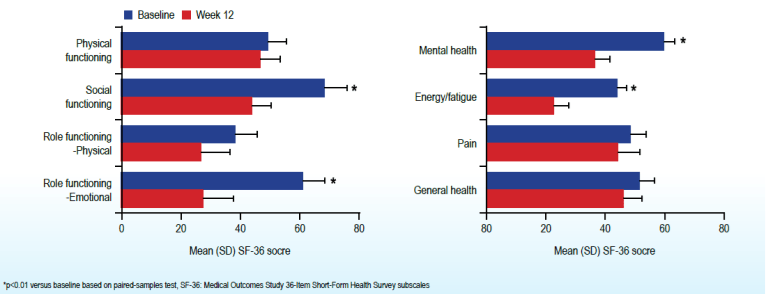
Therefore, escitalopram significantly improved the symptoms of depression and anxiety in elderly with comorbid anxiety and depression.4
Summary
Comorbid anxiety and depression increases the severity of symptoms, lowers the quality of life, leads to poor outcomes and is associated with high incidence of suicide and treatment resistance. High prevalence of overlapping anxiety and depression also poses a treatment challenge. Escitalopram in patients with comorbid depression and anxiety decreases the severity of depression and anxiety symptoms and is associated with high response and remission rates. Escitalopram therapy also improves the quality of life and social functioning in the elderly and has good tolerability. Therefore, escitalopram is a preferred choice in the treatment of comorbid anxiety and depression.
References
- Olié JP, Tonnoir B, Ménard F, et al. A prospective study of escitalopram in the treatment of major depressive episodes in the presence or absence of anxiety. Depress Anxiety. 2007; 24(5):318-24.
- Coplan JD, Aaronson CJ, Panthangi V et al. Treating comorbid anxiety and depression: Psychosocial and pharmacological approaches. World J Psychiatry. 2015; 5(4):366-78.
- Laux G, Friede M, Muller WE. Treatment of comorbid anxiety and depression with escitalopram: results of a post-marketing surveillance study. Pharmacopsychiatry. 2013; 46(1):16-22.
- Mohamed S, Osatuke K, Aslam M, et al. Escitalopram for comorbid depression and anxiety in elderly patients: A 12-week, open-label, flexible-dose, pilot trial. Am J Geriatr Pharmacother. 2006; 4(3):201-9.
- Hoschl C, Svestka J. Escitalopram for the treatment of major depression and anxiety disorders. Expert Rev Neurother. 2008; 8(4):537-52.
Challenges in Depression Management
The Role of Anger/Hostility in Treatment-Resistant Depression
Introduction
Elevated levels of anger, hostility, and irritability are found to be common features of depression in some of the patients with major depressive disorder (MDD).1 Irritability has been reported in about 40% of the outpatients enrolled in Sequenced Treatment Alternatives to Relieve Depression study.2 Presence of hostility in patients with MDD is found to be associated with suicide attempts, higher levels of perceived stress3 and higher rates of cardiovascular disease risk factors such as hypercholesterolemia and long-term smoking behaviours.4 Symptoms such as rapid heartbeat, hot flashes, sweating, and tightness of the chest are also observed in MDD patients present with anger, hostility, and irritability.4 Dysregulation in dopamine and serotonin neurotransmitter systems is found to be the biological basis for anger/hostility subtype of MDD4. The relationship between irritability, anger attacks, and other serious outcome require identification of effective treatments for depression with irritability.4
Lower Depressive Treatment Response Rates in Patients with High Anger/Hostility4
Researchers assessed the efficacy and tolerability of a low-dose atypical antipsychotic agent (2 mg/d) added to antidepressant therapy (ADT) in MDD patients (n=225) with inadequate response to prior antidepressant treatment (ADAPT-A).
Patients were randomized to 1 of 3 sequence arms: atypical antipsychotic agent (2 mg/d, in phase 1; 5 mg/d in phase 2), placebo/ atypical antipsychotic agent (Placebo in phase 1; 2mg/d in phase 2), or placebo/placebo (in both phases). The patients were on stable ADT doses throughout the study.
Patients were divided into 2 groups: low anger/hostility [Kellner Symptom Questionnaire (KSQ) anger-hostility subscale total score <10] and high anger/hostility (KSQ anger-hostility subscale total score ≥10). The present analyses used the MADRS (The Montgomery and Asberg Depression Scale) to assess depression severity and treatment response. Treatment response rates were defined as a 50% reduction in MADRS scores. The study revealed that
- Patients in the high anger/hostility group reported to have a greater number of lifetime depressive episodes (mean ± SD, 7.74 ± 16.60 vs. 4.02 ± 3.23; p = 0.01) and higher baseline scores on the MADRS (mean ± SD, 31.90 ± 4.73 vs. 29.79 ± 4.03; p < 0.001) compared with patients in the low anger/hostility group.
- MADRS response rates were reported to be higher in patients with low anger/hostility compared to patients with high anger/hostility in each treatment group at each phase of the study (Table 1) , but a significant difference was observed in placebo response rates between patients with low and high anger/ hostility in phase 1 (p = 0.003).
- A significant difference in drug response rates between patients with low and high anger/hostility was observed (p=0.07) (fig. 1, panel A) 4. When response rates were pooled across both phases and treatments, there was a significantly higher response rate among patients with low anger/hostility than patients with high anger/hostility (p<0.001) (fig. 1, panel B).
|
MADRS response rates by level of anger/hostility |
Drug |
Placebo |
Weighted difference (95%CI) |
p* |
||
|
Phase 1 |
Phase 2 |
Phase 1 |
Phase 2 |
|||
|
Low anger/hostility |
21.7% (5/23) |
30.0% (6/20) |
29.5% (18/61) |
10.0% (2/20) |
6.12% (−9.73% to 21.96%) |
0.4493 |
|
High anger/hostility |
13.8% (4/29) |
10.5% (4/38) |
10.9% (11/101) |
7.3% (3/41) |
3.06% (−6.31% to 12.42%) |
0.5227 |
|
p |
0.452 |
0.062 |
0.003 |
0.720 |
0.7446 |
|
|
p value was generated using generalized estimated equations, weighted differences of proportions |
||||||
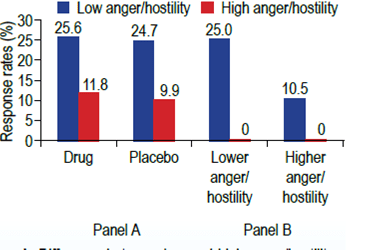
A, Difference between low and high anger/hostility among drug group, p=0.07; difference between low and high anger/hostility among placebo group, p < 0.01. B, Difference between low and high anger/hostility group, p<0.001. P-values were generated using generalized estimating equations.
Summary
Depressed patients with high anger/hostility demonstrate a lower depressive response rate and increased levels of depression severity than those with low anger/hostility. This suggests that the depression with anger/hostility may result in poorer outcomes to adjunctive treatment.
References
- Fava M, Hwang I, Rush AJ, Sampson N et al. The importance of irritability as a symptom of major depressive disorder: results from the National Comorbidity Survey Replication. Mol Psychiatry. 2010; 15:856–867.
- Perlis RH, Fraguas R, Fava M, et.al. Prevalence and clinical correlates of irritability in major depressive disorder: a preliminary report from the sequenced treatment alternatives to relieve depression study. J Clin Psychiatry. 2005; 66: 159–166.
- Farabaugh AH, Mischoulon D, Fava M, et al. The potential relationship between levels of perceived stress and subtypes of major depressive disorder (MDD). Acta Psychiatr Scand. 2004; 110(6):465–470.
- Fisher BL, Fava M, Doros DG,et.al. The Role of Anger/Hostility in Treatment-Resistant Depression. A Secondary Analysis From the ADAPT-A Study. J Nerv Ment Dis. 2015; 203(10):762-8.
Talking Point
Dissociating Patho-Mechanisms of Depression with Functional MRI
Depression is a psychiatric disorder wherein the patients are not able to experience reward, thus impairing motivation- and incentive-based learning which are essential for daily adaptive behaviors. The nucleus accumbens (NAcc) plays an important role in the reward circuit and is at the center of the reward system. Imaging studies have demonstrated the involvement of NAcc in different contexts of reward. Studies have reported inconsistently replicated hypoactivity of the NAcc and ventral striatum while investigating reward processing in depression. This heterogeneity is predicted to have resulted due to disturbed dopaminergic bottom-up input or impaired top-down regulation of the NAcc. Therefore, it is unclear whether the impaired reward system in patients with depression is due to abnormal modulatory mechanisms.
Evidence Suggesting Bottom-Up or Top-Down Dysfunctions of the Reward System in Patients with Depression
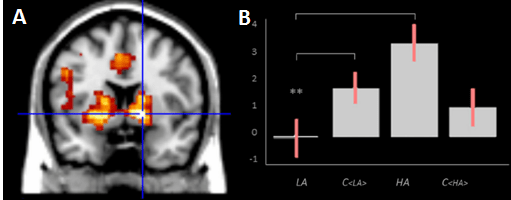
Researchers investigated the activation of the NAcc with functional magnetic resonance imaging (MRI) using the desire-reason-dilemma (DRD) paradigm. This allows tracking the NAcc activity during the acceptance or the rejection of previously conditioned reward stimuli.
Patients were divided into subgroups of lower (LA) or higher (HA) NAcc activation considering that dysfunctional bottom-up mechanisms should lead to LA and dysfunctional top-down mechanisms should lead to HA at the NAcc region. Findings revealed:
Bottom-up Dysfunction
Compared with age-/gender-matched controls for LA (CLA) and HA, LA patients presented significant hypoactivation in the ventral tegmental area and bilateral ventral striatum, which confirmed impairments in the bottom-up input to the NAcc.
Top-down Dysfunction
Compared with age-/gender-matched controls for HA (CHA) and LA groups, significant hyperactivation was observed in prefrontal areas such as the rostral anterior cingulate cortex and the anterior ventral prefrontal cortex in addition to bilateral ventral striatum in the HA patients, suggesting disturbances in the top-down regulation of the NAcc (Figure 2A to 2B).
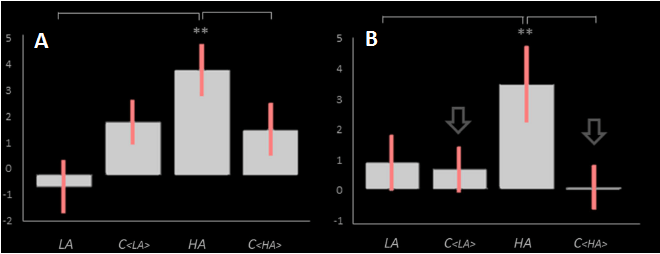
Open arrows signalize the top-down suppression from DC to RC (Figure A to B)
Researchers suggested that the midbrain and prefrontal regions were more specific pathophysiological substrates for each depression subtype. They suggested that specific depression related pathogenesis can be sorted by segregating patients with similar dysfunctional mechanisms of the dopaminergic system. This may be used as a guide for the development of personalized targets for future therapies.
Reference
Goya-Maldonado R, Weber K, Trost S et al. Dissociating pathomechanisms of depression with fMRI: bottom-up or top-down dysfunctions of the reward system. Eur Arch Psychiatry Clin Neurosci. 2015; 265(1):57-66.
Current News
Patients with Coronary Heart Disease have High Risk of Depression
Patients with coronary heart disease (CHD) are shown to have high risk of depression. A study was conducted to determine the prevalence of depression and its risk factors among patients with CHD. After 5 years, 21.8% of the CHD group and 14.2% of the control group were diagnosed with depression (p<0.001). CHD was observed to be a strong risk factor for developing depression (HR = 1.54, 95% CI: 1.49-1.59, p<0.001). Factors such as prior depressive episodes, dementia, and eight other chronic conditions were associated with a higher risk of developing depression - Diabetes mellitus, hypertension, dementia, stroke, heart failure, myocardial infarction, cardiac arrhythmias, osteoporosis, cancer, and osteoarthritis. Compared with younger patients and men, older patients and women were also more likely to be diagnosed with depression, respectively.
Reference
Konrad M, Jacob L, Rapp MA, et al. Depression risk in patients with coronary heart disease in Germany. World J Cardiol. 2016 Sep 26; 8(9): 547-52.
Trauma at Different Ages has Differential Impact on Depressive and PTSD Symptoms
Trauma exposure is a known risk factor for psychopathology. The effect of age at first trauma exposure on levels of adult depressive and posttraumatic stress disorder (PTSD) symptoms was evaluated. Those exposed to trauma at any age had higher depressive and PTSD symptoms compared to their unexposed peers. Those exposed to child maltreatment first during early childhood had twice as high depression and PTSD symptoms compared to those exposed during later developmental stages. First exposure to other types of trauma such as interpersonal violence during middle childhood also had twice as high depressive symptoms scores as those first exposed during adulthood. Therefore, trauma exposure at different ages has different impact on depressive and PTSD symptoms in adulthood.
Reference
Dunn EC, Nishimi K, Powers A, et al. Is developmental timing of trauma exposure associated with depressive and post-traumatic stress disorder symptoms in adulthood? J Psychiatr Res. 2016 Sep 26; 84:119-127.
Orthostatic Intolerance Symptoms Significantly Correlate with Depression And Diminished QOL
Postural tachycardia syndrome is often associated with depression and corresponding impairment in quality of life (QOL). Researchers evaluated whether the maximal heart rate (HR) increment after standing is associated with the clinical symptoms in patients with excessive orthostatic tachycardia (OT) and correlations among the symptoms of orthostatic intolerance (OI), depression, and health-related QOL in these patients.
No association was observed between the maximal orthostatic HR increment and the clinical symptoms. The OI symptoms were found to have significant correlation with depression and diminished QOL. The Beck depression inventory-II (BDI-II) score showed a positive linear relationship with total OIQ score (r = 0.516), whereas both physical and mental component summary scales of SF-36 showed a negative linear relationship with total orthostatic intolerance questionnaire (OIQ) score (r = -0.542 and r = -0.440, respectively; all p <0.001). Concentration difficulties and chest discomfort were observed to be the most influential OI symptoms for depression, while nausea for physical and concentration difficulties for mental QOL. The two most common complaints were dizziness and headache in patients with mild to moderate OI symptoms. Additionally, considerable deterioration in QOL was seen in subjects with minimal OI symptoms.
Reference
Moon J, Kim DY, Byun JI et al. Orthostatic intolerance symptoms are associated with depression and diminished quality of life in patients with postural tachycardia syndrome. Health Qual Life Outcomes. 2016 Oct 12; 14(1): 144.