Bright Times: Issue 2


Clinical Focus
Optimizing Escitalopram Therapy in Patients with Partial Response
Clinical Context
Major depression is a serious, recurrent disorder that leads to medical morbidity, mortality and reduces the functioning and quality of life. Worldwide, depression is ranked as the 4th leading cause of disability by the World Health Organization (WHO) and is projected to be the 2nd leading cause of disability by 2020.1
Need for Optimizing Antidepressant Therapy in Patients with Partial Response
Various clinical evidences have reported that, around 30–50% of depressed patients have an inadequate outcome and generally a recurrent or chronic course of depression following an antidepressant therapy. Previously, researchers focused on the ‘response’ of depressed patients to the treatment, and was usually considered as 50% reduction of symptoms as measured by depression rating instruments. Recently, trials have focused on attaining ‘remission’ as a goal of antidepressant therapy.2 Those patients not attaining remission are observed to have a 3.5 fold increased risk of relapse, worsening of disability, increased cognitive and work impairment, non-adherence to other treatments for co-existing medical disorders and suicide.2,3 In patients achieving only partial or inadequate response, various treatment strategies such as increasing the dose, switching of antidepressants, combinations of antidepressants and augmentation of antidepressants with other medications have been suggested.2,4
Beneficial Effects of Escitalopram in Patients with Partial Response
A survey conducted at a psychopharmacology course showed that, ≥80% of the attendees suggested raising the dose of selective serotonin reuptake Inhibitor (SSRI) as their first choice in patients with minimal response after 4 weeks, or partial response after 8 weeks of adequate treatment.4 Escitalopram, an S-isomer of the racemic compound citalopram, is a SSRI used widely for the treatment of depression. It is a pure agent having improved safety and efficacy profile than the parent compound. The selectivity of escitalopram for serotonergic receptors and lacking selectivity for muscarinic, histaminergic, or adrenergic receptors makes it a safe option with lower incidences of side-effects such as dry mouth, sedation, or cardiovascular side effects.5
Escitalopram has High Response and Remission Rates vs. Other SSRIs
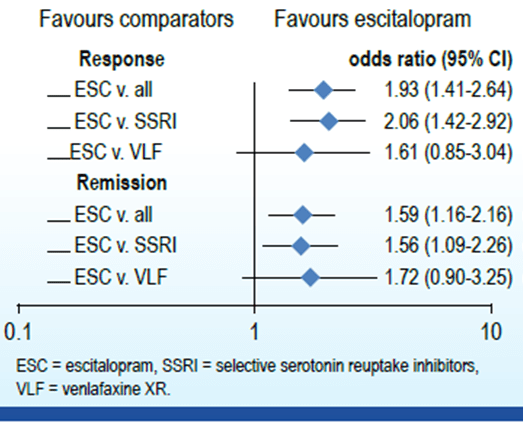
Researchers conducted a meta-analysis in which escitalopram was compared with other antidepressants and relative efficacy was assessed. A statistically significantly higher response rate (≥ 50% reduction in baseline MADRS total score) was found for patients treated with escitalopram (65.8% vs. 61.6% response [p<0.01] in all patients, and 67.6% vs. 57.8% response [p<0.001] in severely depressed). The remission rate (MADRS total score≤12) observed for patients treated with escitalopram was statistically significantly higher (58.1% vs. 55.0% remission [p<0.05] in all patients and 53.8% vs. 45.9% remission [p<0.01] in severely depressed). Figure 1 shows the estimated difference in treatment effect in response and on remission. The withdrawal rate due to adverse events was 6.7% for escitalopram compared with 9.1% for the comparators (p<0.05). Therefore, escitalopram showed significant superiority in efficacy compared with the active controls6.
Improved Response Rates by Switching to Escitalopram Therapy and Escalating its Dose
It has already been reported that up to 50% of patients may fail to respond to the initial antidepressant treatment. Therefore, dose escalation is often considered the first choice to achieve improved outcomes. Wade et al investigated the efficacy, safety and tolerability of escitalopram in doses up to 50 mg for up to 32 weeks in patients with MDD (n=60) who had not responded to adequate treatment with citalopram. Findings revealed:
- Forty-two patients (70%) completed the study. Remission was achieved in 21 (35%) of the 60 patients who completed the study; this accounts to 50% of the 42 patients.
- Of the 21 patients who achieved remission, 67% achieved sustained remission (a score of ≤8 and staying at ≤12) and 57% achieved absolute sustained remission (a score of ≤8 and staying at ≤8).
- Remission was achieved over the range of 20 to 50 mg doses, and 38% of the patients required 50 mg to reach this status.
- A significant association was observed between remission at the end of the study and a 50% reduction in MADRS at 8 weeks in patients on 20 or 30 mg of escitalopram (78.6% responders in remission, odds ratio 6.60, 95% CI 1.48 to 29.36, p=0.009). MADRS responders (patients with at least a 50% decrease in MADRS from baseline MADRS score) at each study visit are shown in Figure 2.
- Doses up to 40 mg were generally well tolerated.
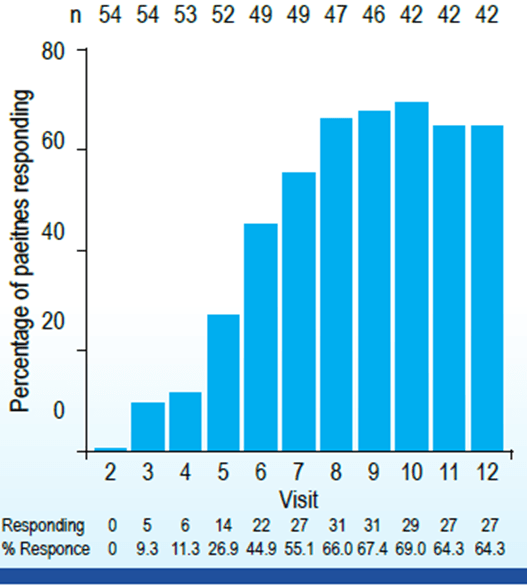
Response was defined as a 50% decrease in MADRS from baseline MADRS score.
Therefore, it was observed that approximately one third of non-responders to at least 20 mg of citalopram for at least 6 weeks achieved remission (MADRS ≤8) during the treatment period with escitalopram at doses up to 50 mg. Hence, dose escalation with escitalopram is reported to have a useful role in the management of patients with treatment-resistant MDD.7
Escitalopram Shows Improved Efficacy and Tolerability during Extended Treatment
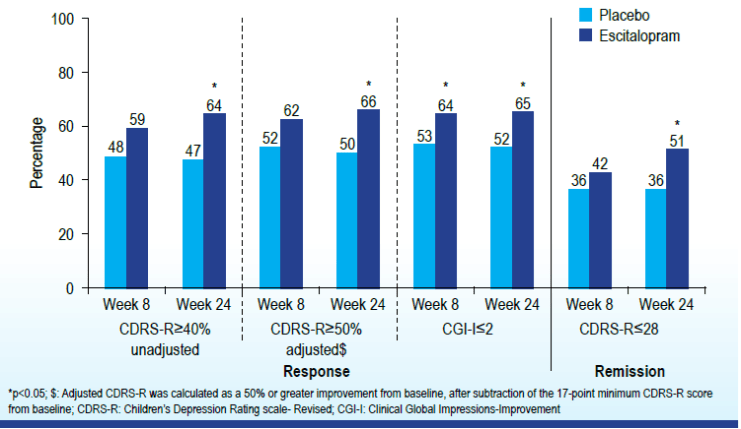
Researchers evaluated the extended efficacy, safety, and tolerability of escitalopram patients with MDD. Adolescents who had completed an 8-week study with escitalopram 10–20 mg were enrolled into the extended study of 16–24-week with escitalopram at same doses. The Children's Depression Rating Scale-Revised (CDRS-R) total score improvement was significantly greater for escitalopram than for placebo. Response rates were found to be significantly higher for escitalopram than for placebo (Figure 3); remission rates (CDRS-R ≤28) were 50.6% for escitalopram and 35.7% for placebo (p=0.002). Most adverse events occurred were mild/moderate. Therefore, the extended therapy of escitalopram is safe and provided beneficial effects in MDD8.
Summary
- Following an antidepressant therapy, the response outcome is generally reported to be inadequate in around 30–50% of depressed patients which may also lead to a recurrent or chronic course of depression. The risk of relapse is increased in patients not attaining remission.
- Escitalopram therapy increases the response and remission rates in patients with depression compared with other SSRIs.
- In non-responders, switching to escitalopram and increasing its dose led to higher remission and response rates in patients with MDD. Escitalopram is well-tolerated at doses up to 40mg in patients with treatment-resistant MDD.
- Extended escitalopram therapy for up to 24 weeks is safe and provides improved response rates in patients with depression.
References
- Kessler RC, Bromet EJ. The epidemiology of depression across cultures. Annu Rev Public Health. 2013; 34:119-38.
- Olver JS, Ignatiadis S, Maruff P, et al. Quetiapine augmentation in depressed patients with partial response to antidepressants. Hum Psychopharmacol. 2008; 23(8): 653-60.
- Reynolds CF 3rd, Dew MA, Martire LM, et al. Treating depression to remission in older adults: a controlled evaluation of combined escitalopram with interpersonal psychotherapy versus escitalopram with depression care management. Int J Geriatr Psychiatry. 2010; 25(11):1134-41.
- Berney P. Dose-response relationship of recent antidepressants in the short-term treatment of depression. Dialogues Clin Neurosci. 2005; 7(3): 249–262.
- Culpepper L. Escitalopram: A new SSRI for the treatment of depression in primary care. Prim Care Companion J Clin Psychiatry. 2002; 4(6): 209-214.
- Kennedy SH, Andersen HF, Lam RW. Efficacy of escitalopram in the treatment of major depressive disorder compared with conventional selective serotonin reuptake inhibitors and venlafaxine XR: a meta-analysis. J Psychiatry Neurosci. 2006; 31(2):122-31.
- Wade AG, Crawford GM, Yellowlees A. Efficacy, safety and tolerability of escitalopram in doses up to 50 mg in Major Depressive Disorder (MDD): an open-label, pilot study. BMC Psychiatry. 2011; 11:42.
- Findling RL, Robb A, Bose A. Escitalopram in the treatment of adolescent depression: a randomized, double-blind, placebo-controlled extension trial. J Child Adolesc Psychopharmacol. 2013; 23(7):468-80.
Talking Points
Prescription Pattern of Antidepressants in India
The report on Global Burden of Disease has shown that the one-year prevalence of depression is 5.8% for men and 9.5% for women and that by the year 2020 it may increase to 5.7% becoming the second leading cause of disability-adjusted life years (DALYs), only after ischemic heart disease. Depressive disorders can cause significant dysfunction, disability and poor quality of life in sufferers, and is a significant burden on the caregivers. Furthermore, the duration of illness and severity of depression have been shown to be associated significantly with impaired quality of life and disability.1
Treating Depression
Apart from depression, antidepressants are also used in the pharmacological treatment of other psychiatric disorders such as anxiety disorders, obsessive compulsive disorders, somatoform disorders, etc. irrespective of the presence or absence of comorbid depression. Choice of antidepressant in an individual is dependent on a number of factors including patient’s demographic characteristics, illness profile, side effects of the medication, comorbidities and cost-effectiveness.2
Understanding the Antidepressant Prescription Patterns
Multi-centric studies examining antidepressant prescription patterns have been lacking in India. Recently, researchers have conducted a study to determine antidepressants’ prescription pattern from five geographically distant tertiary psychiatric care centers in India. This was a cross-sectional study of patients
(n=312, mean age=39±14.28 year) who visited the outpatients department or were admitted in the psychiatry wards at Lucknow, Chandigarh, Tiruvalla, Mumbai and Guwahati on a fixed day and were using or had been prescribed antidepressants.2
- Among patients receiving antidepressants, 52.2% had depression and 23.7% patients had anxiety disorder.
- The most common co-morbid medical condition was diabetes mellitus, reported in 5.78% of the patients.
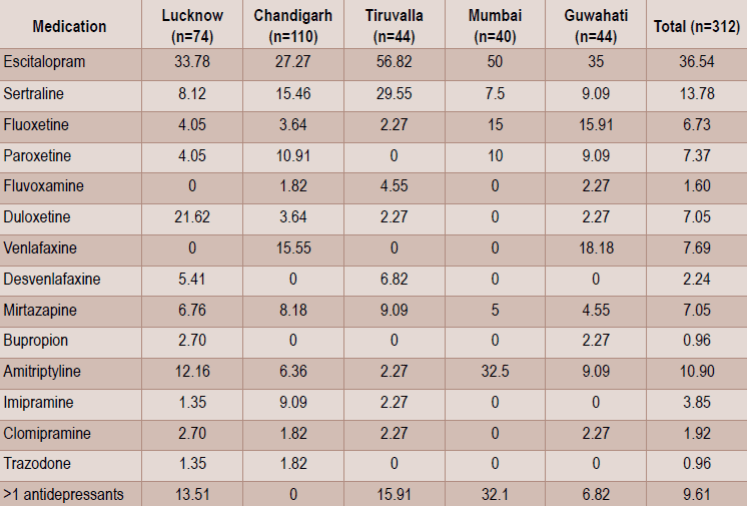
A total of 194 (62.2%) patients were using selective serotonin reuptake inhibitors (SSRIs). The most common antidepressant prescribed for depressive disorders was escitalopram followed by sertraline and in anxiety disorders it was escitalopram followed by paroxetine. Table 1 provides antidepressant prescription patterns of the patients.
- About 9.62% patients were given one antidepressant, and about 50.96% patients were prescribed hypnotic or sedative medications with clonazepam being the most common.
Conclusion
The study concluded that SSRIs were the most common class of antidepressants and escitalopram was the most common drug prescribed. The concomitant use of two antidepressants was infrequent, but hypnotic and sedatives were prescribed often along with antidepressants.
Summary
Depressive disorders are becoming increasingly becoming prevalent and can cause significant dysfunction, disability and poor quality of life. Antidepressant are often used to treat depression and the choice of drug is depended on a number of factors such as patient characteristics, illness profile, side effects of the medication, etc. In this recent study of prescription pattern of antidepressants in Indian centers, researchers reported that SSRI were common class of antidepressant and escitalopram was the most prescribed drug.
References
- Grover S, Dutt A, and Avasthi A. An overview of Indian research in depression. Indian J Psychiatry. 2010; 52(Suppl1): S178–S188.
- Tripathi A, Avasthi A, Desousa A, et al. Prescription pattern of antidepressants in five tertiary care psychiatric centres of India. Indian J Med Res. 2016; 143: 507-13.
Challenges in Depression Management
Agitated "Unipolar" Depression Re-Conceptualized as a Depressive Mixed State: Implications for the Antidepressant-Suicide Controversy
Agitated depression which involves major depressive episode (MDE) with psychomotor agitation is present without any subtypes in bipolar and unipolar major depressive disorders in DSM-IV-TR and ICD-10. Its diagnostic validity is supported by few studies which demonstrate agitated depression as a bipolar mixed state. Studies have reported agitated depression to be a more severe variant of bipolar depression in bipolar I patients; with symptoms such as psychomotor agitation, greater talkativeness, distractibility, irritability and racing thoughts. Researchers have opinionated that bipolar I agitated depression is more often than not of a mixed nature. A link has also been found between agitated depression and depressive mixed state in bipolar II patients. Therefore, it was left to be tested whether unipolar agitated depression could be classified as mixed states belonging to the broader bipolar spectrum.
Can Agitated Unipolar Depression be Regarded as ‘A Depressive Mixed State’?
Researchers conducted a study and included patients unipolar major depressive disorder (MDD) and assessed intra-MDE hypomanic symptoms with ≥3 such symptoms required for a diagnosis of depressive mixed state (DMX). Agitated depression was defined as an MDE with HIGH-C psychomotor agitation score ≥2.
Findings revealed:
- Presence of agitated depression in 19.7% of unipolar patients
- Compared with non-agitated patients, those with agitated depression had significantly fewer recurrences, less chronicity, higher rate of family history for bipolar disorder, and DMX. Among the intra-depressive non-euphoric hypomanic symptoms, these patients experienced distractibility, racing/crowded thoughts, irritable mood, talkativeness, and risky behavior.
- A robust association between agitated depression and DMX (OR=36.9).
- Significantly higher rate of weight loss and suicidal ideation in patients with psychomotor agitation
- An association between suicidal ideation, psychomotor activation, and racing thoughts of the DMX symptoms
- Independent significant positive predictors of agitated depression were DMX, talkativeness, and suicidal ideation (as analyzed by forward stepwise logistic regression versus all variables).
In the current study, agitated depression emerged as a distinct affective syndrome including weight loss, pressure of speech, racing thoughts and suicidal ideation. The strong clustering of intra-episode non-euphoric hypomanic symptoms along with bipolar family history suggests a link with the bipolar spectrum. Therefore, based on the study results, agitated depression can best be regarded as “pseudounipolar.” Since, these patients are found to be typically activated along the lines of risk-taking behavior, ‘excited (mixed) depression’ can be the preferred terminology for them over agitated depression.
Implications for the Antidepressant-Suicide Controversy
The reported data regarding increased risk of suicidal ideation in some depressed patients on antidepressant therapy may be due to baseline psychomotor activation or agitation as part of an unrecognized bipolar mixed state. Without adequate prospective double-blind studies, it is not possible to answer whether antidepressants induce de novo suicidality in MDD. However, it is agreed on that the agitated, activated, or excited depressions may overlap with antidepressant "activation syndrome." Similarly, rare occurrence of suicidality on antidepressants does not confirm that new antidepressants decrease the worldwide suicide rates. Therefore, since DSM-IV and ICD-10 fails to recognize the bipolar nature of depressive mixed states, it leads to a failure in protecting pseudo-unipolar patients from antidepressant monotherapy considering it to be inappropriate in these patients.
Reference
Akiskal HS, Benazzi F, Perugi G, et al. Agitated "unipolar" depression re-conceptualized as a depressive mixed state: implications for the antidepressant-suicide controversy. J Affect Disord. 2005; 85(3): 245-58.
Current News
Anxiety and Depression in IBD
Several studies have conducted extensive research to study the prevalence of anxiety and depression in patients with inflammatory bowel disease (IBD). Neuendorf et al, performed a comprehensive systematic review of 171 studies to evaluate the prevalence of all mood anxiety and depression in a total of 158,371 patients with IBD. The review data revealed that the prevalence rate of anxiety disorder accounted for 20.5% while its symptoms accounted for 35.1%. The prevalence rate of depression in IBD patients was found to 15.2%, while its symptoms accounted for 21.6%. Patients with active IBD disease state were noted to have higher prevalence of anxiety (75.6%) and depression (40.7%) compared to patient with IBD in remission. Patients with Crohn’s disease showed a higher prevalence of depression (25.3%) compared to patients with ulcerative colitis. Researchers concluded that patients with IBD have high prevalence of anxiety and depression.
Neuendorf R, Harding A, Stello N, et al. Depression and anxiety in patients with Inflammatory Bowel Disease: A systematic review. J Psychosom Res. 2016; 87: 70-80.
Severe Diabetic Retinopathy is Associated with Increased Risk of Depression Among Patients with Diabetes
Rees et al. conducted a cross-sectional study to examine if diabetes-related eye complications [diabetic retinopathy (DR) and diabetic macular edema (DME)] were associated with symptoms of anxiety and depression. The study involved patients with diabetes who underwent a comprehensive eye examination and patients diagnosed with DR and DME were graded based on disease severity. Of the total participants, 15.4% (n=80) and 22.7% (n=118) were detected with symptoms of depression and anxiety, respectively. After adjusting sociodemographic factors and clinical characteristics (visual acuity), multivariate analysis revealed that severe non-proliferative DR (NPDR) and symptoms of depression was independently associated.
Severe NPDR or Proliferative DR (PDR) accounted for 19.1% while the history of depression or anxiety accounted for 60.6% of total and unique variance of depressive symptoms. However, DME and symptoms of depression and anxiety were not associated in patients with diabetes. Since the symptoms of depression and NPDR and PDR were independently associated with each other, researchers suggested that its severity indicates to monitor depression symptoms in high-risk patients with diabetes.
Rees G, Xie J, Fenwick EK, et al. Association between diabetes-related eye complications and symptoms of anxiety and depression. JAMA Ophthalmol. 2016 Jul 7. [Epub ahead of print]
Type D Personality Has A Long-Term Association with Depression and Anxiety in Patients with PCI
Patients with coronary heart disease are associated with depression at a prevalence rate ranging from 25%-50%. Negative affectivity and social inhibition were associated with depression and anxiety in patients with distressed personality (type D).
Researchers investigated the long-term association of depression and type D personality in 534 patients with a history of percutaneous coronary intervention (PCI, baseline: 6 months post-PCI), with a follow-up period of 10 years. Patients had 25% prevalence rate of type D personality at baseline. About 42% of the patients with type D personality were often depressed than non-type D personality patients. The 10 year follow-up report showed a 75% response rate of anxiety and depression. At the follow-up period, depression was diagnosed in about 31% of patients with type D personality compared to patients with non-type D personality, 13%. However, a similar association was found with anxiety. The risk of depression was 3.69 times and 2.72 times higher in patients with type D personality early after PCI and 10 years after PCI. Thus the study confirmed that patients with a history of PCI have a long-term association with the risk of depression. The study also suggests that type D personality serves an indicator to identify patients with high-risk depression and anxiety.
Al-Qezweny MN, Utens EM, Dulfer K, et al. The association between type D personality, and depression and anxiety ten years after PCI. Neth Heart J. 2016 Jun 13. [Epub ahead of print]