




Perampanel as First Add-on Therapy in Patients with Focal Epilepsy: Insights from 3-year Extension Study

17 Dec, 21
Introduction
Patients experiencing seizure recurrence while on monotherapy are usually treated with an add-on anti-epileptic drug (AED). Early clinical trials have successfully evaluated the efficacy and safety of perampanel when used as an adjunctive therapy in patients with drug-resistant epilepsy. Currently long-term data on efficacy and safety of perampanel are lacking.
Aim
To evaluate the long-term efficacy and safety of perampanel as a first add-on therapy in patients with focal epilepsy
Patient Profile
- Patients with focal epilepsy (age ≥12 years) with a requirement of add-on therapy to control seizures
Methods
Study Design
- An extension phase of a retrospective, multicenter, open-label, phase IV trial
Treatment Strategy
- Perampanel was initiated as once-daily tablet (individualized dosage) at bed-time
- The dosage could be increased by 2 mg/day over a period of ≥2 weeks interval, to a maximum dosage of 12 mg/day
- Concomitant treatment with AEDs was permitted as clinically indicated
Outcomes
Primary Efficacy Outcomes
- 50% and 100% responder rates (seizure freedom) for total seizures during the 3-year extension period
Secondary Efficacy Outcome
- Perampanel retention rates
Safety Outcomes
- Incidence of adverse events (AEs)
- Discontinuation of perampanel from the start of the extension period
Results
- The study population of this extension-phase comprised 74 patients.
- After excluding the patients for whom the primary efficacy outcomes were not evaluated; 55, 48 and 46 patients were included in the full analysis at first, second and third year, respectively. Mean age of the study population was 43.3 years.
- During the extension study, the daily perampanel dose was increased in 9 (12.2%) patients (4–6 mg, n=5; 6–8 mg, n=3; 6–10 mg, n=1), was decreased in 17 (23.0%) patients (12 to 6 mg, n=1; 10–4 or 8 mg, n=2; 8 to 6 mg, n=6; 6–4 mg, n=8), and remained unchanged in 48 (64.8%) patients.
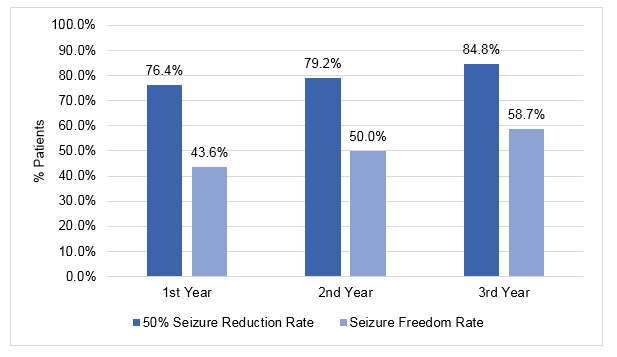
- During the entire 3-year period of the extension study the 50% responder and seizure freedom rates were 71.7% and 32.6%, respectively. Sustained reduction in seizure freedom rate and >50% seizure reduction was observed during the 3-year extension period with perampanel (Fig. 1).
Fig. 1: 50% seizure reduction rate and seizure freedom rate during the study period
- Perampanel retention rates at 1-, 2-, and 3-year were 62.5%, 53.1%, and 52.1%, respectively.
- Efficacy of perampanel was higher in patients aged >55 years, male, and those receiving ≤4 mg of perampanel.
- Perampanel was generally well tolerated; 47.3% patients experienced at least one AE during the 3 years of extension period (46 adverse events (AEs) in 35 patients). The most common AEs observed during the study included; dizziness (33.8%), somnolence (5.4%), anger (4.1%), and irritability (4.1%).
- Perampanel dose reduction or discontinuation resolved the AEs in 10 (13.5%) and 12 (16.2%) patients, respectively.
Conclusion
- The study demonstrated sustained long-term efficacy and safety of perampanel when used as a first add-on therapy in patients with focal epilepsy.
- Sustained and effective control of seizures could be achieved with low perampanel doses (≤4 mg/day), this could potentially avoid adverse drug reactions.
Epilepsy Behav. 2021;125 (108407) DOI: 10.1016/j.yebeh.2021.108407.

More From Area Of Interest
You may also like

12 Nov, 26

12 Oct, 26

21 Sep, 26

21 Sep, 26

21 Sep, 26

13 May, 26
Latest Items

20 Nov, 26
Journal Scans
20 Nov, 26

20 Nov, 26
Journal Scans
19 Nov, 26

19 Nov, 26


