




Perampanel as First Add-on Therapy in Patients with Focal Epilepsy: Insights from 3-year Extension Study

17 Dec, 21
Introduction
Patients experiencing seizure recurrence while on monotherapy are usually treated with an add-on anti-epileptic drug (AED). Early clinical trials have successfully evaluated the efficacy and safety of perampanel when used as an adjunctive therapy in patients with drug-resistant epilepsy. Currently long-term data on efficacy and safety of perampanel are lacking.
Aim
To evaluate the long-term efficacy and safety of perampanel as a first add-on therapy in patients with focal epilepsy
Patient Profile
- Patients with focal epilepsy (age ≥12 years) with a requirement of add-on therapy to control seizures
Methods
Study Design
- An extension phase of a retrospective, multicenter, open-label, phase IV trial
Treatment Strategy
- Perampanel was initiated as once-daily tablet (individualized dosage) at bed-time
- The dosage could be increased by 2 mg/day over a period of ≥2 weeks interval, to a maximum dosage of 12 mg/day
- Concomitant treatment with AEDs was permitted as clinically indicated
Outcomes
Primary Efficacy Outcomes
- 50% and 100% responder rates (seizure freedom) for total seizures during the 3-year extension period
Secondary Efficacy Outcome
- Perampanel retention rates
Safety Outcomes
- Incidence of adverse events (AEs)
- Discontinuation of perampanel from the start of the extension period
Results
- The study population of this extension-phase comprised 74 patients.
- After excluding the patients for whom the primary efficacy outcomes were not evaluated; 55, 48 and 46 patients were included in the full analysis at first, second and third year, respectively. Mean age of the study population was 43.3 years.
- During the extension study, the daily perampanel dose was increased in 9 (12.2%) patients (4–6 mg, n=5; 6–8 mg, n=3; 6–10 mg, n=1), was decreased in 17 (23.0%) patients (12 to 6 mg, n=1; 10–4 or 8 mg, n=2; 8 to 6 mg, n=6; 6–4 mg, n=8), and remained unchanged in 48 (64.8%) patients.
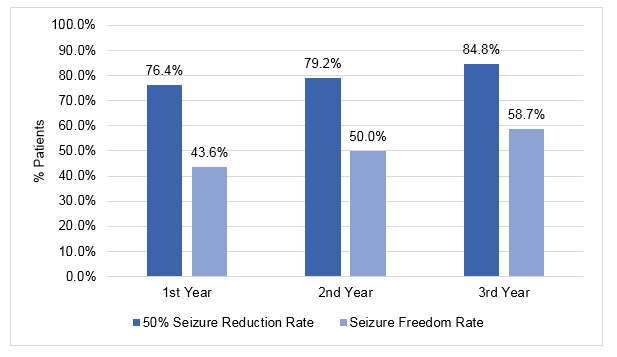
- During the entire 3-year period of the extension study the 50% responder and seizure freedom rates were 71.7% and 32.6%, respectively. Sustained reduction in seizure freedom rate and >50% seizure reduction was observed during the 3-year extension period with perampanel (Fig. 1).
Fig. 1: 50% seizure reduction rate and seizure freedom rate during the study period
- Perampanel retention rates at 1-, 2-, and 3-year were 62.5%, 53.1%, and 52.1%, respectively.
- Efficacy of perampanel was higher in patients aged >55 years, male, and those receiving ≤4 mg of perampanel.
- Perampanel was generally well tolerated; 47.3% patients experienced at least one AE during the 3 years of extension period (46 adverse events (AEs) in 35 patients). The most common AEs observed during the study included; dizziness (33.8%), somnolence (5.4%), anger (4.1%), and irritability (4.1%).
- Perampanel dose reduction or discontinuation resolved the AEs in 10 (13.5%) and 12 (16.2%) patients, respectively.
Conclusion
- The study demonstrated sustained long-term efficacy and safety of perampanel when used as a first add-on therapy in patients with focal epilepsy.
- Sustained and effective control of seizures could be achieved with low perampanel doses (≤4 mg/day), this could potentially avoid adverse drug reactions.
Epilepsy Behav. 2021;125 (108407) DOI: 10.1016/j.yebeh.2021.108407.

More From Area Of Interest
You may also like

12 Oct, 26

21 Sep, 26

21 Sep, 26

21 Sep, 26

13 May, 26

17 Apr, 26
Latest Items

6 Nov, 26
Journal Scans
5 Nov, 26

5 Nov, 26

3 Nov, 26


