

Overuse of Short Acting Beta2-Agonists in Asthma in European Countries: Findings from SABINA Program


Introduction
Globally, as-needed short-acting ?2-agonists (SABAs) have been used traditionally for the symptom relief. However, there is an increasing evidence on the safety risks associated with high SABA use. Clinical trials have reported superiority of anti-inflammatory reliever therapy with as-needed ICS-formoterol versus SABAs with respect to symptom control. SABA monotherapy in step 1 is eliminated by the recent Global Initiative for Asthma (GINA) recommendations. Hence the overreliance on SABAs have been a concern. Most often the asthmatics use SABA for immediate symptom relief when the symptoms worsen, often at the expense of inhaled corticosteroids (ICS) maintenance therapy. However, the underlying inflammation is not taken care of by SABA-only thereby leaving them at risk of preventable exacerbations. Such relief-seeking behavior has been reinforced by long-standing treatment guidelines, which until recently recommended SABA-only use for immediate symptom relief. A pan-European view pf potential SABA overuse and ICS underuse is lacking. The global extent and clinical outcomes of SABA and ICS use in asthma was initiated through the SABA use IN Asthma (SABINA) program.
Aim
SABINA program describes the current burden of SABA use and trend of asthma reliever prescriptions relative to recent recommendations among European individuals with asthma.
Patient Profile
- Subjects aged >12 years with a current diagnosis of asthma and no other chronic respiratory conditions
Method
Study Design
- The SABINA program encompasses three main pillars:
- SABINA I - a retrospective, observational database study with expanded objectives in the UK
- SABINA II - a distributed harmonized set of multicountry retrospective observational database studies in Europe and Canada
- SABINA III - a prospectively collected multicountry cross-sectional study in 25 countries
- This study analyzed the prescription data from SABINA I and SABINA II
Treatment Strategy
- Prescription and/or dispensing data during 2006–2017 from electronic medical records and/or national patient registries in the United Kingdom (UK) (SABINA I), Germany, Italy, Spain, and Sweden (SABINA II) were analyzed.
- The percentage of individuals who were prescribed SABA during 12-month period were recorded
- SABA overuse was defined as at least three SABA canisters per year.
- Individuals with asthma were categorized into treatment steps (1–5) and severity (mild, steps 1–2; moderate–severe, steps 3–5) by their ICS prescriptions (low, medium, or high) in the year prior to their index date
- Asthma treatment step and severity were based on treatment guidelines in use in each individual country.
End Points
- Prevalence of SABA overuse
Results
- Overall, 1.06 million individuals with asthma were included across five European countries.
- Majority of individuals were over 45 years of age, except in Sweden, where the mean age was 27.6 years and individuals aged over 45 years were excluded to avoid a potential chronic obstructive pulmonary disease co-diagnosis.
- The cohort was predominantly female (55–64%), except in the UK (46%).
- The severity of asthma varied across countries.
- In Germany and the UK, 60% and 65% were treated as having mild asthma respectively
- In Italy and Spain, 63% and 73% had moderate-to-severe asthma respectively
- In Sweden, they were distributed almost equally across severities.
- The prevalence of SABA overuse was highest in UK (Figure 1)
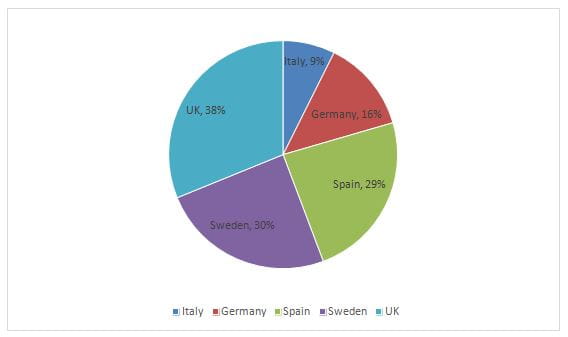
- SABA overuse was greater in individuals with moderate-to-severe asthma as compared to those with mild asthma in UK (58% vs 27%, respectively)
- In other European countries, SABA overuse was similar across individuals with mild and moderate-to-severe asthma (9-32% and 8-31% respectively).
Conclusions
- The analysis of this study from the SABINA program demonstrated that a significant proportion of asthmatic patients use at least three SABA canisters per year across Europe, despite the different healthcare and reimbursement policies of each country.
Adv Ther. 2020; 37:1124–1135. Doi:10.1007/s12325-020-01233-0.