

Efficacy and Safety of ZOL With or Without MTX for Treatment and Prevention of Osteoporosis in RA Patients

Background
Secondary osteoporosis may occur in patients with rheumatoid arthritis (RA), causing irreversible joint damage and disability. The bisphosphonate drugs such as disodium etidronate, pamidronate, alendronate sodium, risedronate sodium, and zoledronic acid are commonly used in osteoporosis treatment and prevention to increase bone density and reduce the risk of vertebral fractures.
Aim
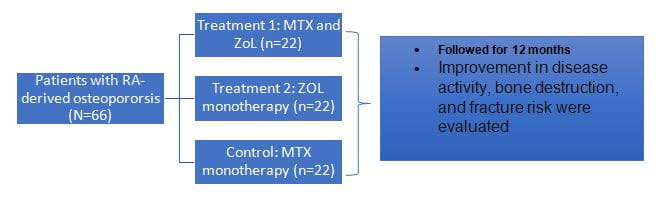
To evaluate the efficacy and safety of zoledronic acid (ZOL), with or without methotrexate (MTX), for the prevention and treatment of bone destruction in RA patients
Patient Profile
RA patients with symptoms of secondary osteoporosis
Methods
- Randomized Controlled Trial
Results
- Combined treatment with ZOL and MTX had significantly better clinical efficacy compared with either ZOL or MTX monotherapy (P < 0.05)
|
|
Time |
Combined |
p* |
ZOL |
p* |
MTX |
p* |
|
Morning stiffness (min) |
0 M |
92.21 |
– |
81.29
|
– |
89.97 |
– |
|
|
6 M |
21.34
|
< 0.001 |
71.27 |
0.371 |
44.15
|
0.021 |
|
|
12 M |
13.09
|
< 0.001 |
42.69 |
0.019 |
25.19 |
< 0.001 |
|
VAS (mm) |
0 M |
64.36 |
– |
63.94 |
– |
65.28
|
– |
|
|
6 M |
37.90 ? |
< 0.001 |
43.02 |
0.040 |
40.08 |
0.048 |
|
|
12 M |
29.23? |
< 0.001 |
37.02? |
< 0.001 |
38.72?
|
< 0.001 |
|
ESR (mm/h) |
0 M |
49.87 |
– |
50.43
|
– |
52.25
|
– |
|
|
6 M |
30.61 |
0.022 |
40.25 |
0.467 |
37.21? |
0.038 |
|
|
12 M |
23.58 |
0.008 |
38.67
|
0.363 |
36.24?
|
0.023 |
|
CRP (mg/L) |
0 M |
25.14
|
– |
23.67
|
– |
26.21
|
– |
|
|
6 M |
13.57 |
0.031 |
18.52
|
0.077 |
15.39 |
0.035 |
|
|
12 M |
8.60 |
0.029 |
18.78
|
0.079 |
11.02
|
0.019 |
|
DAS28 |
0 M |
7.21
|
– |
7.17 |
– |
6.36 |
– |
|
|
6 M |
4.89 ** |
< 0.001 |
5.11 |
0.036 |
4.27 |
0.032 |
|
|
12 M |
4.17 ** |
< 0.001 |
4.67 |
0.019 |
4.12 |
0.021 |
VAS visual analog scale, ESR erythrocyte sedimentation rate, CRP C-reactive protein, DAS 28 disease activity scores-28; *p values indicate the comparison with that before treatment within the same group; ? indicates p < 0.05 for the comparison between two groups at the same time point on their difference over the treatment
· ZOL combined with MTX reduces bone loss and risk of hip fracture in RA patients with secondary osteoporosis
o The combination significantly improved the lumbar spine and hip BMD and reduced FRAX scores
|
FRAX |
Treatment 1 (n = 18) |
p* |
Treatment 2 (n = 20) |
p* |
Control (n = 18) |
p* |
|
Before treatment |
5.76 |
– |
5.86 |
– |
5.83 |
– |
|
6 months |
5.08 |
0.047 |
5.98 |
0.097 |
5.65 |
0.145 |
|
12 months |
4.34 ? |
0.035 |
5.44 ? |
0.072 |
5.64 |
0.139 |
*p values indicate the comparison with that before treatment within the same group; ? indicates p < 0.05 for the comparison between two groups at the same time point on their difference over the treatment
- Both ZOL and MTX monotherapy was well tolerated, with most side effects occurring within 48 h after drug administration
o mild adverse reactions
o mainly fever (3 last less than 24 h, 1 lasts between 24 and 48 h and 1 lasts longer than 48 h)
o joint pain (3 last less than 24 h and 3 last between 24 and 48 h)
o myalgia (4 last less than 24 h, 2 last between 24 and 48 h, and 1 lasts longer than 48 h)
o gastrointestinal discomfort (1 lasts less than 24 h)
- No cases of inflammatory eye disease, jaw osteonecrosis, atrial fibrillation, or serum creatinine or creatinine clearance anomalies were observed
Conclusion
- The study demonstrated that administration of zoledronic acid, combined with MTX, reduces RA disease activity, risk of fracture, and bone pain in patients with RA-derived secondary osteoporosis.
- ZOL has a synergistic effect when combined with MTX, inhibiting RA disease activity, reducing fracture risk, and improving quality of life in RA patients with secondary osteoporosis
Reference
Journal of Orthopaedic Surgery and Research .2019;14:421