




To assess the efficacy and safety of Risedronate 150-mg once-a-month oral dose compared with the 5-mg daily regimen.
Efficacy and Safety of Risedronate 150-Mg once a Month over 2 years in the Treatment of Postmenopausal Osteoporosis

29 Apr, 13


Efficacy and Safety of Risedronate 150-mg Once a Month Over 2 Years in the Treatment of Postmenopausal Osteoporosis
Aim
Materials and Methods
- This was a randomized, double-blind, active-controlled, parallel-group non-inferiority study.
- Women with postmenopausal osteoporosis were randomly divided into two groups -
- Group 1, n= 642 women receiving Risedronate 5-mg daily for 2 years.
- Group 2, n= 650 women receiving 150-mg once a month Risedronate for 2 years.
- Calcium (1000 mg/day) and Vitamin D (400-500 IU/day) were also supplied to all subjects.
- Primary efficacy endpoint mean percent change from baseline in lumbar spine BMD after 1 year.
- Assessment parameters -
- Bone mineral density (BMD) of lumbar spine and proximal femur
- Lateral thoracic and lumbar spine radiographs for new vertebral fractures
- Bone turnover markers
- Serum bone-specific alkaline phosphatase (BALP)
- Urinary N-terminal crosslinking telopeptide of type I collagen (NTX)/crcatininc (Cr)
- Serum C-terminal crosslinking telopeptide of type I collagen (CTX)
- Adverse events
Results
BMD of Lumbar Spine and Proximal Femur
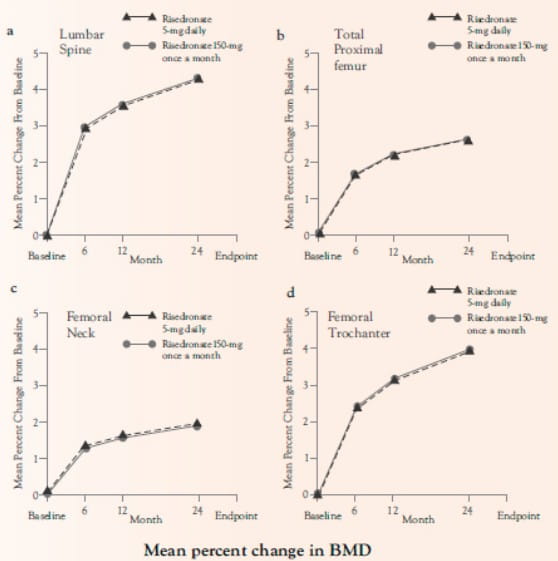
- Mean percent changes in Lumbar spine BMD at 24 months:
- Risedronate 5-mg daily group - 3.9%
- Risedronate 150-mg once-a-month group -4.2%
- Mean percent change in BMD at the lumbar spine or regions of the proximal femur did not differ significantly between the treatment groups.
-
150-mg once-a month regimen was determined to be non-inferior to 5-mg daily regimen at 24 months.
New Vertebral Fractures
- There was no difference in the occurrence of new incident vertebral fractures in the two groups.
- Percentage of patients experiencing a fracture:
- Risedronate 5-mg daily group -2.5%
- Risedronate 150-mg once-a-month group - 2.6 %
Bone Turnover Markers
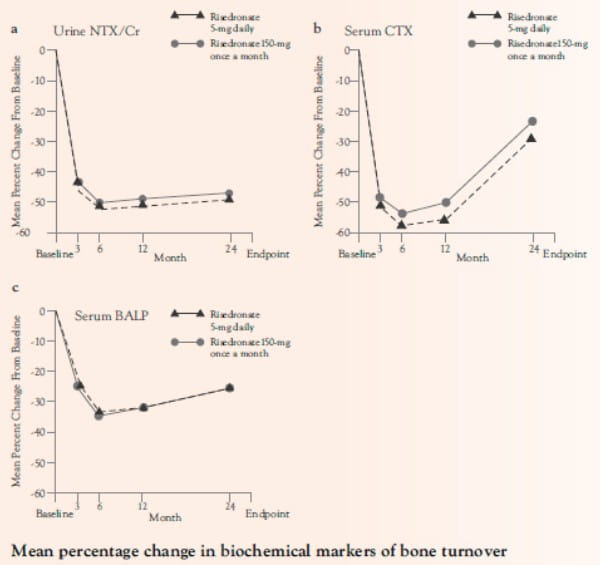
- All biochemical markers of bone turnover significantly decreased from baseline at 3, 6, 12, and 24 months in both treatment groups.
- There was no statistically significant difference between treatment groups at endpoint for any of these markers.
Safety Assessments
- The frequency of overall adverse events and the adverse events of special interest for bisphosphonates were in similar proportions in both the groups.
- The incidence of atrial fibrillation was low and was similar between the two groups.
- There were no reported cases of osteonecrosis of the jaw.
- Clinical chemistry and other laboratory measurements, including hepatic and renal function were similar in both groups.
Conclusion
- The efficacy and tolerability of Risedronate 150-mg once a month, taken for 2 years, is similar to the 5-mg daily dosing regimen which inturn has been proved to reduce the incidence of vertebral and nonvertebral fractures.
-
The Risedronate 150-mg once-a-month dose is well tolerated over 2 years, with a safety profile similar to that seen with the 5-mg daily regimen.
Osteoporos Int 2012 DOI 10.1007/s00198-012-2056-0

More From Area Of Interest
You may also like

13 May, 26

17 Apr, 26
Our Research
23 Feb, 26

23 Feb, 26

11 Feb, 26

11 Feb, 26

11 Feb, 26
Latest Items
Journal Scans
27 Jul, 26
27 Jul, 26
Journal Scans
23 Jul, 26

23 Jul, 26
23 Jul, 26


