Comparison of Mirabegron and Solifenacin in Prevention of Catheter-Related Bladder Discomfort


Introduction
Catheter-related bladder discomfort (CRBD) can worsen the postoperative quality of life in patients undergoing trans urethral resection of the prostate (TURP) by increasing the incidence of bleeding, discomfort and dysphoria. The symptoms of CRBD are comparable to that of overactive bladder (OAB). OAB patients on mirabegron, a β3-adrenoceptor agonist, had better treatment continuation due to reduced occurrence and severity of side effects. Solifenacin, an antimuscarinic, has been used in the treatment of OAB.
Aim
This study compared the efficacy and safety of mirabegron and solifenacin in preventing CRBD in patients who had indwelling catheters post TURP.
Method
Study Design
- Prospective, randomized, controlled, single-blind, multicenter study.
Patient Profile
- BPH patients aged >50 years undergoing TURP and willing to keep the catheter for 3 days post-surgery.
Treatment Strategy
- The cohort was randomized into 3 groups:
- M group receiving 50 mg mirabegron, 1 hr before anesthesia induction and once daily for 1 week
- S group receiving 5 mg solifenacin, 1 hr before anesthesia induction and once daily for 1 week
- C group was the control
- All patients had their overactive bladder symptoms score (OABSS) and blood pressure checked before surgery.
- The cohort was evaluated for the endpoints at 6, 24, 48, and 72 hours after surgery.
- The OABSS and side effects were documented on the 7th day.
Endpoints
Primary Endpoints
- Incidence of CRBD at 6, 24, 48 and 72 hours postoperatively
Secondary Endpoints
- Changes in OABSS
- Blood pressure
- Adverse events (AEs)
Results
- The final cohort comprised 99 patients, 33 in each group
- The OABSS was comparable among the groups preoperatively
- OABSS was significantly lower in groups S and M as compared to group C (p < 0.001); but was similar in groups S and M
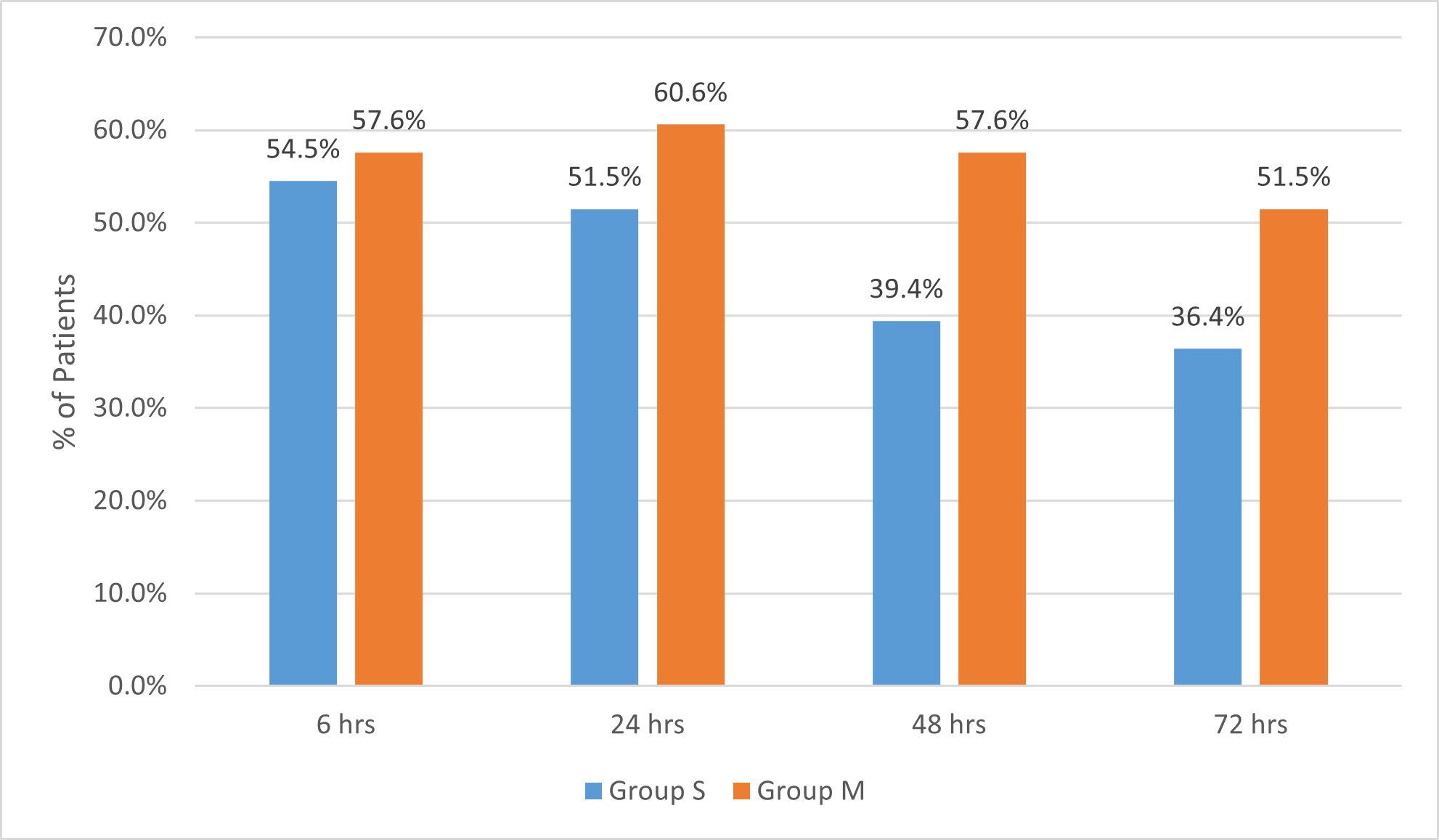
- The incidence of CRBD was significantly lower in groups S and M at different timepoints as seen in Figure 1.
Figure 1. Incidence of CRBD
- The severity of CRBD was significantly higher in group C than the other 2 groups
- No significant differences in blood pressure or heart rate were noted in the groups
- There were no considerable differences in the occurrences of new-onset dry mouth (P = 0.84) or constipation (P = 0.64) among the 3 groups
Conclusion
- Efficacy and safety of mirabegron was non-inferior to that of solifenacin and could be a viable alternative for the prevention of catheter-related bladder discomfort in patients undergoing transurethral resection.
Andrologia. 2021 Aug;53(7): e14086. Doi: 10.1111/and.14086.