




Comparing the Impact of Levetiracetam vs. Carbamazepine Monotherapy on Lipid Profile and Thyroid Function in Children with Epilepsy

15 May, 20


Background
Long-term adverse event profile of an antiepileptic drug (AED) has a crucial role during the drug selection. Previous studies have ascertained the influence of AEDs on lipid profiles and thyroid hormone levels, there is not much evidence with respect to the impact of levetiracetam (LEV) on the lipid profiles and thyroid hormone levels.
Aim
To evaluate the impact of LEV and carbamazepine (CBZ) treatment on lipid profile and thyroid hormone levels in children with newly diagnosed epilepsy.
Patients Profile
Inclusion Criteria
- Children age between 4 and 15 years with diagnosis of epilepsy with at least two focal seizures within a year and newly treated with LEV or CBZ monotherapy (n=20)
Exclusion Criteria
- Patients with previous neurological history such as intellectual disability or chromosomal abnormality
- Patients diagnosed with structural/metabolic epilepsy
- Patients with other medical conditions requiring continuous medication
- Patients with unbalanced diets or taking supplements
- Patients who had discontinued initial AED or had taken any medication known to impact the liver or thyroid function prior to final evaluation period
Methods
Study Design
- Prospective, multicenter, observational longitudinal study
Assessments
- Serum lipid profile and thyroid hormone levels were measured at baseline and after one and six months of AED initiation.
Outcomes
Primary Outcome
- The change in serum lipid levels [triglyceride (TG) and total cholesterol (TC)] from pretreatment period to one and six months
Secondary Outcome
- Change in other serum lipid values [high-density lipoprotein cholesterol (HDL-C), low-density lipoprotein-cholesterol (LDL-C)] between baseline and one and six months
- Change in thyroid-stimulating hormone (TSH), and free thyroxine (fT4) between baseline and one and six months
- The seizure-free rate between one month and six months
- Adverse events
- Other serum values; aspartate aminotransferase (AST), alanine aminotransferase (ALT), gamma-glutamyltransferase (GGT), uric acid, C-reactive protein (CRP), and glucose
Treatment Strategy
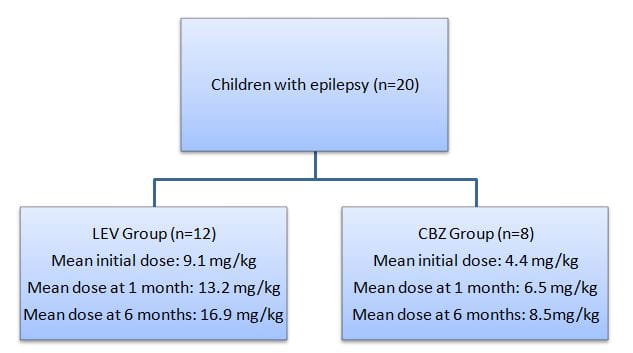
Results
- Greater proportion of patients in LEV group vs. CBZ group remained seizure-free between one month and six months (75% vs. 38%).
- Triglyceride levels tended to be increased in the CBZ group (baseline: 58.3 mg/dl, 1 month: 63.8 mg/dl, 6 months: 92.3 mg/dl, p = 0.22), though there were no significant changes in TC, HDL-C, or LDL-C in either group and TG level in the LEV group.
- Patients in the CBZ group had significantly decreased fT4 levels (baseline: 1.15 ng/dl, 1 month: 1.00 ng/dl, 6 months: 0.98 ng/dl, p = 0.03), though they remained euthyroid during the study period. On the contrary, patients in the LEV group experienced no significant changes in fT4 or TSH levels.
- Except for one patient who discontinued taking LEV (not included in this analysis), none of the patients in both the groups experienced any serious adverse events
- Other serum values; aspartate aminotransferase (AST), alanine aminotransferase (ALT), gamma-glutamyltransferase (GGT), uric acid, C-reactive protein (CRP), and glucose
- With respect to other serum variables, there was an increase in GGT in the CBZ group (baseline: 12.3 U/l, 1 month: 24.0 U/l, 6 months: 34.2 U/l, p = 0.02). Serum GGT remained significantly higher in the CBZ group as compared with LEV group after 1 month (24.0 U/l vs. 12.5 U/l, p = 0.001) and after 6 months (34.2 U/l vs. 12.9 U/l, p = 0.005).
Conclusions
- Levetiracetam monotherapy does not affect lipid profile or thyroid function in children with epilepsy. On the contrary, CBZ monotherapy may cause thyroid dysfunction.
- Levetiracetam monotherapy may have advantage over CBZ therapy in children with non-structural/metabolic epilepsy.
Epilepsy Behav. 2019;90;15–19.

More From Area Of Interest
You may also like
13 May, 26

17 Apr, 26
Our Research
23 Feb, 26

23 Feb, 26
11 Feb, 26
11 Feb, 26
11 Feb, 26
Latest Items
Journal Scans
27 Jul, 26
27 Jul, 26
Journal Scans
23 Jul, 26

23 Jul, 26
23 Jul, 26


