Dyslipidemia is a common problem affecting HIV-infected patients receiving antiretroviral therapy and it is very commonly associated with the protease inhibitors which were observed in various studies in adults and children. The commonly used protease inhibitor is lopinavir/ritonavir (LPV/r) in children. Few studies have earlier evaluated the impact of reduction of LPV/r dose and have concluded that it could be associated with decrease in triglyceride level in patients during the treatment.
The HIVNAT 152 PEARL study is an open-label trial which was carried out in HIV-infected children with age less than 18 years and weighing 25- 50 kg in Thailand to analyse the effect of low dose LPV/r on dyslipidemia. This study was presented in the 7th IAS Conference which is currently being conducted in Malaysia. The children were randomised with the FDA- recommended standard dose of lopinavir/ritonavir heat stable tablets or with low dose which was 70 % of the standard dose. The dosage was different as per the body weight of the child. Viral load, lopinavir Ctrough, cholesterol and triglyceride level were monitored.
Zidovudine/lamivudine, zidovudine/didanosine, tenofovir/lamivudine were the NRTI backbone used to randomize 200 children. At week 48, virological suppression was maintained in 92% and 94% of children from standard dose arm and low dose arm respectively. Around 21% of children on low dose had cholesterol level > 200 mg/dl in comparison with 34% on standard dose. Also when the triglyceride level was observed, 60% of children with standard dose had > 150 mg/dl than 44% who were on low dose.
In conclusion, this study showed decrease in dyslipidemia in children with low dose of LPV/r. Also, the efficacy of low dose is non-inferior to the standard dose which may lead to the reduction of drug cost by this dosing regimen.
The introduction of protease inhibitors (PI) containing antiretroviral (ARV) regimens in the treatment of HIV infection in infants, children, and adolescents has dramatically decreased morbidity and mortality. Currently the preferred PI regimen for initial therapy in children is low- dose ritonavir (RTV)-boosted lopinavir (LPV/r) in combination with two nucleoside reverse transcriptase inhibitors (NRTIs). Ritonavir-boosted darunavir (DRV/r), the latest PI to be FDA approved for pediatric patients more than 6 years old. Clinical trials like POWER, ARTEMIS, and the DELPHI trials have proved the efficacy of DRV/r use in children.
ARIEL (TMC114-C228) is a 48-week, open-label, single-arm, phase II trial evaluating PK, safety and efficacy of darunavir/ritonavir (DRV/r) plus an optimized background regimen (OBR) in HIV-positive treatment-experienced children. It involved antiretroviral-experienced children 3 to less than 6 years old who weighed 10 to less than 20 kg. First they received twice-daily darunavir/ritonavir at a dose of 20/3 mg/kg plus at least two other active antiretrovirals.
Children aged 3-< 6 years, weighing 10-< 20kg, were on an antiretroviral regimen for ≥12 weeks. They had an HIV-1 RNA >1000 copies/mL and < 3 darunavir resistance-associated mutations (RAMs) at screening. Patients received darunavir oral suspension (100mg/mL) plus ritonavir 20/3mg/kg twice-daily with an investigator-selected optimized OBR. After pharmacokinetic analysis at Week 2 and Data and Safety Monitoring Board recommendations, patients weighing < 15 kg received darunavir/ritonavir 25/3mg/kg twice-daily. Patients weighing 15-< 20kg received darunavir/ritonavir 375/50mg twice-daily.
Twenty-four week results of phase II ARIEL Trial showed that darunavir/ritonavir plus an optimized background regimen (OBR) was effective in treating HIV-1-infected treatment-experienced children, with no new safety concerns versus adults. The 48-week safety and efficacy outcomes of this study were presented at IAS 2013 Conference.
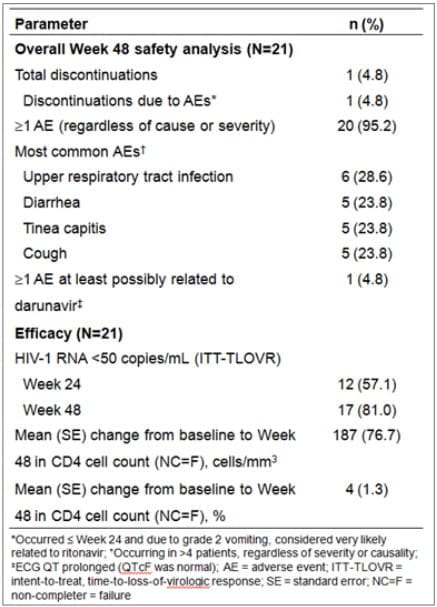
The 48 week analysis included 21 patients (47.6% male; median age at screening 4.4 years) from 10 sites. Baseline mean log10 plasma HIV-1 RNA was 4.34copies/mL and median CD4 cell count was 927 cells/mm3 (median CD4% 27.7%). There was a median of 0 primary protease inhibitor (PI) RAMs, 4 secondary PI RAMs, 0 darunavir RAMs, 1 NRTI RAM and 1 NNRTI RAM. Outcomes are summarized.
There were no adverse events (AEs) ≥ grade 2 considered possibly related to darunavir. Two patients had grade 4 AEs (stenosing tenosynovitis and asthmatic crisis), both considered serious but not treatment-related. All laboratory abnormalities were grade 1 except for one grade 3 neutropenia (present at baseline; not treatment-related). The Week-48 virologic response was high (81.0%). There were 3 (14.3%) virologic failures (VFs) (2 never suppressed; 1 rebounder). Of the 2 VFs with paired baseline/endpoint genotypes, neither developed PI nor NRTI RAMs.
The investigators concluded that the treatment-experienced HIV-1-infected children aged 3-< 6 years receiving darunavir/ritonavir plus an OBR showed a high virologic response and a favorable safety profile after 48 weeks.