Highlights of the 21st Conference on Retroviruses and Opportunistic Infections
The current HIV treatment guidelines recommend the use of 2 nucleoside reverse transcriptase inhibitors (NRTIs) along with an non-nucleoside reverse transcriptase inhibitor (NNRTI) or boosted-protease inhibitor (PI/r) or integrase inhibitor (INSTI) for first-line treatment of HIV infection. However, NRTIs are known to be associated with long-term mitochondrial toxicities and side-effects. Also with the availability of newer classes of antiretrovirals (ARVs), developing an NRTI-free regimen looks like a good alternative.
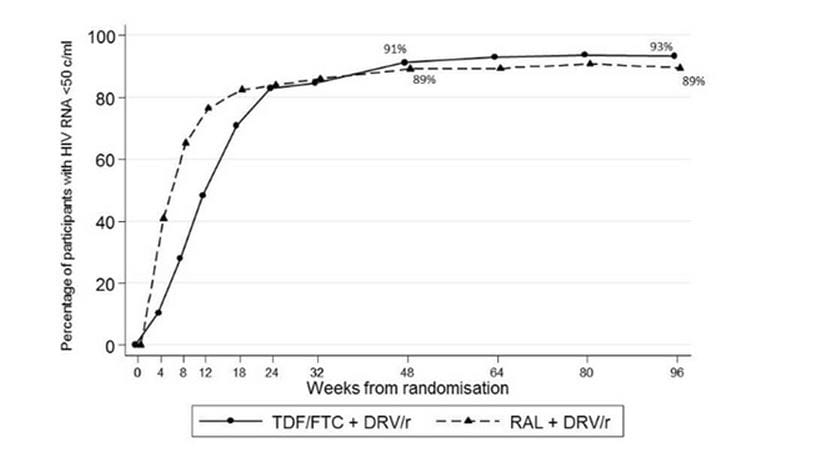
Francois Raffi and colleagues of the NEAT 001/ANRS 143 study group, conducted a phase 3, randomized, open-label, non-inferiority study comparing efficacy, safety and tolerability of boosted darunavir (DRV/r) plus either Raltegravir (RAL) or Tenofovir/ emtricitabine (TDF/FTC) in antiretroviral therapy (ART)-naive HIV-infected adults, the 96 weeks, results of which were presented at CROI 2014.
The study enrolled 805 ART-naive HIV-infected adults from 78 sites in Europe and were required to have a CD4 count of at least 500 cells/mm3 (median about 330 cells/mm3) and no major drug-resistance mutations. Study participants were randomized (1:1) to receive either RAL (400 mg b.i.d.) with TDF/FTC or DRV/r (800/100mg o.d.) with TDF/FTC and were followed for 96 weeks.
The primary study endpoint was treatment failure defined as time to occurrence to any of the following:
- Virological:
- Change of treatment before 32 weeks because of insufficient virologic reponse
- HIV-1 RNA < 1 log10 c/ml by 18 weeks
- HIV-1 RNA ≥400 c/ml at 32 weeks
- HIV-1 RNA ≥50 c/ml at 32 weeks
- HIV-1 RNA ≥50 c/ml at any time after 32 weeks
- Clinical:
- Death due to any cause
- Any new or recurrent AIDS - defining event
- Any new serious non-AIDS - defining event
At the end of 96 weeks it was observed that probability of meeting one of the criteria of primary endpoint was 17.4% for RAL group participants and 13.7% for TDF/FTC group participants.
The pre-defined non-inferiority margin was defined as an absolute difference of at most 9% for the failure rate of RAL versus TDF/FTC in the intent-to-treat (ITT) analysis estimated by Kaplan-Meier methods. The difference recorded fell within this margin, which indicated that RAL was overall non-inferior to TDF/FTC. In most cases, this was due to viral load >50 copies/ml at week 32 or after.
Also 15% in the RAL group showed virological failure compared to 12% in TDF/FTC group, and 23% in RAL group versus 19.8% in TDF/FTC group either met the primary endpoint or stopped the randomized regimen for any reason.
There were four deaths (three in the RAL arm and one in the TDF/FTC arm), eight AIDS-defining events (five and three, respectively) and 14 non-AIDS events (seven in each arm). All this further proved the non-inferiority between the two treatment groups.
There was no significant difference observed in terms of serious adverse events (SAE) or grade 3 or 4 AEs or treatment modifying AE. Increase in CD4 cells in RAL vs TDF/FTC group were also similar (+197 vs +193 at 48 weeks, +267 vs +266 at 96 weeks). The following graph shows that similar proportions of patients in the two arms achieved HIV RNA <50 copies/ml.
Treatment-emergent resistance was seen in 5/28 (RAL) vs 0/13 (TDF/FTC) patients with available genotype at failure. The total-to-HDL cholesterol ratios remained stable in both arms and the kidney function in terms of creatinine clearance (measured as the estimated glomerular filtration rate or eGFR) showed a decline in the TDF/FTC arm (-3.8 ml/min) while showing a rise in the RAL arm (+0.9 ml/min), which was a significant difference.
On the basis of the above observations made at the end of 96 weeks, investigators of the NEAT 001/ANRS 143 trial group concluded that the NRTI-sparing regimen, RAL + DRV/r, was found to be non-inferior to TDF/FTC + DRV/r in terms virological/clinical efficacy, safety and tolerability in first-line ARV therapy.
References: First-Line RAL + DRV/r Is Non-Inferior to TDF/FTC + DRV/r: The NEAT001/ ANRS143 Randomised Trial. 21st Conference on Retroviruses and Opportunistic Infections (CROI). Boston, March 3-6, 2014. Abstract 153LB.
Various HIV treatment guidelines recommend the use of a dual NRTI - backbone along with a third agent. Efavirenz (EFV), which is a NNRTI - is usually the most preferred third agent; however, it may not be suitable for all HIV-infected persons due to its central nervous system (CNS) side effects.
Recently presented at CROI 2014, study A5257 provided an analysis of the virologic efficacy and tolerability of three NNRTI - sparing preferred initial ART regimens. In this study, 1809 ART-naive individuals were randomized to receive TDF/FTC - backbone either with boosted atazanavir (ATV/r), DRV/r or RAL and were followed for 96 weeks.
Participants having HIV-1 RNA (VL) >1,000 copies/ml (c/ml) and no resistance to any of the study regimens were enrolled. All participants received TDF/FTC (300mg/200mg) as the NRTI backbone and randomized 1:1:1 to ATV/r (300mg/100mg o.d.), RAL (400mg b.i.d.) or DRV (800mg/100mg).
The primary endpoints were time to virologic failure (VF), defined from study entry to confirmed VL >1,000 c/ml (week 16 to before week 24) or >200 c/ml (≥ week 24) and time to tolerability failure (TF) was from entry to discontinuation of ATV, RAL or DRV for toxicity. Switching to one of the other drugs in the study for reasons of toxicity was allowed.
Out of the 1,809 participants enrolled, 24% were women. Also, around 34% were non-Hispanic white, 42% non-Hispanic black and 22% Hispanic. Their mean VL at entry was 4.6 log10 c/ml and mean baseline CD4 cell count was 308/mm3. In all, 92% of participants completed 96weeks.
It was observed that VL was ≤50 c/ml for 94% in the RAL group compared to 88% of the ATV/r and 89% of the DRV/r group at 96weeks (intent to treat). RAL proved to be significantly better than DRV, with a 5.6% absolute difference in the rate of virological failure.
With respect to tolerablility, there was 16% discontinuations in the ATV/r group compared to 1% in the RAL group and 5% in the DRV/r group. Discontinuations were more frequent with ATV (14%) than with RAL (1%) or DRV (5%), mainly due to clinical jaundice and hyperbilirubinemia with ATV. Discontinuations due to gastrointestinal toxicity was highest in ATV/r group (25), then DRV/r (14), and least in the RAL group (2). Therefore, in terms of in terms of tolerability failure, TF, ATV was inferior to RAL and DRV.
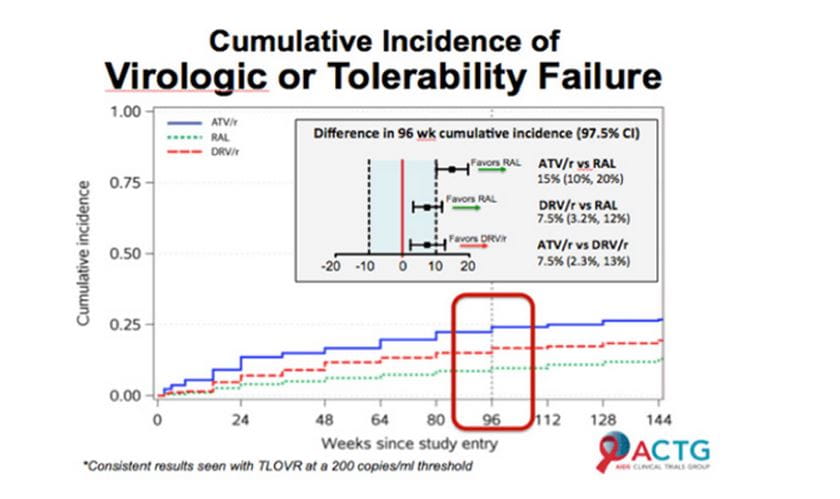
While considering overall treatment failure, which is a combined measure of the virologic and toxicity failure, RAL proved to be 15% better than ATV/r and 7.5% better than DRV/r, and DRV/r proved to be 7.5% better than ATV/r (as depicted in the graph).
If switching drugs due to toxicity was included in the definition of treatment failure, then the overall efficacy of the drugs at 96 weeks was 80% for RAL, 73% for DRV/r and 63% for ATV/r.
This 96-week analysis concluded that RAL was superior to both ATV/r (largely due to elevated bilirubin) and DRV/r (driven by both virology and differences in gastrointestinal toxicity).
References: Efficacy and Tolerability of Atazanavir, Raltegravir, or Darunavir with FTC/Tenofovir: ACTG 5257. 21st Conference on Retroviruses and Opportunistic Infections (CROI). Boston, March 3-6, 2014. Abstract 85.
The 48-week analysis of the SINGLE study proved that Dolutegravir (DTG) 50 mg + abacavir (ABC)/lamivudine (3TC) once daily was superior in terms of virologic efficacy and safety/tolerability when compared to TDF/FTC/ EFV in ART-naive HIV-1patients.
Investigators of the SINGLE study group accessed the durability of this regimen for 96 weeks. The SINGLE study is an ongoing Phase III, randomized study comparing the efficacy and safety of DTG plus ABC/3TC to TDF/FTC/EFV in treatment-naive HIV patients.
Around 833 participants similar at baseline were randomized to receive either of the regimens. Randomization was stratified by baseline plasma HIV-1 RNA (≤ vs >100,000 c/mL) and CD4 cell count (≤vs > 200 cells/mm3). The following observations were made at the end of 96 weeks.
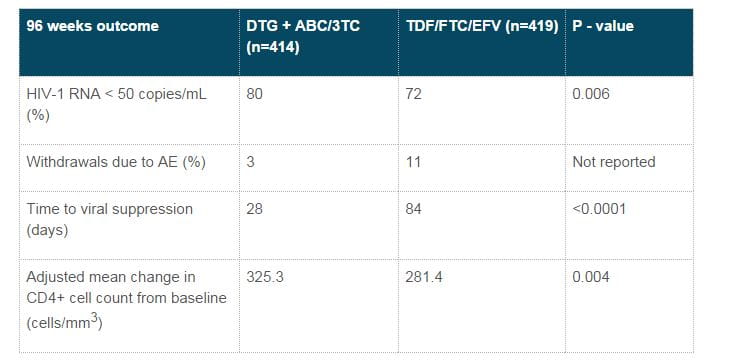
It was observed that at the end of 96 weeks, 80% of DTG+ABC/3TC and 72% of TDF/FTC/EFV subjects achieved <50 c/mL plasma HIV-1 RNA based on the FDA snapshot algorithm. This showed that DTG-based regimen continued to show superior virologic efficacy as compared to TDF/FTC/EFV.
Differences in time to viral suppression, change from baseline in CD4+ cells and higher rate of discontinuation due to adverse events (AEs) over 96 weeks favoured the DTG + ABC/3TC arm as observed in the table above.
Also there was a lower incidence of treatment-related AEs with DTG + ABC/3TC versus TDF/FTC/EFV.
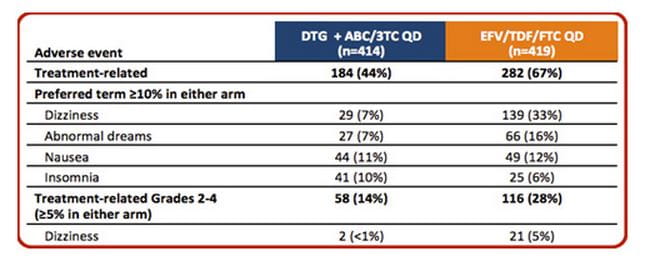
Apart from the efficacy and safety, it was seen that occurrence of protocol-defined virologic failure increased from 4% to only 6% of participants in both arms between week 48 and 96. In the TDF/FTC/EFV group, 6 patients showed major NNRTI-resistance mutation and 1 showed NRTI mutation. No treatment - emergent primary integrase inhibitor (INSTI) or NRTI resistance mutations were seen in the DTG+ABC/3TC group.
Therefore, at the end of 96 weeks, DTG+ ABC/3TC showed durable virologic suppression and remained superior to TDF/FTC/EFV in maintaining a favorable AE profile, with no treatment-emergent primary INSTI or NRTI resistance mutations and having a low rate of discontinuation due to virologic failure.
References: Dolutegravir regimen statistically superior to efavirenz/tenofovir/emtricitabine: 96-week results from the SINGLE study (ING114467). 21st Conference on Retroviruses and Opportunistic Infections (CROI). Boston, March 3-6, 2014.Abstract 543.
The current WHO 2013 recommendation includes EFV-based combination ART for all pregnant women. A systematic review and meta-analysis reported that there is no increased risk of overall birth defects among women exposed to EFV during the rst trimester of pregnancy compared with exposure to other ARVs. Prevalence of overall birth defects with first trimester EFV exposure was similar to the ranges reported in the general population. There are limited data on maternal/infant outcomes and alternative ART regimens. (AIDS 2010, 24:000,000)
A study by Cohen et al. reported the maternal/infant outcomes of the PROMOTE trial, which compared virologic, immunologic and safety outcomes of lopinavir/ritonavir (LPV/r) to EFV-based cART in rural Uganda.
PROMOTE was an open label trial which enrolled 389 HIV+ ART-naive pregnant women between 12 and 28 weeks gestation. Women received zidovudine (AZT)/3TC and either LPV/r or EFV at enrolment through 1 year of breastfeeding. LPV/r increased to 600/150 twice daily at 30 weeks. All women received cotrimoxazole and infants received ART prophylaxis as per Ugandan guidelines. The mean age was 29, median pre-ART CD4 count was 370, and mean pre-ART viral load was 61,611 c/mL.
The study results were as follows:
- Compared to LPV/r, women on EFV were significantly more likely to achieve viral suppression (<400 copies/mL). Women on LPV/r experienced greater CD4 count recovery by 24 weeks post-ART initiation (see table below).
- Among the 373 women with virologic suppression, there was significantly more virologic failure in the LPV/r arm (P =.03).
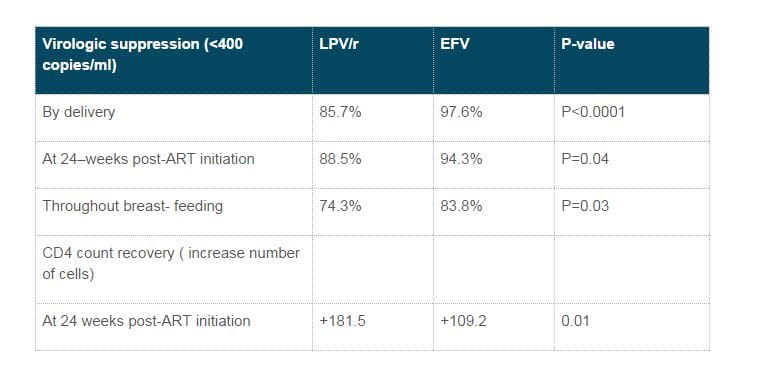
- There was no difference in grade 3 or 4 AEs (incidence rate [IR] 0.26 per woman-year), though grade 1 or 2 gastrointestinal AEs were significantly more likely for women on LPV/r (p < .0001).
- HIV transmission rate was 2/374 live-born infants (.5%, .01-1.9%) - one inutero and one breastfeeding transmission in the LPV/r arm.
- HIV-free infant survival did not differ between arms (92.9% [LPV/r] versus 97.2% [EFV] P=.10) and there was no difference in grade 3 or 4 AEs among infants (P=. 21).
- The study concluded that EFV was associated with superior virologic outcomes compared to LPV/r among ART-naive pregnant and breastfeeding women. Both regimens were extremely effective at preventing HIV transmission during pregnancy and breastfeeding. These data affirm WHO guidelines recommending EFV as first-line cART for Option B + and support LPV/r as an alternative.
References: AIDS 2010, 24:000-000
Cohan et al .Efficacy and Safety of LPV/r Versus EFV in HIV + Pregnant and Breast-Feeding Ugandan Women. 21st Conference on Retroviruses and Opportunistic Infections (CROI). Boston, March 3-6, 2014. Abstract 69
Very early ART in infants can probably alter the establishment and persistence of HIV-1 infection. This was well-depicted in the,"Mississippi Baby", case presented last year at CROI 2013. Here, an infant born to an HIV-infected woman began ART 30 hours after birth and showed undetectable levels of HIV-1 RNA at 30 months of age even after therapy was discontinued (when the child was 18 months of age).
At the 21st CROI 2014, researchers presented the follow-up report on virologic and immunologic markers at 21 months off ART in the Mississippi baby and also in another similar case of a perinatally-infected infant who started cART by 4 hours of age and remained on cART through the age of 8 months.
Standard HIV DNA and RNA tests were used to confirm infection and assess virologic responses to cART. HIV-specific immune responses, CD4+ and CD8+ T-cell percentages, proviral burden in peripheral blood mononuclear cells (PBMCs), resting CD4+ T-cells, activated CD4+ T-cells and monocytes in these two cases were assessed.
It was observed that at 21 months after stopping cART, the Mississippi baby showed undetectable plasma viremia <20 copies/mL and normal CD4+, CD8+ T-cell counts at 39 months of age. Trace proviral DNA was persistently detectable in PBMCs but replication competent HIV was not. HIV-specific immune responses remain undetectable.
The second infant from Long Beach, California, with a high-risk exposure to HIV was confirmed with a positive status showing HIV RNA in blood and cerebrospinal fluid (CSF) and HIV DNA in cells 4 hours after birth. She was started on AZT, 3TC and nevirapine (NVP). NVP was switched to LPV/r at 2 weeks and this regimen was continued for 9 months. The mother was not on ARVs during pregnancy and was having a VL of 138,811 copies at delivery.
It was observed that HIV RNA remained undetectable in blood with a 20-copy assay for 9 months. The assay for proviral DNA was found to be negative 6 days after treatment began and remained negative at 1.6 months and 2.2 months. At 1, 3, or 9 months, no infectious virus was detected. Proviral DNA was <5.3 copies per million in PBMCs after 6 days of treatment. At the age of 3 months, the HIV antibody was found to be indeterminate by Western blot. The child had a normal CD4 percent.
Therefore, very early ART in the HIV-infected Mississippi Baby led to sustained HIV remission through 39 months of age, 21 months after stopping ART. In the second infant, ART by 4 hours of life led to rapid clearance of the replicating virus and an undetectable proviral DNA by clinical assays within 6 days of life, supporting the restriction of HIV spread with very early ART.
These cases provide a basis for approaches will be necessary to guide the optimal management of very early HIV-infected infants treated very early in order to achieve remission.
References: Very Early Combination Antiretroviral Therapy in Perinatal HIV. 21st Conference on Retroviruses and Opportunistic Infections (CROI). Boston, March 3-6, 2014. Abstract 75LB
The results of the HPTN 052 study in 2011 established that undetectable viral load in HIV-infected patients reduces the risk of transmitting the virus to an HIV-negative partner by 96%. This study primarily looked at heterosexual couples and had very few gay couples participating to establish if the same applied to them.
To overcome this gap, a second large study PARTNER, is being conducted by Dr. Lundgren and his team to understand whether people with HIV become non-infectious if they are on ART. So far, 1,110 couples where the partners have differing HIV status has been recruited so far. Nearly 40% of them are gay couples. In a 2-year interim analysis, 767 couples were evaluated.
The inclusion criteria for the study were that couples have to be having sex without condoms at least some of the time, HIV-negative partner should not be using post-exposure or pre-exposure prophylaxis (PEP or PrEP) and the HIV-positive partner has to be on ART, with the most recent viral load below 200 copies/ml.
As per the study criteria, HIV-positive partners were on ART for 5 years in the gay couples and for 7-10 years in the heterosexuals; the proportion reporting an undetectable viral load was 94% in the gay men and 85-86% in the heterosexuals. The incidences of sexually transmitted infections (STIs) were much more common in the gay couples (16%) as compared with the heterosexuals (5%), mainly gonorrhea or syphilis.
The result of this interim analysis suggest that, so far, there have been no transmissions within couples from a partner with an undetectable viral load. According to researchers, an estimated 50-100 transmissions would have taken place if no one in the study had been taking ARVs.
Although some of the HIV-negative partners became HIV positive, genetic testing of the HIV revealed that, in all cases, the virus came from someone other than the main partner. No transmissions occurred despite quite high levels of STIs, especially in the gay couples.
The study found that there were no cases where someone with a viral load under 200 copies/ml transmitted HIV, either by anal or vaginal sex. As stated by the researchers,the PARTNER study is still recruiting gay male couples and, the full results will not be out till 2017.
References:HIV transmission risk through condomless sex if HIV+ partner on suppressive ART: PARTNER study. 21st Conference on Retroviruses and Opportunistic Infections (CROI). Boston, March 3-6, 2014. Abstract 153LB.
Approximately 150 million globally are chronically infected with HCV and the pandemic is concentrated in middle-income countries (MICs); while 15% of the 150 million people with chronic HCV live in high-income countries (HICs), 72% live in MICs and 13% in low-in- come countries (LICs). HCV-related liver complications kill an estimated 350,000 people annually. Currently, the standard of care is injectable peg-interferon (PEG-IFN) used in combination with ribavirin (RBV). The cure rate is 50-75%, and the treatment is associated with strong side effects. Interferon-free treatments for HCV that can be safely co-administered with ART are needed for HIV/HCV co-infected patients.
A nucleotide HCV polymerase inhibitor, sofosbuvir (SOF) has been licensed for the treatment of chronic HCV infection in people with or without HIV. In people without HIV infection, sofosbuvir plus ribavirin has yielded high sustained virological response (SVR) in people infected with HCV genotypes 1, 2, and 3. To test the efficacy and safety ofthis regimen in people with HIV, researchers conducted the PHOTON-1 study.
PHOTON-1 enrolled 114 treatment-naive genotype 1co-infected patients. In addition, the study also included 68 treatment-naive and 41 treatment-experienced people with genotypes 2 or 3.
HCV patients with stableHIV disease received SOF 400mg q.d. and RBV 1,000-1,200mg/day; treatment-naive genotype 1 and treatment experienced genotype 2/3 patients received 24 weeks and treatment-naive genotype 2/3 patients received12weeks of treatment. Multiple ART regimens were permitted for patients with compensated cirrhosis. The primary efficacy endpoint was sustained virologic response 12 weeks after treatment (SVR12), safety assessments included HIV RNA and CD4 cell count.
Across all the study arms, most participants (about 85%) were men and the mean age was about 50 years. One-third of genotype 1 patients and about 15% of genotype 2 or 3 patients were Black. 30% of treatment-naive patients and half of the treatment-experienced participants had the favorable IL28B CC gene variant associated with good interferon responsiveness. Most genotype 1 patients (79%) had harder-to-treat subtype 1a.Rates of liver cirrhosis ranged from 4% among naive genotype 1 patients to 24% in the experienced genotype 2/3 group.
Participants had well-controlled HIV disease. More than 90% were on ART and the mean CD4 T-cell count was above 600 cells/mm3. Unlike some HCV protease inhibitors, sofosbuvir does not affect CYP3A4 drug metabolism and it has no significant interactions with many widely used antiretrovirals. More than one-third of patients used efavirenz, nearly 20% used boosted atazanavir or darunavir, and about 15% used the integrase inhibitor raltegravir; most also took tenofovir/emtricitabine.
Results:
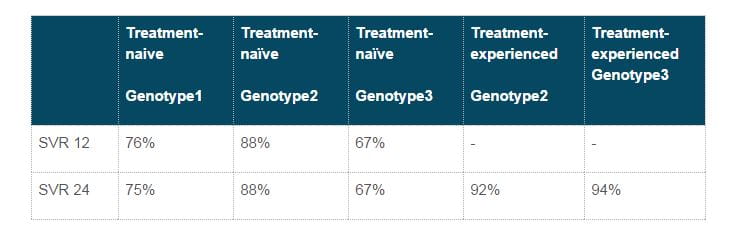
In treatment-naive genotype 1 patients,76% achieved SVR12.
The 2 patients with HCV viral breakthrough while on treatment were found to have undetectable sofosbuvir levels, indicating probable non-adherence.
No resistance mutations (including S282T) were detected on deep sequencing in patients with virological failure.
Sofosbuvir plus ribavirin was generally safe and well-tolerated.
Serious adverse events were experienced by7 people treated for 12 weeks and 6 treated for 24 weeks and 4 and 3 patients, respectively, discontinued treatment for this reason.
The most common side effects were fatigue, insomnia, headache, and nausea.
Among the 11 co-infected patients who were not on ART, there were no clinically significant changes in HIV viral load
There were 2 cases of transiently increased HIV RNA, both associated with antiretroviral non-adherence
Absolute CD4 cell counts decreased a known effect of ribavirin -- but CD4 percentages remained the same
HCV subtype 1a versus 1b and IL28B status were not significant predictors of treatment response in a multivariate analysis
People with liver cirrhosis appeared to have somewhat lower response rates, but the number was small and the difference was not statistically significant
The study concluded that treatment-naive HCV genotype 2 and 3 patients co-infected with HIV achieved high rates of SVR12 with an interferon-free, all-oral regimen of SOF+RBV, suggesting that SOF+RBV treatment is well-tolerated and safely co-administered with multiple ART regimens and may be equally safe and efficacious in patients with and without HIV co-infection.
References: S Naggie, MS Sulkowski, J Lalezari, et al. Sofosbuvir Plus Ribavirin for HCV Genotype 1-3 Infection in HIV Co-infected Patients (PHOTON-1). 21stConference on Retroviruses and Opportunistic Infections (CROI). Boston, March 3-6, 2014. Abstract 26
In the United States, more than 4,000 new cases of cancer are diagnosed in HIV patients each year.Cancer risk is elevated with HIV infection.However, it is unknown whether immune suppression results in more aggressive, advanced stage cancers.A meta-analysis published in Lancet 2007 showed that in HIV and transplant patients, immune deficiency rather than other risk factors for cancer is responsible for the increased risk of cancer in these two immune-compromised groups. (Lancet 2007; 370: 59-67)
But tumour biology and delayed utilization of healthcare may lead to late-stage diagnosis among HIV-infected individuals.
Meredith et al. conducted a different type of analysis focused on the cancer stage at diagnosis and limited to US residents with HIV or a transplant. The investigators noted that, besides immune suppression, tumor aggressiveness and/or delayed screening may lead to later diagnosis.
Investigators compared the cancer stage in HIV-infected individuals with solid organ transplant recipients, an immune suppressed population with more frequent utilization of care. Researchers used the data on all cases of 15 cancer sites, occurring during 1996-2010 in two US registry linkage studies: the HIV/AIDS cancer match (HACM) and the transplant cancer match (TCM), which linked cancer registries to HIV and transplant registries, respectively. Cancer registries provided data on Surveillance, Epidemiology and End Results (SEER) summary stage at diagnosis. Odds ratios (ORs) for distant (vs. local)disease were estimated comparing HIV and transplant populations with the general population in separate logistic regression models, adjusted for age, sex, race, registry and calendar year.
- In the HACM Study, 9,362 of 4.7 million cancer cases occurred in HIV-infected individuals.
- In the TCM Study, 8,225 of 9.7 million cancer cases occurred in transplant recipients.
Compared with cancer cases in the general population, HIV-infected individuals had more distant stage breast (OR=1.78), lung (OR=1.20), prostate (OR=1.39) and cervical cancers (OR=1.51) and melanoma (OR=2.53), and fewer cases of distant-stage anal cancer (OR=0.57).
In contrast, compared to the general population, transplant recipients had fewer distant-stage prostate (OR=0.50) and lung (OR=0.59) cancers, and no difference in the stage of cervical cancer (OR=0.58) or melanoma (OR=1.33).
Similar to HIV-infected individuals, transplant recipients had fewer distant-stage anal cancers (OR=0.30).
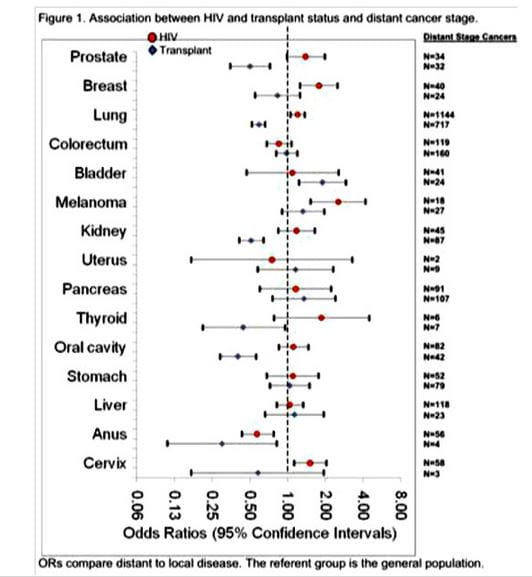
The study concluded that prostate, lung, breast and cervical cancers and melanomas diagnosed in HIV-infected individuals were more likely to be distant-stage than in the general population. In contrast, among transplant recipients, none of these cancer sites was more likely to be distant-stage relative to the general population. This analysis suggests that the increased stage observed in people with HIV is likely driven by delayed diagnosis due to under-utilization of care, particularly for screen-detectable cancers, and is unlikely to be due to immune suppression increasing cancer progression.
References:
- Meredith S. Shiels et al. Cancer Stage at Diagnosis in HIV-Infected Individuals and Transplant Recipients. 21st Conference on Retroviruses and Opportunistic Infections (CROI). Boston, March 3-6, 2014.Abstarct 705
Prevalence of low bone mineral density (BMD) and risk of fractures is greater in HIV patients; several studies suggest that fracture rates are higher in HIV-infected patient populations than among matched uninfected patients. A retrospective analysis comparing 8,525 patients with HIV and 2,208,792 patients without HIV found an increased fracture prevalence based on ICD-9 coding (2.9 versus 1.9 per 100 persons, p<0.0001). In the HIV Outpatient Study (HOPS), a prospective cohort study of 5,826 HIV-infected patients in treatment at 10 HIV clinics throughout the United States, age-adjusted fracture rates were 1.98 to 3.69 times higher than rates in the general population.
FRAX is a 10 year fracture risk assessment developed by the WHO that calculates a 10-year fracture probability in women and men. FRAX has been developed as a tool to help healthcare providers identify and proactively treat patients with a high risk of debilitating bone fractures due to low bone mass and other significant risk factors. FRAX reliably predicts 10-year fracture risk for adults in the general population. However, its utility for HIV-infected adults has not been assessed.
The study included 1,006 participants from two CDC-sponsored HIV cohorts (SUN study and HOPS study). Clinical data for these study participants were collected prospectively during 2004-2012. BMD values of left femoral neck were obtained using dual energy X-ray absorptiometry. Initial FRAX 10-year risk of a major osteoporotic fracture (i.e., hip, spine, forearm or shoulder) were calculated. Rates of any new bone fracture and major osteoporotic fracture per 100 person-years (py) of follow-up, stratified by initial FRAX-score intervals, using Cox proportional hazards models to identify clinical and demographic risk factors for any new fracture were analyzed.
The baseline characteristics of the patients were as follows: 83% were male, 67% were non-Hispanic white, median age at date of DEXA scan was 42 years, and median CD4+ cell count was 408 cells/mm3.
Following were the study results
During a median of 4.2 years of observation after initial DEXA, 95 participants (9.4%) had any new fracture: 7.1% occurred among persons with FRAX score <3% (1.39 per 100py) and 15.3% among persons with FRAX score ≥3% (3.27 per 100py).
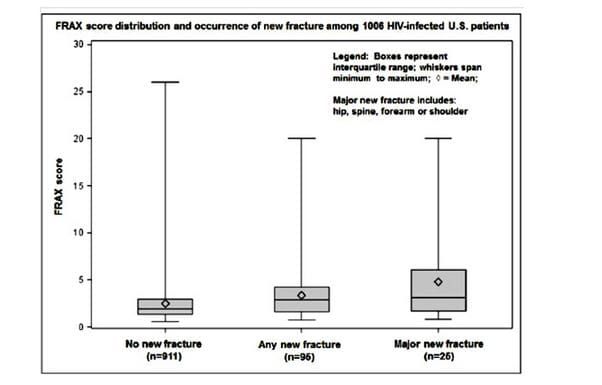
New major osteoporotic fractures were observed among 1.5% of persons with a FRAX score <3% (0.30 per 100py), and among 4.9% (1.04 per 100py) of persons with a FRAX score ≥3%.
In multivariate analyses, having a prior fracture (adjusted hazard ratio [aHR: 2.02), older age (aHR: 1.30 per 10 years), and lower BMD (aHR: 0.14 per g/cm2) were associated with risk of any new fracture.
In a separate model, having a FRAX score ≥3% versus a FRAX score of <3.0% was associated with any new fracture (HR: 2.31).
The researchers concluded that in a large convenience sample of relatively young HIV-infected US adults, a FRAX score ≥3%, low baseline BMD, history of prior fracture, and increased age were significantly associated with elevated risk of new fracture.
References: Battalora et al. New Fracture Risk and FRAX 10 Year Probability of Fracture in HIV- infcetd Adults. 21st Conference on Retroviruses and Opportunistic Infections (CROI). Boston, March 3-6, 2014abstract 778
In March 2008, the large D:A:D cohort, designed to assess relationship between HIV andART with cardiovascular endpoints reported that even after adjusting for many confounders, there was an association between use of abacavir (ABC) and didanosine with cardiovascular events. While these observations have been supported by some studies, others have not seen such an association. A major concern was that there are unmeasured factors that might be driving the results. There could be possibility that those with renal disease, which is a risk factor for cardiovascular events, could be disproportionately given ABC to avoid the nephrotoxicity of TDF. In order to clarify this, reinvestigation was done for this relationship with subsequent follow-up.
All the study participants were followed from study entry until the first of myocardial Infarction (MI), death, 1st February 2013 or end of follow-up. Association between ABC use before and after March 2008 and 10-year cardiovascular diseases (CVD) risk, as defined by Framingham model (low risk:< 10%, moderate risk: 10%-20%, and high risk: >20%) was assessed with multivariable logistic/Poisson regression.Poisson regressionalso assessed the association between current ABC use (with 6-month lag to allow for recent discontinuation) and MI risk, adjusting for use of other ART drugs and confounders. Analysis was performed separately for pre- and post-March 2008. Sensitivity analysis was conducted following adjustment for potential confounders (e.g., diabetes, glucose, CVD risk, blood pressure, and weight loss/gain, use of antihypertensive drugs or angiotensin-converting enzyme [ACE] inhibitors, creatinine).
The key finding in the study were as follows:
- Initiation of ABC use increased from 10% in 2000 to 20% in 2008, before stabilizing at 18-19% (see figure).
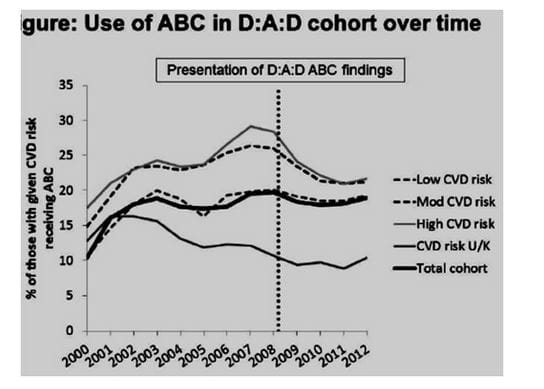
- Initiation of ABC appeared more frequent in patients with moderate-to-high CVD risk versus patients with low or unknown risk before March 2008 and less frequent after March 2008.
- Increases in use pre-March 2008, and subsequent decreases, were greatest in those withmoderate and high CVD risk.
- Post-March 2008, those on ABC at moderate/high CVD risk were more likely to discontinue ABC than those at low/unknown CVD risk, regardless of VL (<1,000 cps/ml: relative rate (RR) 1.49; >1,000 cps/ ml: 1.23); no such associations were seen pre-March 2008.
- There was some evidence that ART-naive people at moderate/high CVD risk post-March 2008 were less likely to initiate ABC than those at low/unknown CVD risk (odds ratio: 0.74).
- In all, 941 MI events occurred in 367,559 person years (py) By 1 February 2013, the MI rate 0.26.
- MI rate with current ABC use: 0.47.
- MI rate with no current ABC use: 0.21.
- Current ABC use was associated with a 98% increase in MI rate (RR 1.98).
- No difference in the pre- (1.97; 672 events, 210,250 py) or post- (1.97; 269 events, 157,309 py) March 2008 periods (p=0.74).
- Results were unchanged after further adjusting for factors potentially on the causal pathway (pre-March 2008: 1.88; post-March 2008: 2.03), including renal function, dyslipidaemia and hypertension.
The researchers concluded that despite channelling of ABC away from those with higher CVD risk since 2008, they continue to observe an association between ABC use and MI risk.
References: Sabin et al .Is There Continued Evidence for an Association Between Abacavir and Myocardial Infarction Risk? 21stConference on Retroviruses and Opportunistic Infections (CROI). Boston, March 3-6, 2014. Poster 747LB
In the era of ART, there has been a decrease in the severity of HIV-associated neurological disorders (HAND), however, it still continues to occur in many HIV-infected individuals and is usually underdiagnosed. Usually, the virus crosses the blood-brain barrier, invading the central nervous system (CNS) early, probably along with the initial systemic HIV infection and person is asymptomatic.
The inflammatory markers of the brain are at an increased level in the presence of antiretroviral therapy (ART) initiated during chronic infection. The extent these markers may normalize after early ART initiation is still unknown.
To understand this aspect, Julia Peterson and her colleagues investigated soluble and cellular markers of immune activation in the blood and cerebrospinal fluid (CSF) of 24 subjects with primary HIV infection (PHI, defined as <1 year HIV infection). The time of ART initiation after infection varied among the subjects.
Blood and CSF samples were analysed at baseline and at a 6-12 month interval after starting ART. CSF white blood cells (WBC), protein, CSF to plasma albumin ratio, and CSF and blood neopterin were measured to assess immune activation. These values were compared with those in 20 age-matched HIV-negative controls using the Mann Whitney's test, to investigate abnormality after early treatment initiation.
PHI subjects (median age = 38years) at 139 days post-infection (dpi) had abnormal immune and inflammatory measures at baseline compared with HIV-negative subjects (p<0.01), including CD4 count 507 cells/uL, CSF WBC 6 cells/uL, CSF neopterin 8.8 nmol/L, and plasma neopterin 13.89 nmol/L. CSF protein and CSF to: plasma albumin ratio were not different from HIV-negative subjects at baseline
Patient initiated ART 532 dpi and had a repeat sampling at 242.5 days after ART initiation. The values measured post-ART are as follows: CSF WBC 2 cells/uL, CSF protein 36 cells/uL, CSF to : plasma albumin ratio 4.57, CSF neopterin 4.95 nmol/L, and plasma neopterin 7 nmol/L.
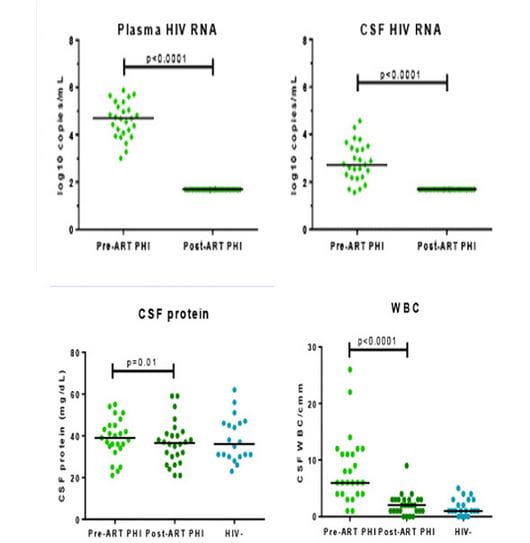
As observed in the graphs above, there is a significant decline in the plasma and CSF viral at a median of 9.3 months after ART began (p<0.0001). CSF protein also decreased after initiating ART (p=0.01). CSF WBCs declined significantly after ART started (p<0.0001), returning to levels recorded in HIV-negative people (median=2 cells/uL).
CSF neopterin fell significantly with ART (p=0.001) to levels equivalent to those in HIV-negative controls. A significant elevation in PHI after sustained ART compared to HIV-negative controls was detected only in blood neopterin (p=0.03). It was observed that patients who started ART during primary HIV infection had blood and CSF neopterin levels which were lower than those recorded in a historical comparison group of people who began ART during chronic infection. Also pre-ART levels of CSF neopterin, plasma neopterin and CSF/plasma albumin ratio correlated with post-ART CSF neopterin.
Therefore,this study showed that CNS inflammatory markers, which were initially abnormal during PHI, normalized at a median of 8 months after ART. These findings are in contrast to prior reports of persistent CNS immune activation in chronic infection, and may suggest a benefit of early initiation of ART.
References: Early Antiretroviral Therapy Appears To Normalize Intrathecal Markers of Immune Activation. 21st Conference on Retroviruses and Opportunistic Infections (CROI). Boston, March 3-6, 2014. Abstract 30
Bone disease represents one of the most common long-term complications of HIV infection. The prevalence of reduced bone mineral density (BMD) and the risk of fragility fractures are higher among HIV-infected people. Vitamin D deficiency is common among HIV-infected and uninfected individuals; further, EFV decreases vitamin D levels. Vitamin D and calcium supplementation have well-described beneficial effects on bone health.
ACTG A5280 was a 48-week prospective, randomized trial designed to determine whether vitamin D and calcium supplementation would reduce the decline in BMD observed in patients starting a TDF/FTC/EFV regimen. The rationale for this study included the fact that there is a predictable decline in BMD in patients starting antiretroviral therapy, and that EFV is associated with lower levels of vitamin D.
The study enrolled 165 patients planning to start TDF/FTC/EFV and randomized them to receive vitamin D (4,000 IU per day) plus calcium carbonate (1,000 mg per day), versus placebo. The enrolled patients had relatively low vitamin D intake at baseline, being ~150 versus the recommended 600 IU per day. The primary endpoint was the percent change in the total hip BMD over 48 weeks.
Results
Vitamin D plus calcium supplementation associated with significant reduction (~50%) in BMD decline at total hip from baseline to week 48 vs. placebo (p<.001)
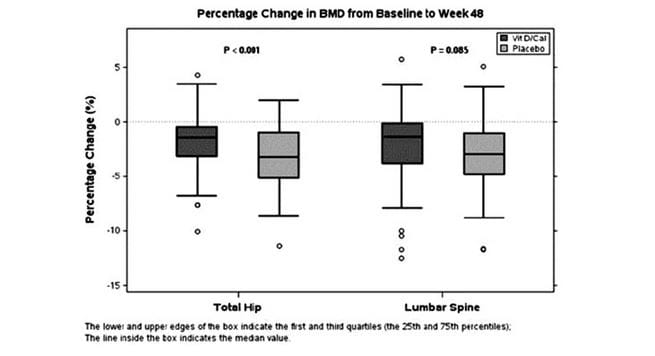
Subjects receiving vitamin D/calcium supplementation had less decline in total hip BMD (median: -1.46%; 161-3' quartile (01, 03): -3.16%,-0.40%) than placebo (-3.19%; -5.12%, -1.02%) (p=0.001). BMD loss at lumbar spine was similarly reduced with vitamin D/calcium supplementation (-1.41%; -3.78%, 0.00 %vs. -2.91; -4.84%, -1.06%) but failed to achieve statistical significance (p=0.085)
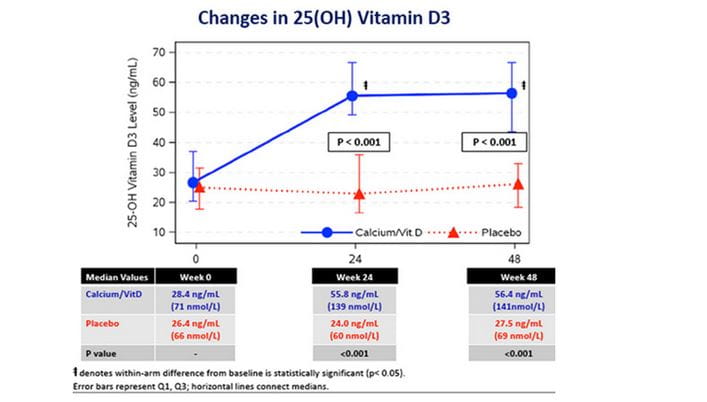
Vitamin D supplementation was associated with a significant increase in 25(OH) vitamin D3 levels at Weeks 24 and 48
- Vitamin D/calcium supplementation was well tolerated
- Due to toxicities, 3 patients discontinued
- 22% in the vitamin D arm and 23% in placebo arm reported grade 3 or 4 adverse events
The study concluded that vitamin D/calcium supplementation mitigated the loss of BMD seen with initiation of TDF/FTC/EFV, particularly at the total hip, which is the site of greatest concern for fragility fracture.
References: Edgar T. Overton et al. High- Dose Vitamin D and Calcium Attenuates Bone Loss with ART Initiation : Results from ACTG A5280. 21st Conference on Retroviruses and Opportunistic Infections (CROI). Boston, March 3-6, 2014. Abstract no 133