




Stenotrophomonas maltophilia

2 May, 11
Stenotrophomonas maltophilia
Facts
- Bacterium bookeri, now known as S. Maltophilia, was first isolated in 1943 and was subsequently classified as a member of the genus Pseudomonas in 1961 and then Xanthomonas in 1983, finally coming to rest in Stenotrophomonas in 1993.
- Although it was considered previously to have limited pathogenicity, reports indicate that infection with this organism is associated with significant morbidity and mortality particularly in severel compromised patients.
- The genus Stenotrophomonas currently consists of four species, only one of which, S. Maltophilia, is known to cause infection in human beings.
- The ability of S. Maltophilia to colonise airway epithelia and plastic surfaces of indwelling medical devices has led to its emergence as a major nosocomial pathogen especially in the ICU setting.
- Can form biofilms on its own or together with other species; once growing in biofilms it becomes more resistant to phagocytes and antibiotics.
- Occur in almost any aquatic or humid environment, including the drinking water supply.
- Occasionally been misidentified as Burkholderia cepacia.
Microbiological Background
- Motile, Non fermentative Gram negative bacilli.
- Cells are straight or slightly curved, non-sporulating and are 0.5 to 1.5 pm long.
- Oxidase-negative and widespread in the environment.
- Grows on most bacteriological media, typically producing pigmented (yellow or lavender - green) colonies.
- Generally considered to be non-beta hemolytic.
- A unique feature of S. Maltophilia that may aid in its identification is a positive reaction on deoxyribonuclease (DNase) test agar.
Environmental Sources of S. Maltophilia
- Epidemiological studies revealed considerable genomic diversity suggesting that multiple environmental sources could be an important mode of transmission rather than a single source.
- Ubiquitous in the environment with wide geographic distribution.
- Can readily be isolated from water, soil, plants, human and animal faeces, frozen fish, woodland ticks and raw milk.
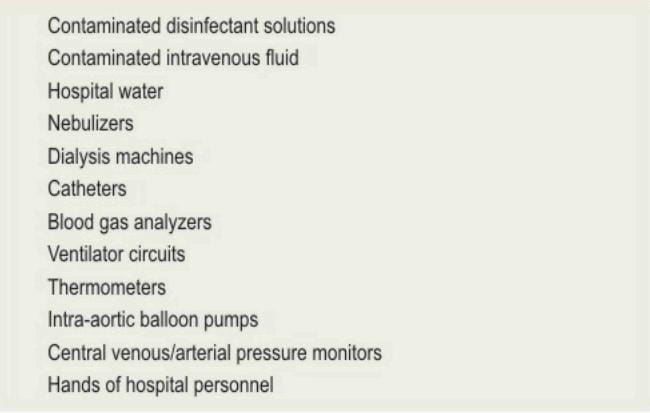
- Is common in the hospital setting, usually as a commensal, contaminant or part of the patient's endogenous flora.
Table I: Common nosocomial sources of S. Maltophilia
Pathogenicity
- Though little information is available currently, the most striking feature of the bacterium is its ability to produce large amount of extracellular enzymes.
- It produces proteases and lipases which is able to breakdown the protein component of collagen, fibronectin and fibrogen and thus may lead to local tissue damage and haemorrhage.
- Other potential virulence factors that have been identified in S. Maltophilia include elastase, mucinase. hyaluronidase, deoxyribonuclease, ribonuclease, and haemolysin.
- Positively charged surface and flagella promotes its ability to colonize the respiratory tract and plastic surfaces like catheters and endotracheal tubes, while fimbrial adhesions results in biofilm formation.
Predisposing Factors
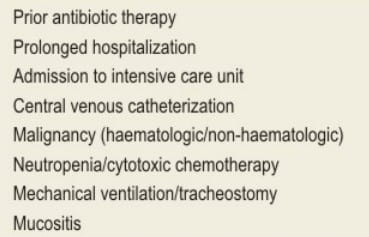
- Studies analyzing predisposing factors have elucidated several risk factors associated with S. Maltophilia infection and these are summarized in Table II.
- Underlying malignancy/transplantation and neutropenia, especially profound neutropenia are confirmed as the major predisposing factors.
Table II: Significant risk factors associated with S. Maltophilia infection
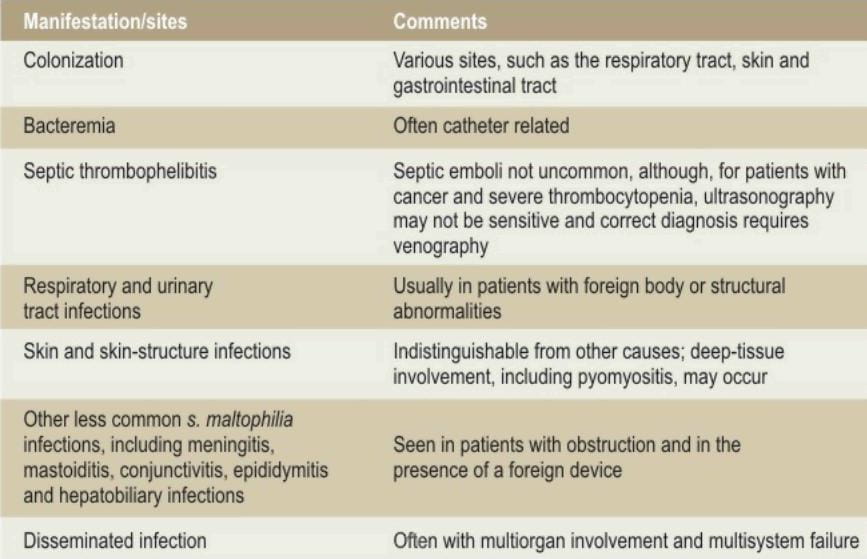
Clinical Syndromes Associated with S. Maltophilia Infection
- Associated with an expanding spectrum of clinical syndromes like:
- Endocarditis (mainly post-surgery in prosthetic valves or intravenous drug users)
- Intra-abdominal infections (peritonitis, cholangitis, liver abscess, periurethral, scrotal abscess)
- Ophthalmic syndromes (conjunctivitis, keratitis, dacrocystitis, pre-septal cellulitis)
- Septic arthritis
- Sinusitis (may mimic fungal infection)
Management
- Preferred: Trimethoprim-sulphamethaxazole (TMP/SMX) 15-20 (TMP component) mg/kg/d IV/PO in three divided doses.
- Alternatives:
- 3.1 gm IV q 4h or Ceftazidime 2gm IV q8h or Tigecycline 10Omg IV x 1, then 50mg IV q 12h.
- Fluoroquinolones: ciprofloxacin 500-750 mg PO/ 400mg IV q 12h, 400 mg PO/IV every day, levofloxacin 750mg PO/IV every day.
- Some experts recommend coverage with TMP/SMX plus ticarcillin/clavulanate due to concern for resistance.
- Multiply-resistant: Colistin 1-2 MIU tid in patients with normal renal function.
- Remove catheter in catheter-related bacteremia.
- Treatment duration uncertain, but usually > 14d.
Prevention
- S. Maltophilia is a ubiquitous environmental bacterium, hence appropriate and maintenance of the environment and hospital water supply play a greater part in prevention of S. Maltophilia transmission.
- Hand hygiene practices and wearing of gloves when handling contaminated respiratory secretions and wound drainage.
- Avoidance of inappropriate antibiotic use and of prolonged implantation of foreign devices.
Medico-legal Pitfalls
- Clinicians often make the mistake of treating S. Maltophilia colonization with antibiotics. Except when the pathogenic role of S. Maltophilia is clear (i.e. intravenous line sepsis secondary to contaminating infusions, colonization related to intravenous monitoring devices, urological instrumentation resulting in colonization), the mere presence of S. Maltophilia should not prompt treatment because it usually implies colonization rather than infection.
- The most common clinical pitfall with S. Maltophilia colonization is to treat it when the organism is recovered from urine. S. Maltophilia bacteriuria ordinarily should not be treated. In a patient with an indwelling Foley catheter, S. Maltophilia may be accompanied by pyuria, which represents colonization rather than infection unless recent antecedent urological instrumentation has been performed.
- The most common clinical error with S. Maltophilia colonization involves treating patients on respirators in ICUs because S. Maltophilia was recovered from their respiratory secretions.
- Because S. Maltophilia has not been reported to cause pneumonia except in rare cases involving cystic fibrosis or bronchiectasis, colonization should not be treated in patients who are ventilated, even if they have fever, pulmonary infiltrates, and leukocytosis.
- The needless and inappropriate treatment of S. Maltophilia with antibiotics may predispose patients to adverse drug effects, e.g. and drug fever or drug rash secondary to the sulfisoxazole component of TMP-SMX.
- The treatment of S. Maltophilia colonization may also predispose patients to fungal colonization or infection because of the selective pressures on the microbial milieu in the ICU.
References
1. Emedicine medscape.com; Stenofrophomonas maltophilia accessed on 05.09.2009
2. Clinical Infectious Diseases 2007; 45:1602-9
3. Johns Hopkins Stenofrophomonas maltophilia John G. Barttett. M.D. 26-03-2009
4. Journal of Hospital Infection 2004; 57 1-7
2. Clinical Infectious Diseases 2007; 45:1602-9
3. Johns Hopkins Stenofrophomonas maltophilia John G. Barttett. M.D. 26-03-2009
4. Journal of Hospital Infection 2004; 57 1-7
Related Topics
More From Area Of Interest
You may also like

12 Oct, 26

21 Sep, 26
21 Sep, 26

21 Sep, 26

13 May, 26

17 Apr, 26
Latest Items
12 Oct, 26

12 Oct, 26
Journal Scans
8 Oct, 26
8 Oct, 26


