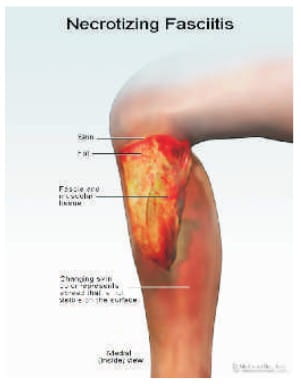
A dangerous infection of soft-tissue that starts in the subcutaneous tissue and spreads along the flat layers of fibrous tissue that separate different layers of tissue (fascial planes). It most commonly occurs in the arms, legs and abdominal wall. The death rate is up to 40%.
Necrotizing fasciitis can be monomicrobial or polymicrobial. Monomicrobial infections account for 10% and polymicrobial for 90% of cases of necrotizing fasciitis.
Symptoms include erythema, edema and tenderness. The degree of pain typically is greater than the severity of these findings and the person appears terribly ill. The original skin wound is often evident. Skin changes may include bullous lesions (blisters) and local skin anesthesia (due to blocking of little vessels in the skin). A crinkly or crackling feeling called crepitus indicates gas in the tissues but occurs in only about half of cases.
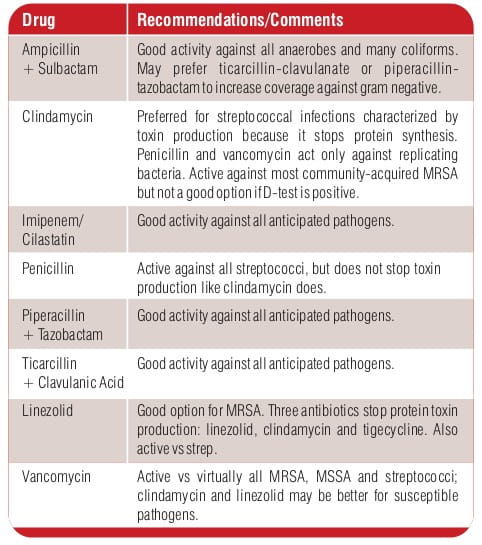
Emergency diagnosis and treatment are essential. Broad-spectrum antibiotic treatment and prompt surgical removal of dead and infected tissue decreases the death rate.
- Infection extending along fascial plane-usually an extremity, perianal area. genitals (Fournier's).
Severe pain, severe systemic toxicity, process with rapid spread, fever, skin necrosis with bullae, tense edema &/or black-blue discoloration.
- Some patients havepreceding injury orsurgery; some do not.
- ?Cellulitis: treated with antibiotics and NO surgery (big difference).
- Gas gangrene,
- Vibrio vulnificus,
- Soft tissue infection
- Myositis
- Pus with anaerobic infection is "dishwater gray," has a characteristic putrid smell & gram stain/culture of pus shows mixed flora.
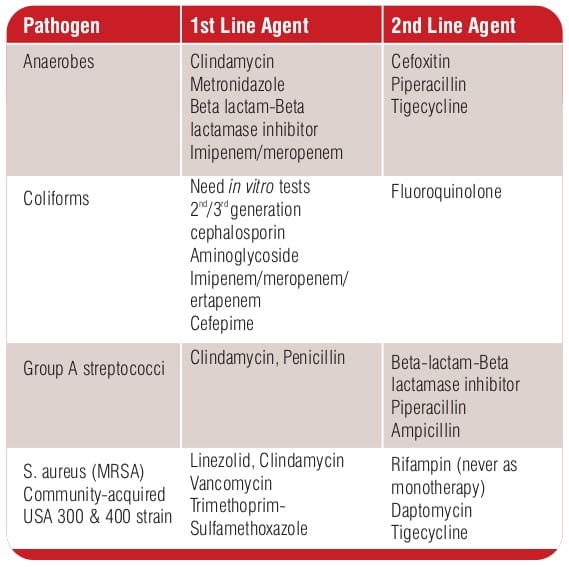
- Group A streptococci, mixed anaerobes + coliforms, or MRSA. Distinguish by GS & culture of exudate, bullae, aspirate or blood.
- Mixed anaerobic infections are most common form--also requires rapid surgery.
- Host specific etiologies
Lab: CT scan or MRI showing fascial plane infection. Some patients should not be delayed by imaging studies, but rather have rapid surgical consultation and proceed to operating room.
Causes for Alarm with Soft Tissue Infection
- Severe pain
- Systemic toxicity
- Bullae
- Cutaneous necrosis
- Gas in tissue
- Tense edema
Rapid extension with necrosis & toxic shock syndrome.