

Mind Matters (Issue 2) - Relationship between Depression and Cosmetic Problems: Role of Escitalopram

Impact of Physical Appearance on Psychology
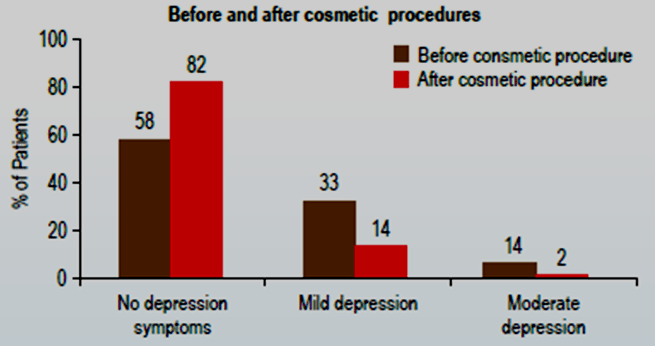
The 21st century being the age that values aesthetic beauty; an increasing number of patients are undergoing different cosmetic procedures to improve or eliminate aesthetic defects due to disease, aging or dissatisfaction with appearance. Physical appearance or its self-perception directly influence a sense of wellbeing, sense of disease, and may cause psychological problems such as depression and personality disorders. There are also patients who may have personality disorders or psychological problems that influence their self-image. A study in individuals with aesthetic defects demonstrated an increase in the percentage of patients with no depressive symptoms increased from 58 % to 82 % after the cosmetic procedures (Figure 1).1
Relationship between Depression and Dermatological Problems
The most common mood disorders encountered in dermatology patients include major depression and dysthymic disorder.2 Psychosocial impairment and psychiatric disturbance is reported in at least 30% of patients having dermatologic disorders such as acne, pruritus, urticaria, alopecia, and herpes simplex.2,3 The cause of depression in dermatology is often multifactorial; involving psychosocial stressors, age of patients at onset of skin disease, body areas involved, physical discomfort such as pruritus, pain, or burning sensation and severity of these conditions. Depression also functions as a biologic and psychosocial stressor that can worsen skin disease. Moreover, the physical symptoms and demands of living with skin disease along with psychosocial effects of discrimination, rejection, and stigmatization can aggravate depression. Psychodermatologic disorders are separated into two major groups:
- Cutaneous association of psychiatric disorders (neurotic excoriations, acne excorie, skin manipulation associated with delusions of parasitosis, and excessive concerns about cutaneous body image or odors).
- Dermatologic disorders exacerbated by psychosocial stress and are comorbid with depression; such as psoriasis, rosacea, atopic dermatitis (AD), chronic idiopathic urticaria, alopecia areata (AA), and acne.2
Depression in dermatology is associated with multifactorial cause such as psychosocial stressors, age on onset of skin disease, body areas involved, physical discomfort and severity of skin disease.2
Significant Depression and Suicidal Ideation in Patients with Cosmetically Disfiguring Dermatological Disorders
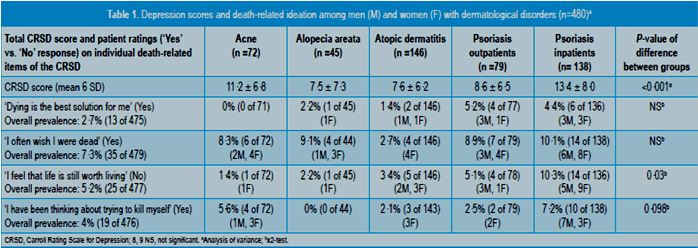
Researchers evaluated the prevalence of depression and acute suicidal ideation among 480 patients with cosmetically disfiguring dermatological disorders such as non-cystic facial acne (n=72), alopecia areata (n=45), atopic dermatitis (n=146) and psoriasis (79 outpatients, 2.5% suicidal ideation and 138 inpatients, 7.2% suicidal ideation). It was observed that inpatients severely affected with psoriasis (mean±SD total body surface area affected: 52±23.4%) had the highest (p<0.05) Carroll Rating Scale for Depression (CRSD) score, followed by the patients with mild to moderate acne; both being in the range for clinical depression (CRSD score>10). Psoriasis and acne patients had higher prevalence of active suicidal ideation (5.6-7.2%) compared with the general medical patients (2.4-3.3%). Table 1 summarizes the depression scores and the frequency of a death wish and suicidal ideation among the five subgroups of dermatology patients. It is therefore important to recognize psychiatric comorbidity, especially depression, among dermatology patients.4
Negative Effect of Acne on QOL Increases the Risk Of Depression and Anxiety
Yazici et al evaluated the relationship between acne severity, anxiety, depression and disease-specific quality of life in patients with acne. Findings revealed:
- Patients with acne had significantly higher mean Hospital Anxiety and Depression Scale - Anxiety (HAD-A) and HAD depression subscale (HAD-D) scores compared with healthy controls.
- The rates of subjects at risk for anxiety (26.2%) and for depression (29.5%) were significantly higher in the patient group than in the control group (0% and 7.9%, respectively; p=0.001 for anxiety and p=0.011 for depression; Figure 2).
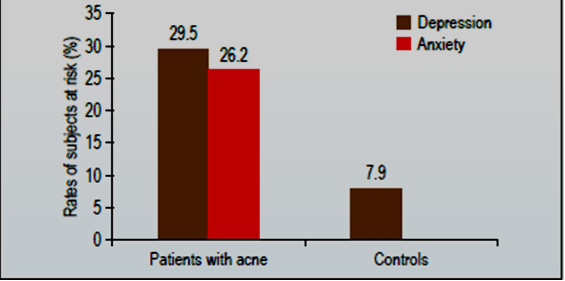
Thus, patients with acne are at an increased risk for developing anxiety and depression compared to the normal population. Acne has also shown to negatively affect the patients’ quality of life which ultimately has a greater impact on the level of anxiety and depression.5
Acne has a negative impact on the patients’ quality of life which ultimately increases the risk for anxiety and depression.5
Presence of Significant Depression in Patients with Pruritus and Chronic Idiopathic Urticaria6
Patients with chronic idiopathic urticaria and idiopathic generalized pruritus were investigated to determine the incidence of significant symptoms of depression and anxiety. Standardized self-assessment psychological questionnaires were used for assessment. Findings revealed:
- As per the Beck depression inventory, significantly more patients with generalized pruritus (32.4%) were observed to have depressive symptomatology (score >14) than general dermatology out-patients (controls; 13.2%, p?0.05; Figure 3).
- More patients with chronic urticaria had depressive symptomatology (14.7%) than controls (4.4%; Figure 3).
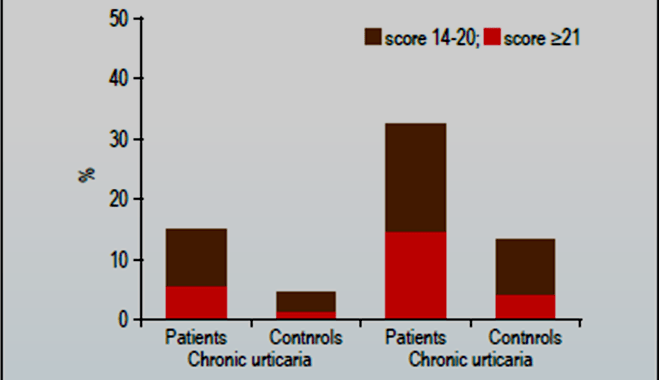
Evidence suggests that more patients with generalized pruritus demonstrate symptoms of depression than those without urticaria.6
Management of Psychodermatologic Disorders
The management of psychodermatologic disorders involves evaluating the skin manifestation and various other issues (social, familial and occupational) underlying the problem. After diagnosis of the skin disorder, a dual approach may be necessary for managing it; addressing both dermatologic and psychologic aspects. Self-induced skin problems also require supportive dermatological care so that secondary issues such as infections can be avoided.7 Appropriate interventions and identification of depression is necessary for effective management of skin conditions.2
Significant Effect of SSRIS in Patients with Depression and Cosmetic Problems
Selective Serotonin Reuptake Inhibitors (SSRIs) have shown to be effective in treating comorbid depression and/or anxiety in patients with chronic pruritis.8 SSRIs demonstrated antipruritic effects in patients with chronic generalized pruritus with psychiatric comorbidity by contributing to the interruption of scratching and the healing of chronic scratch lesions. Researchers observed healing or improvement of scratch lesions upon cessation of pruritus under SSRI treatment. Of the patients with psychiatric comorbidity influencing pruritis, around 71.4% demonstrated treatment benefit compared with 64.9% of patients without psychiatric comorbidity.9
Escitalopram is Effective than other SSRIS in Treatment of Depression
Escitalopram the active S-enantiomer of racemic citalopram prevents relapse and recurrence of Major Depressive Disorder (MDD). Escitalopram demonstrates a highly selective and potent, dose-dependent inhibition of the serotonin transporter, inhibiting serotonin reuptake into presynaptic nerve terminals and thus increasing serotonergic activity in the CNS.10
In a meta-analysis, escitalopram was compared with active controls, including other SSRIs (citalopram, fluoxetine, paroxetine, sertraline) and serotonin/noradrenaline reuptake inhibitors [SNRIs] (venlafaxine, duloxetine) in patients with major depressive disorder (MDD). Findings revealed:
- Escitalopram was significantly more effective than comparators in overall treatment effect and in responder (63.7 vs. 58.3%, p<0.0001) and remitter (53.1 vs. 49.4%, p<0.0059) analyses. Escitalopram had an estimated mean treatment difference of 1.1 points on the MADRS (p<0.0001) than comparators.
- Escitalopram was significantly superior to other SSRIs, with an estimated difference in response of 62.1 vs. 58.4% and remission of 51.6 vs. 49.0%.
- In comparison to SNRIs, the estimated difference in response was 68.3 vs. 59.0% (p=0.0007) and for remission the difference was 57.8 vs. 50.5% (p=0.0088).
- The withdrawal rate at 8-week due to adverse events was 5.4% for escitalopram and 7.9% for the comparators (p < 0.01).
Therefore, escitalopram demonstrated superior efficacy and tolerability compared to SSRIs and SNRIs in the treatment of MDD.11
SSRIs interrupt the scratching and healing of chronic scratch lesions in patients with chronic generalized pruritus and psychiatric comorbidity.9
Efficacy of Escitalopram in Treating Depression in Patients with Cosmetic Problems
Escitalopram 10 mg daily was found to be effective in a patient with delayed pressure urticaria and depression. Escitalopram could be used as an alternate treatment option in patients with urticaria and depression, since it is associated with significantly less disturbing adverse effects and cardio toxicity than the tricyclic antidepressants.12
Escitalopram showed superior efficacy and tolerability in the treatment of MDD compared with other SSRIs and SNRIs. A higher response rate and remission rate is achieved in patients treated with escitalopram than with other SSRIs or SNRIs.11
Summary
- Depression and personality disorders may occur as a result of physical appearance which has a direct effect on the sense of wellbeing. Dermatologic disorders such as acne, pruritus, urticaria, alopecia, and herpes simplex are shown to be responsible for causing psychosocial impairment and psychiatric disturbance. Additionally, depression can worsen skin disease by increasing the biologic and psychosocial stress.
- Patients with disfiguring dermatological disorders such as psoriasis, acne, alopecia areata, and atopic dermatitis are shown to have high depression scores and higher prevalence of active suicidal ideation compared to patients with general medical conditions.
- Acne has shown to increase the risk for depression and has shown to negatively affect the patients’ quality of life. Patients with urticaria also demonstrate symptoms of depression compared with those without urticaria.
- It is therefore necessary to identify depression for effective management of skin conditions.
- SSRIs interrupt the scratching and help in the healing of chronic scratch lesions in patients with chronic pruritus and comorbid depression.
- Escitalopram has proven superior efficacy and tolerability compared to other SSRIs and SNRIs in the treatment of MDD. Hence, in patients with cosmetic problems and depression, escitalopram could be a beneficial option.
Escitalopram could be a preferred alternative in patients with urticaria and depression due to its less disturbing adverse effects and cardio toxicity compared with the tricyclic antidepressants.12
References
- Magdziarz-Orlitz J, Gerlicz-Kowalczuk ZA, Dziankowska-Bartkowiak B et al. Self-reported depression and sense of disease in cosmetic patients. Postep Derm Alergol. 2012; XXIX (4): 267–74.
- Fried RG, Gupta MA, Gupta AK. Depression and skin disease. Dermatol Clin. 2005; 23(4):657-64.
- Shenefelt PD. Management of psychodermatologic disorders. Medscape. Available on: http://www.medscape.com/viewarticle/730033_5 Assessed on: 19th Sep 2016
- Gupta MA, Gupta AK. Depression and suicidal ideation in dermatology patients with acne, alopecia areata, atopic dermatitis and psoriasis. Br J Dermatol. 1998; 139(5):846-50.
- Yazici K, Baz K, Yazici AE et al. Disease-specific quality of life is associated with anxiety and depression in patients with acne. J Eur Acad Dermatol Venereol. 2004; 18(4):435-9.
- Sheehan-Dare RA, Henderson MJ, Cotterill JA. Anxiety and depression in patients with chronic urticaria and generalized pruritus. Br J Dermatol. 1990; 123(6):769-74.
- Koo J, Lebwohl A. Psychodermatology: The Mind and Skin Connection. Am Fam Physician. 2001; 64(11):1873-9.
- Tey HL, Wallengren J, Yosipovitch G. Psychosomatic factors in pruritus. Clin Dermatol. 2013; 31(1):31-40.
- St?nder S, B?ckenholt B, Sch?rmeyer-Horst F, et al. Treatment of chronic pruritus with the selective serotonin re-uptake inhibitors paroxetine and fluvoxamine: results of an open-labelled, two-arm proof-of-concept study. Acta Derm Venereol. 2009; 89(1):45-51.
- Garnock-Jones KP, McCormack PL. Escitalopram: A review of its use in the management of major depressive disorder in adults. CNS Drugs. 2010; 24(9):769–96.
- Kennedy SH, Andersen HF, Thase ME. Escitalopram in the treatment of major depressive disorder: a meta-analysis. Curr Med Res Opin. 2009; 25(1):161-75.
- Eskeland S, Tanum L, Halvorsen JA. Delayed pressure urticaria treated with the selective serotonin reuptake inhibitor escitalopram. Clin Exp Dermatol. 2016; 41(5):526-8.