Migraine Times
Migraine is a syndrome characterised by a paroxysmal, mostly unilateral headache as the leading symptom, varying
considerably in intensity, frequency and duration. This headache is usually accompanied by autonomic nervous
symptoms such as nausea, emesis, tachycardia, hypersensitivity to light and noise and occasionally by a
transitory breakdown of neurologic functions.
The main forms are common migraine, classical migraine and complicated migraine. In the new classification by the
International Headache Society, the terms migraine without aura, migraine with aura, and migraine with prolonged
aura were introduced. Because the former terms still appear in many of the publications under review, they will
also be used in this article. Migraine is a common disease with an estimated incidence of 2-10%. The onset of
attacks may date back to early childhood reaching a peak in the third and fourth decades of life. The
etiopathology of migraine has not been fully clarified and a causal therapy has therefore not been established.
Although various symptoms associated with migraine respond to drug therapy, one should differentiate between the
interruption of attacks and the prevention of migraine (i.e., treatment also during attack-free intervals).
The association between migraine and several psychiatric disorders has been well demonstrated; the most important
comorbidity appears to be with mood, anxiety and panic disorders. The migraineurs have a five-fold higher risk
of depression, and longitudinal studies have shown that the relationship is bidirectional in patients with
depression having a three-fold higher risk of migraine. This bidirectionality suggests that migraine and
depression share a common neurobiology. Moreover, compared to individuals without migraine, migraineurs are at
4-5 times greater risk for generalised anxiety disorder (GAD), at five times greater risk for obsessive
compulsive disorder (OCD), and run 3-5 times higher risk of suffering from panic disorder. An increased risk is
demonstrated for suicide ideation too, especially in migraine with aura.
The onset of anxiety often precedes migraine, while the risk of depression usually increases later. From a
clinical point of view, the coexistence of a psychiatric disorder has many practical implications: it alters the
quality of life, the total disability, the course of migraine and the final prognosis. A subgroup of migraine
sufferers evolves from a stage of episodic migraine into a stage in which the pain is present almost daily
(chronic migraine). Several factors have been associated with migraine clinical progression: depression and
stressful life events are independent risk factors for progression and may affect other negative variables such
as obesity and medications overuse. The relationship between obesity and migraine frequency is modified by
depression and anxiety and the strongest effect on migraine frequency is observed in migraineurs with both
depression and anxiety. A complex relationship exists with sleep disorders that may result from or may cause
headache. Depression and anxiety cause disturbed sleep and sleep deprivation or excessive sleep may increase the
frequency of migraine attacks. There are many clinical evidences that depression plays a role in the processing
and perception of pain, and that depressed patients are more vulnerable to painful physical symptoms. Cutaneous
allodynia is the perception of pain or discomfort in response to non-noxious thermal and mechanical stimuli
applied to normal skin; it is a clinical marker of central sensitisation and is more common in frequent and
chronic migraine. Some studies report the association between cutaneous allodynia and both anxiety and
depression, which probably support the central sensitisation. Furthermore, migraine and depression are
associated to other comorbid pain conditions (irritable bowel syndrome, chronic fatigue syndrome and
fibromyalgia) that share the common mechanism of central sensitisation and have common clinical correlates such
as allodynia and hyperalgesia. The first clinical implication of the previous considerations is that all
patients presenting with frequent episodic and chronic migraine should be screened for depression and anxiety.
It has been seen that psychiatric comorbidity contributes to poor prognosis and poor quality of life, but the
effect of treatments both for migraine prevention and for mood and anxiety disorders on final outcomes was not
examined.
Researchers prospectively examined how psychiatric disorders relate to treatment outcome in a group of patients
with primary headaches. They confirmed that psychiatric comorbidity is very frequent (two-thirds of their
patients were diagnosed with one or more psychiatric disorders), and that the presence of a comorbid depressive
disorder is associated with more frequent and disabling headaches, and also found that patients with psychiatric
disorder improve equally as well as patients with no psychiatric disorder. In this study, patients received the
“best” state-of-the-science treatment and, of course, those with a mood disorder were more likely to
be prescribed antidepressant therapies. The conclusion may be that a migraine patient with psychiatric
comorbidity is a difficult one; often he begins treatment with more headache days, more disability, and poorer
quality of life, but has good expectations of improvement, if psychiatric comorbidity is treated. Moreover,
treating anxiety and depression means to prevent central sensitisation and the evolution to chronic migraine.
Specific therapeutic guidelines for depression and anxiety in migraine are lacking. First of all, choosing a drug
for migraine prevention that may worsen the psychiatric comorbid disorder, has to be avoided. This is true for
flunarizine and beta-blockers in depression. When it is possible, treatment of both conditions would be
accomplished with a single agent.
Between the drugs with known effect on migraine prevention, beta-blockers and flunarizine may help if anxiety is
present; amitriptyline is indicated in mood disorders, but the dose required for treating migraine may be
insufficient to treat the affective disorder, and larger dose may cause collateral effects. In specific cases,
some drugs may play a role in both migraine and psychiatric comorbidity. Pregabalin is indicated in anxiety
disorders and has recently been approved in the United States for the treatment of fibromyalgia that, as it is
seen, is one of the chronic pain conditions associated with migraine and depression. Furthermore, it might be a
useful alternative prophylaxis for chronic migraine.
Divalproex sodium (VPA), topiramate and lamotrigine have demonstrated efficacy in bipolar depression. The
efficacy of VPA and topiramate in migraine prevention has been shown in several double blind, randomised,
placebo-controlled trials and some studies suggest that lamotrigine constitutes a specific prophylactic
treatment of migraine with aura. The migraineurs can sometimes derive benefit from some less traditional
approaches, such as riboflavin or coenzyme Q10, which have marginal evidence in depression in specific cases.
When a single agent has insufficient effect or is not tolerated, two different drugs must be used, one for
migraine prevention and one for the psychiatric disorder. The American College of Physicians recommends the
second-generation antidepressants as the treatment of choice for acute episodes of major depression without
striking differences between selective serotonin reuptake inhibitors (SSRIs), serotonin norepinephrine reuptake
inhibitors (SNRIs) and selective serotonin norepinephrine reuptake inhibitors (SSNRIs).
- Treatment must be modified if the patient does not have an adequate response to pharmacotherapy within 6-8
weeks and must be continued for 4-9 months after a satisfactory response. For GAD, OCD and panic disorder,
the interventions that have evidence for the longest duration of effects are pharmacological therapy and
psychological therapy (cognitive behavioural therapy).
- First-line pharmacological treatments are SSRIs,SNRIs and the calcium channel modulator, pregabalin.
Tricyclic antidepressants (TCAs) are equally effective for some disorders, but many are less well tolerated
than the SSRIs/SNRIs.
- In treatment resistant cases, benzodiazepines may be used when the patient does not have a history of
substance abuse disorders. The increase of synaptic serotonin, a common effect, both of SSRIs/SNRIs and
amitriptyline, seems to be critical for efficacy on depression but not for migraine prevention activity. In
fact, SSRIs/SNRIs have poor evidence of efficacy in preventive treatment of migraine, and in most cases, a
second drug must be added. However, some studies indicate a possible clinical benefit in migraine prevention
of sertraline, fluoxetine and venlafaxine. Interestingly, the efficacy becomes evident only from the third
month of treatment or later.
- The FDA recommends that patients treated concomitantly with a triptan and a SSRI/SNRI be informed of the
rare possibility of serotonin syndrome. Chronic migraine can in some cases evolve in drug refractory chronic
daily headache, a highly disabling condition characterised by high prevalence of psychiatric disorders and
by a resistance to all known treatments.
- Vagal nerve stimulation (VNS) is an established treatment option for selected patients with medical
refractory epilepsy and depression. Small case series support a beneficial effect of chronic VNS in patients
with both drug refractory chronic migraine and depression, offering a chance in an otherwise intractable
condition.
In a parallel, double-blind comparison study of flunarizine, a significant reduction in the frequency of attacks
as compared with placebo was recorded. In the third month of treatment, more than 80% of the patients receiving
flunarizine had no attacks. Based on these encouraging results, more double-blind trials against placebo were
carried out. Six published studies with an adequate number of patients are now available. All of these studies
were carried out in patients with simple or classical migraine according to the definition of the Ad Hoc
Committee. The common criteria for patients in these studies was a throbbing or pulsating pain in severe attacks
requiring therapy, and at least three attacks per month occurring within the last 3 months before the start of
the study. In all studies, a consistently significant reduction of the frequency of attacks or the headache
index was demonstrated. Therefore, the efficacy of flunarizine in migraine prophylaxis must be considered as
well as established. In view of the enormous body of data documenting the efficacy of flunarizine and comparing
this substance with other migraine prophylactics, more specific approaches will be of particular importance in
the future. Because the benefit/risk ratio of flunarizine is comparable to that of propranolol and metoprolol,
it would be useful to the practicing physician to know which type of migraine patient reacts particularly well
to a given substance.
Neurol Sci. 2010;31
Suppl 1:S95-8
A migraine is a common type of headache that may occur with symptoms such as nausea, vomiting or sensitivity to
light. In many people, a throbbing pain is felt only on one side of the head. Triptans have demonstrated
superior efficacy in acute migraine attacks compared with other substance classes and these drugs are currently
widely used for pain relief. Seven different triptans almotriptan, eletriptan, frovatriptan, naratriptan,
rizatriptan and sumatriptan are marketed for the treatment of acute migraine. As only a few head-to-head studies
have compared the efficacy of rizatriptan with other triptans, the comparison of the efficacy and tolerability
of the different triptans cannot be based on comparative studies alone. Therefore, the present report is focused
on the comparison between oral sumatriptan 100 mg and oral rizatriptan 10 mg.
Time to onset of action
Owing to the quick absorption of rizatriptan, a more rapid pain relief with rizatriptan treatment compared with
sumatriptan treatment seems to be probable.
Head-to-head comparison: sumatriptan 100 mg versus rizatriptan 5-10 mg
A large randomised, double-blind, placebo-controlled, triple-dummy study comparing oral treatments with
rizatriptan 5 mg, rizatriptan 10 mg, sumatriptan 100 mg and placebo in 1268 patients with migraine was designed
to assess the time to onset of action and the efficacy versus placebo. In each patient, treatment of one acute
migraine attack was documented.
Response rates
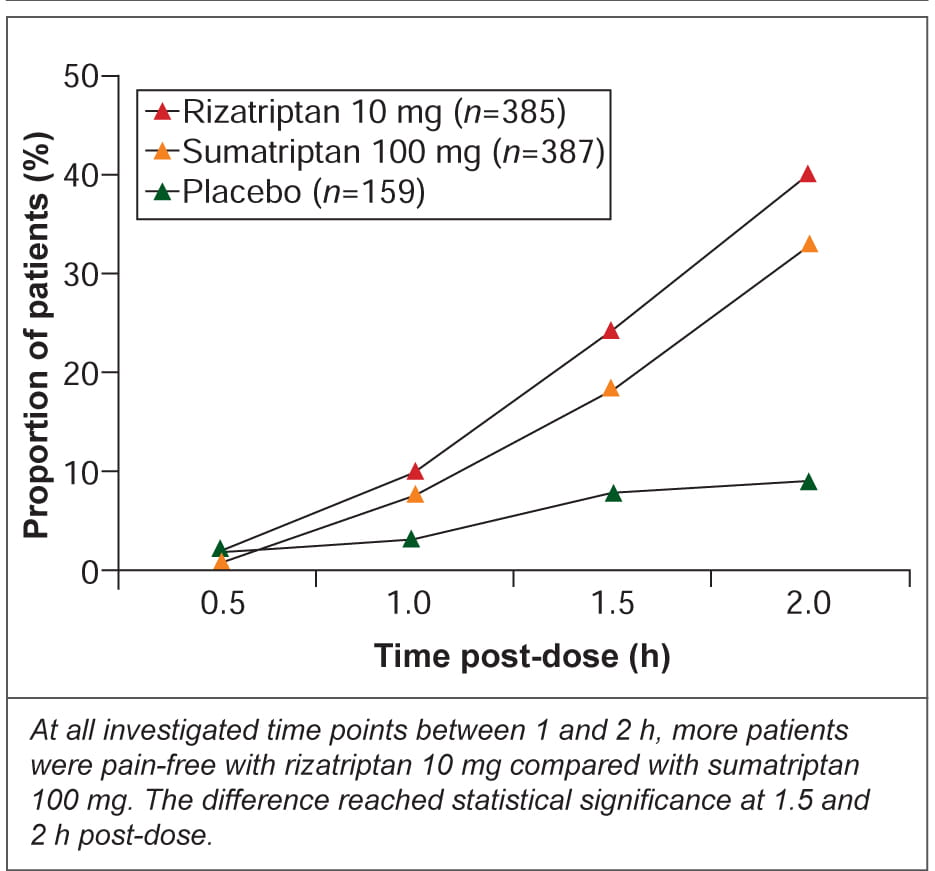
The response rates (pain relief rates) were numerically greater with rizatriptan 10
mg than with sumatriptan 100 mg at each time point upto 2 h post-dose. Statistical significance was achieved 1 h
after drug application. At 1.5 and 2 h post-dose, statistically significantly more rizatriptan 10-mg patients
were pain-free compared with sumatriptan 100-mg patients (1.5 h: 24 vs. 18%, p?0.05; 2 h: 40 vs. 33%, p=0.032;
Figure 1).
Figure 1: Proportion of pain-free patients upto 2 h post-dose
Time to pain relief
As patients receiving sumatriptan were significantly older, an age-adjusted
analysis was conducted to correct this imbalance in the total population. The adjusted analyses showed a faster
pain relief with rizatriptan 10 mg compared with sumatriptan 100 mg (hazard ratio: 1.21; p=0.032).
Safety & tolerability
Drug-related adverse events occurred less frequently with rizatriptan 10
mg compared with sumatriptan 100 mg (33 vs. 41%; p=0.014). Serious adverse events were not observed.
Naturalistic Studies
In an open-label, 'naturalistic' multicentre study, two migraine attacks were treated crossover, either
with rizatriptan 10 mg or the oral triptan which the patients were used to. In total, 673 patients were included
and outcomes were recorded using a diary and a stop watch. Significantly, more patients achieved pain relief or
pain freedom when taking rizatriptan 10 mg compared with treatments with other triptans 2 h after dosing (pain
relief: 88.1 vs. 81.9%; p=0.0003; pain freedom: 60.9 vs. 49.9%; p<0.0001).
Patient's preference
Patient's preference for rizatriptan 10 mg or sumatriptan 50 mg was investigated by two rando- mised,
open-label, multicentre studies. Almost twice as many patients preferred rizatriptan 10 mg to sumatriptan 50 mg
(64.3 vs. 35.7%; p≤0.001). Most patients preferred rizatriptan owing to the faster pain relief.
Consistency of Efficacy
A meta-analysis of 53 randomised, double-blind trials (12 unpublished) investigating triptan treatment in acute
migraine attacks was performed to deliver further evidence supporting therapeutic decisions in clinical
practice.
Endpoints
In most studies included in this analysis, the headache response rate at 2 h post-dose was the primary endpoint.
A second endpoint used in several more recently performed studies is the proportion of patients becoming
pain-free at 2 h post-dose.
Efficacy
Mean absolute sumatriptan 100-mg response rate at 2 h was 59% (improvement from moderate or severe to mild or no
pain); the placebo-subtracted response rate was 29%. Rizatriptan 10 mg and eletriptan 80 mg showed significantly
higher absolute response rates, but placebo subtracted response rate differed only numerically between
rizatriptan 10 mg and sumatriptan 100 mg without reaching statistical significance.
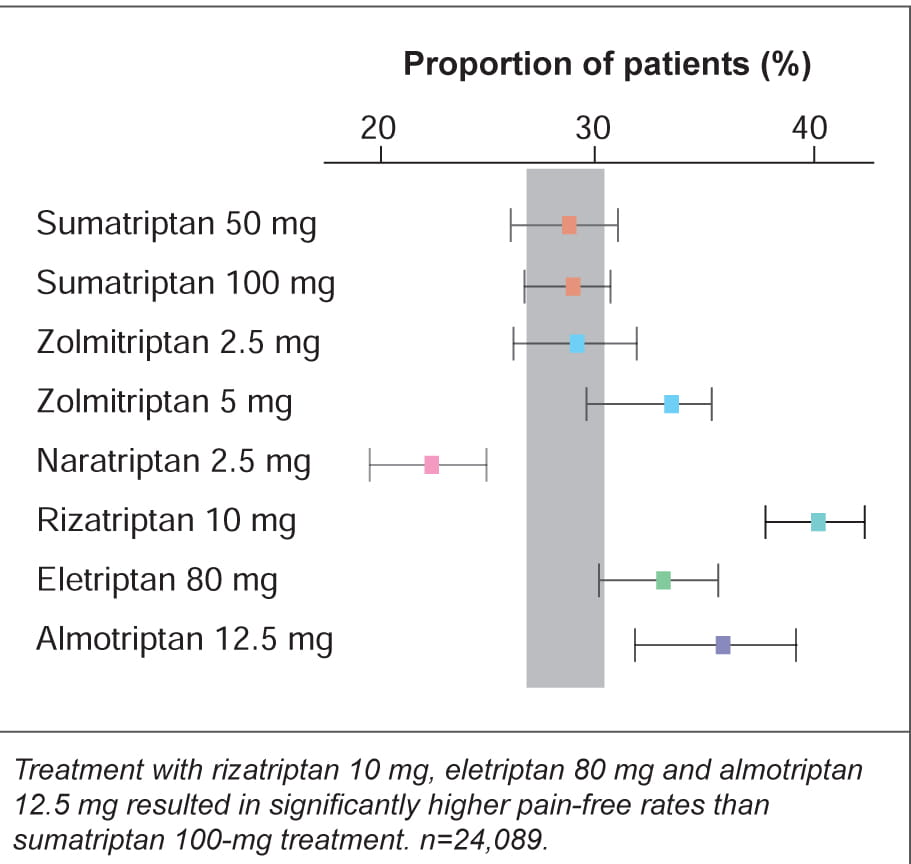
A total of 29% of sumatriptan 100-mg patients were pain-free at 2 h. Higher pain-free rates than sumatriptan were
observed with rizatriptan 10 mg, eletriptan 80 mg and almotriptan 12.5 mg. The placebo-subtracted pain free
rates were significantly higher with rizatriptan 10 mg and eletriptan 80 mg compared with sumatriptan 100 mg
(19%). Treatment with rizatriptan 10 mg, eletriptan 80 mg and almotriptan 12.5 mg also resulted in significantly
higher sustained pain-free rates than sumatriptan 100 mg (20%). Details are presented in Figure 2.
A retrospective subgroup analysis including the data from five randomised placebo-controlled double-blind trials
demonstrated that more rizatriptan patients were able to function normally (grade 4 on the scale of functional
disability) at 2 h after receiving rizatriptan 10-mg medication compared with sumatriptan 100 mg (39 vs. 32%),
sumatriptan 50 mg (47 vs. 42%), sumatriptan 25 mg (48 vs. 36%), naratriptan 2.5 mg (39 vs. 22%) and zolmitriptan
2.5 mg (45 vs. 36%).
Figure 2: Pain-free rates at 2 h after application of different oral triptans
Based on the data of the meta-analysis of randomised placebo-controlled trials reported by Belsey, the relative
cost-effectiveness of different oral triptan therapies in the management of acute migraine attacks was
calculated using cost data from six different countries. Cost-effectiveness ratios were derived from the NNT for
each triptan and dose was analysed based on the mean drug acquisition costs in the six countries.
Pain-freedom after 2 h was achieved most efficiently with rizatriptan 10 mg. Rizatriptan 10-mg treatment resulted
in the lowest mean drug cost per pain-free patient at 2 h in all six analysed countries, followed by eletriptan
40 mg.
The researches concluded that the differences in triptan efficacy have potential economic implications. Despite
the differences in the international pricing structures, this analysis demonstrated that rizatriptan 10 mg and
eletriptan 40 mg are the most cost-effective oral triptans together with a considerable degree of consistency in
the hierarchy of cost-effectiveness in the six investigated countries.
An open pharmacy-based study investigated migraine treatment in 231 patients (589 documented migraine attacks)
based on patient diaries. The primary objective was the triptan consumption per migraine attack (upto 24 h after
the first triptan dose). A total of 149 attacks were treated with rizatriptan 10 mg, 149 with zolmitriptan 2.5
mg, 135 with sumatriptan 50 mg and 90 with naratriptan 2.5 mg. Rizatriptan 10 mg was given more frequently in
severe attacks than sumatriptan 50 mg or zolmitriptan (43 vs. 37 and 33%, respectively).The tablet consumption
per attack (24 h) was lower with rizatriptan 10 mg (1.24±0.56 tablets) compared with sumatriptan 50 mg
(1.75±1.2 tablets; p≤0.05), zolmitriptan 5 mg (1.61±0.86 tablets; p≤0.05) and naratriptan
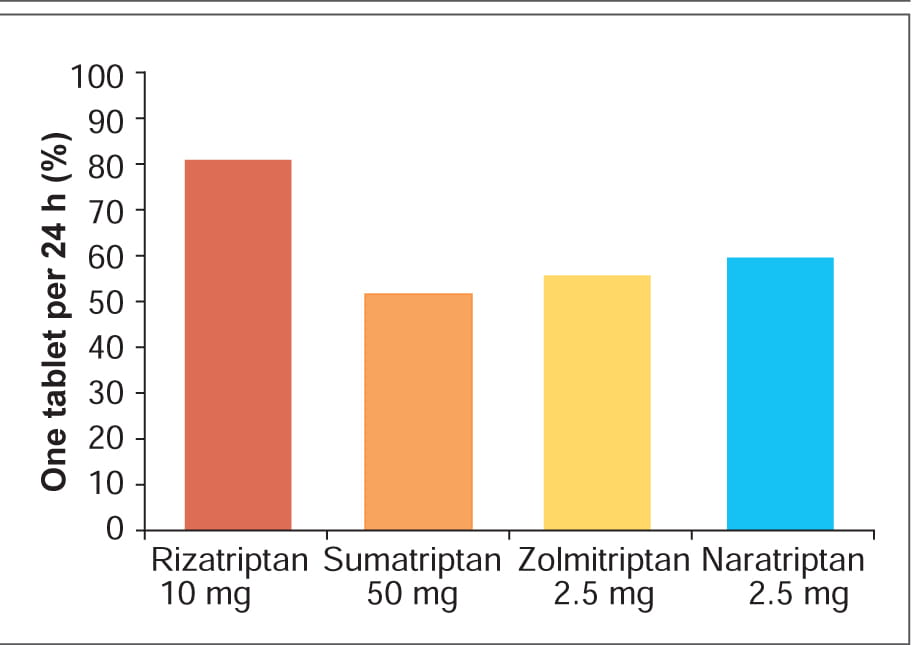
2.5 mg (1.46±0.62 tablets; p=0.05). 81.2% of rizatriptan 10-mg patients needed only one tablet per 24 h
compared with 51.9% of sumatriptan 50-mg patients, 55.7% of zolmitriptan patients and 60% of naratriptan
patients (Figure 3).
Figure 3: Percentage of patients using only one triptan tablet within 24 h after an acute migraine attack
Patients receiving sumatriptan or zolmitriptan had a more than three-times greater probability of using more than
one tablet per attack (sumatriptan: odds ratio: 3.71; p=0.001; zolmitriptan: odds ratio: 3.32; p=0.001) than
rizatriptan 10-mg patients. In patients treated with naratriptan, this probability was more than two-times
greater (odds ratio: 2.66; p=0.004).
Head-to-head comparisons and large meta-analyses of clinical studies delivered strong evidence for a superior
efficacy of rizatriptan 10 mg compared with sumatriptan 50 mg and 100 mg in acute migraine attacks. With
rizatriptan 10 mg, patients achieve pain relief more rapidly and a higher percentage become pain-free at 2 h.
The greater efficacy of rizatriptan 10 mg also results in lower tablet consumption during the first 24 h after a
migraine attack compared with sumatriptan. The vast majority of rizatriptan patients need only one tablet per
attack.
One reason for the insufficient treatment of German patients suffering from migraine might be cost restrictions.
In Germany, physicians have to comply with many prescription guidelines imposed by the Regional Associations of
Statutory Health Insurance Physicians and are financially liable in the case of exceeding prescription limits.
After generic sumatriptan became available in 2006, the percentage of German patients treated with triptans is
likely to have increased. However, sumatriptan response rates are relatively low and treatment failures occur
frequently. Nevertheless, the German Regional Associations of Statutory Health Insurance Physicians consider
sumatriptan as the lead substance of the triptan drug class and favours the prescription of sumatriptan, but
treatment with sumatriptan 100 mg is not optimal for the treatment of migraine attacks.
The placebo-subtracted response rate achieves 29% and only 29% of patients will be pain-free at 2 h. Rizatriptan
10 mg enables a more effective triptan therapy of acute migraine attacks, as it is associated with a more rapid
onset of action (the time to pain relief rizatriptan 10 mg vs. sumatriptan 100 mg has a hazard ratio of 1.21;
p=0.032) and a considerable higher efficacy rate (pain-free rate at 2 h: 40.8%).
A further argument in favour of rizatriptan 10 mg is the consistent efficacy. The consistency demonstrated by a
study observing four acute migraine attacks, with placebo given at random in one attack and rizatriptan in the
three other attacks, was the highest observed with a triptan: 60% of patients responded to rizatriptan 10 mg in
all three verum-treated attacks. This higher reliability and consistency of rizatriptan 10 mg is an advantage
for patients and resulted in excellent cost-effectiveness demonstrated by a great international analysis.
However, these results were only demonstrated in a study including rizatriptan patients only, not in a
head-to-head study.
The start of migraine treatment with generic sumatriptan 100 mg does not seem to save economic resources. The
reductions of drug spending are smaller than initially expected as more sumatriptan patients need a second dose
compared with rizatriptan 10 mg treated patients. Further factors increasing direct and indirect health costs in
patients receiving sumatriptan might be more frequent clinic visits and an increased amount of working time
lost. In conclusion, meta-analyses of double-blind placebo- controlled studies confirmed the superior efficacy
and tolerability profile of rizatriptan.
Expert Rev Neurother. 2010;10(4):499-506