

ERA Series 3: Metabolic

Type 2 Diabetes: Diagnosis
Diagnostic Criteriai
|
|
Fasting plasma glucose mmol/L (mg/dL)ii |
Oral glucose tolerance test (OGTT) 2-h value mmol/L (mg/dL)iii |
HbA1civ (mmol/mol) |
|
Diabetes |
≥7.0 (126) OR → |
≥11.1 (200) |
≥6.5% (≥48) |
|
Impaired glucose tolerance (IGT) |
<7.0 (126) AND → |
7.8-11.0 (140-199) |
Prediabetes 5.7-6.4% (39-47) |
|
Impaired fasting glucose (IFG) |
5.7-6.9 AND (100-125) |
<7.8 (140) |
iAs defined by WHO and International Diabetes Federation (2005)
iiAn abnormal finding should be repeated before confirming the diagnosis.
iiiRecommended in persons with fasting blood glucose of 5.7-6.9 mmol/L (100-125 mg/dL) as it may identify persons with overt diabetes.
ivDo not use HbA1c in the presence of hemoglobinopathies, increased erythrocyte turnover, and severe liver or kidney dysfunction. Falsely high values are measured under supplementation with iron, vitamin C and E as well as older age (age > 70: HbA1c + 0.4%). HbA1c values in treated HIV-positive persons, particularly when on Abacavir (ABC), tend to underestimate type 2 diabetes. Both IGT and IFG increase CVD morbidity and mortality, and increase the risk of developing diabetes by 4-6 fold. These persons should be targeted for lifestyle intervention, and their CVD risk factors must be evaluated and treated.
Type 2 Diabetesi: Management
Treatment Goals
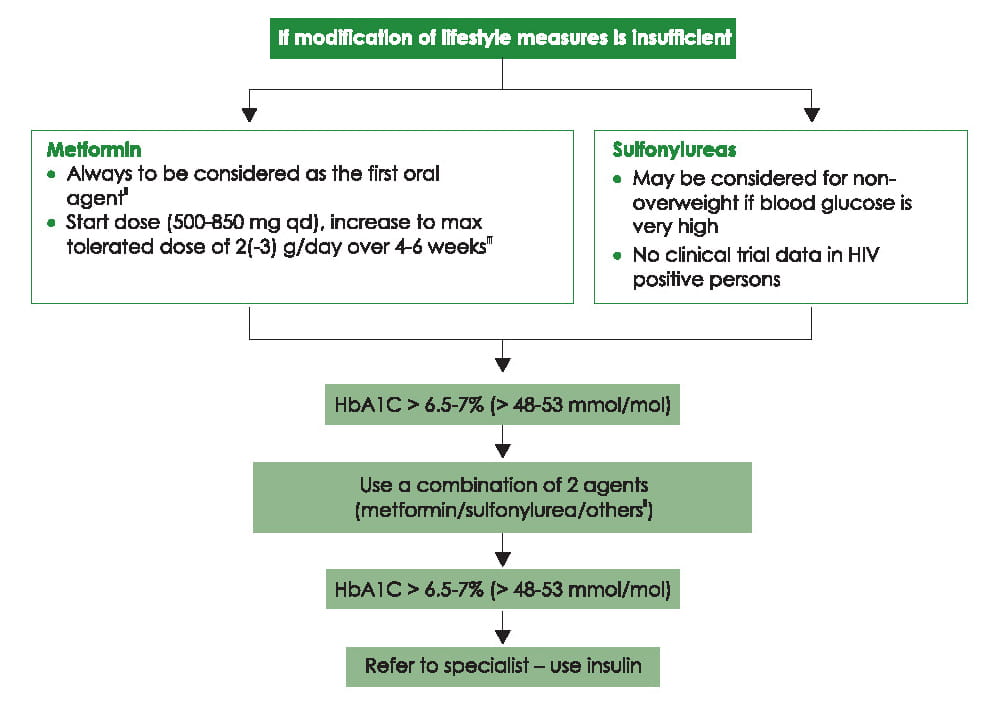
Prevention of hyper-/hypoglycaemia, glucose control (HbA1c < 6.5-7% without hypoglycaemia, fasting plasma glucose 4-6 mmol/L (73-110 mg/dL), and prevention of long-term complications.
- Normal blood lipids, see ERA 2, and blood pressure < 130/80 mmHg, see ERA 2
- Acetylsalicylic acid (75-150 mg/qd) considered in diabetics with elevated underlying CVD risk, see ERA 2
- Nephropathy, polyneuropathy and retinopathy screening should be performed as in diabetic persons without HIV
- Consultation with a specialist in diabetology is recommended
i Type 1 diabetes should be treated according to the national guidelines.
ii Metformin may worsen lipoatrophy. Very limited data for any oral antidiabetic agents in terms of CVD prevention, and no data in HIV positive persons. Incretins (DDP4 inhibitors [e.g. saxagliptin, sitagliptin] and GLP-1 agonists [e.g. liraglutide and exenatide] are currently being evaluated in several major morbidity/mortality studies (neutral results to date); no clinically significant drug-drug interaction or adverse effects on CD4 counts expected; clinical use of pioglitazone questioned by its side effects; HbA1c targets up to 7.5% can be considered for older persons with long-standing type 2 diabetes and evidence of CVD.
iii Consider lower dose in individuals with mild to moderate CKD or individuals receiving DTG.
Bone Disease: Screening and Diagnosis
|
Condition |
Characteristics |
Risk Factors |
Diagnostic Tests | |||||||||
|
Osteopenia
Osteoporosis
|
Common in HIV
|
Consider classic risk factorsii Consider Dual energy X-ray absorptiometry (DXA) in any persons with ≥1 of:iii 1. Postmenopausal women 2. Men ≥ 50 years 3. History of low impact fracture 4. High risk for fallsiv 5. Clinical hypogonadism 6. Oral glucocorticoid use (minimum 5 mg/qd prednisone equivalent for > 3 months) Preferably perform DXA in those with above risk factors prior to ART initiation. Assess effect of risk factors on fracture risk by including DXA results in the FRAX® score (www.shef.ac.uk/FRAX) - Only use if > 40 years - May underestimate risk in HIV positive persons - Consider using HIV as a cause of secondary osteoporosisv |
DXA scan Rule out causes of secondary osteoporosis if BMD lowvi Lateral spine X-rays (lumbar and thoracic) if low spine BMD, osteoporosis on DXA, or significant height loss or kyphosis develops. (DXA based vertebral fracture assessment [VFA] can be used as an alternative to lateral spine X-ray) | |||||||||
|
Osteomalacia |
|
|
Measure 25 (OH) vitamin D in all persons at presentation
If deficient or insuffi- cient, check PTH levels. Consider vitamin D replacement if clinically indicated (see vitamin D table, page 5). | |||||||||
|
Osteonecrosis |
|
Risk factors:
|
MRI |
i Greater loss of BMD observed with initiation of regimens containing TDF and some PIs. Additional loss and gains in BMD observed with switch to and away from TDF-containing ARV regimens, respectively. Clinical relevance to fracture risk not determined.
ii Classic risk factors: Older age, female gender, hypogonadism, family history of hip fracture, low BMI (≤ 19 kg/m2), vitamin D deficiency, smoking, physical inactivity, history of low trauma fracture, alcohol excess (> 3 units/day), steroid exposure (minimum prednisone 5 mg/qd or equivalent for > 3 months)
iii If T-score normal, repeat after 3-5 years in groups 1 and 2; no need for re-screening with DXA in groups 3 and 4 unless risk factors change and only rescreen group 5 if steroid use ongoing.
iv Falls Risk Assessment Tool (FRAT) http://www.health.vic.gov.au/agedcare/maintaining/falls_dev/downloads/b2b_1a_frat.pdf
v If including BMD within FRAX, entering yes in the secondary cause box will not be considered in the FRAX algorithms, as it is assumed that secondary osteoporosis affects fracture risk solely through BMD. However, if the contribution of HIV infection to fracture risk is partially independent of BMD, fracture probability may be underestimated by FRAX.
vi Causes of secondary osteoporosis include hyperparathyroidism, hyperthyroidism, malabsorption, hypogonadism/amenorrhoea, diabetes mellitus, and chronic liver disease.
vii For diagnosis and management of renal phosphate wasting, see Indications and Tests for Proximal Renal Tubulopathy (PRT).
Vitamin D Deficiency: Diagnosis and Management
|
Vitamin D |
Test |
Therapyi |
|
Deficiency: < 10 ng/mL (< 25 nmol/L)ii Insufficiency: < 20 ng/mL (< 50 nmol/L) |
Serum 25-hydroxy vitamin D (25[OH]D) If deficient, consider checking parathyroid hormone (PTH), calcium, phosphateiii, alkaline phosphatase |
If vitamin D deficient, replacement recommended: Various regimens suggestediv Consider re-checking 25(OH) vitamin D levels 3 months after replacement. After replacement, maintenance with 800-2000 IU vitamin D daily. |
|
Vitamin D deficiency prevalent in both HIV+ and HIV- populations
Factors associated with lower vitamin D:
|
Check vitamin D status in patients with history of:
Consider assessment of vitamin D status in persons with other factors associated with lower vitamin D levels (see left column) |
Replacement and/or supplementation of 25(OH) vitamin D is recommended for persons with vitamin D insufficiencyvi and:
Consider retesting after 6 months of vitamin D intake |
i Can be provided according to national recommendations/availability of preparations (oral and parenteral formulations). Combine with calcium where there is insufficient dietary calcium intake. Consider that in some countries food is artificially fortified with vitamin D.
ii Some experts consider a value of ≤ 30 ng/mL as vitamin D deficiency. Low vitamin D has a prevalence of up to 80% in HIV cohorts and was associated with increased risk for osteoporosis, type 2 diabetes, mortality and AIDS events. Consider seasonal differences (in winter approximately 20% lower than in summer).
iii Consider that hypophosphataemia can be associated with tenofovir therapy. This phosphate loss through proximal renal tubulopathy may be independent of low vitamin D (Please see ERA 4; “Drug-associated nephrotoxicity”). A combination of low calcium + low phosphate +/- high alkaline phosphatase may indicate osteomalacia and vitamin D deficiency.
iv Expect that 100 IU vitamin D daily leads to an increase in serum 25(OH) vitamin D of approximately 1 ng/mL. Some experts prefer a loading dose of e.g. 10,000 IU vitamin D daily for 8-10 weeks in persons with vitamin D deficiency. The principal goal is to achieve a serum level > 20 ng/mL (50 nmol/L) and to maintain normal serum PTH levels. Combine with calcium where potential for insufficient dietary calcium intake. The therapeutic aim is to maintain skeletal health; vitamin D supplementation has not been proven to prevent other co-morbidities in HIV-positive persons.
v The role of HIV-therapy or specific drugs remains unclear. Some studies suggest an association of EFV with reductions in 25(OH)D but not 1.25(OH)D. PIs may also affect vitamin D status by inhibiting conversion of 25(OH)D to 1.25(OH)D.
vi The implications of vitamin D levels that are below the physiological reference range but not markedly reduced and the value of supplementation are incompletely understood.
Dyslipidaemia
Principles
Higher LDL-c levels increase risk of CVD, hence reduction diminishes this risk (see table below for drugs used in this indication). The reverse is probably true for HDL-c but trial data are less compelling. The CVD risk implications from higher than normal TG levels are even less clear, as TG has not consistently been shown to independently predict the risk of CVD. Furthermore, the clinical benefit of treating moderate hypertriglyceridaemia is uncertain; very high TG (> 10 mmol/L or > 900 mg/dL) increase risk of pancreatitis.
Less calories, more exercise, reducing bodyweight, and stopping smoking tend to improve HDL. Eating fish, reducing calories, saturated fat and alcohol intake reduce triglyceride levels. Reducing dietary saturated fat intake improves LDL-levels; if not effective, consider change of ART, then consider lipid-lowering medication. Statins should be used by all those with established vascular disease and among those with type 2 diabetes or at high risk of CVD, irrespective of lipid levels.
Drugs used to lower LDL-c
|
Drug class |
Drug |
Dose |
Side effects |
Advice on use of statins together with ART | |
|
Use with PI/r |
Use with NNRTIs | ||||
|
Statini,ix |
Atorvastatinii |
10-80 mg qd |
Gastrointestinal symptoms, headache, insomnia, rhabdomyolysis (rare) and toxic hepatitis |
Start with low dosev (max: 40 mg) |
Consider higher dosevi |
|
Fluvastatiniii |
20-80 mg qd |
Consider higher dosevi |
Consider higher dosevi | ||
|
Pravastatiniii |
20-80 mg qd |
Consider higher dosevi,vii |
Consider higher dosevi | ||
|
Rosuvastatinii |
5-40 mg qd |
Start with low dosev (max: 20 mg) |
Start with low dosev | ||
|
Simvastatinii |
10-40 mg qd |
Contraindicated |
| ||
|
Intestinal cholesterol absorption inhibitor↓i,viii |
Ezetimibeiv |
10 mg qd |
Gastrointestinal symptoms |
No known drug-drug interactions with ART | |
i A statin is preferred first-line therapy; different statins have variable intrinsic LDL-c lowering ability
ii, iii, iv Target levels for LDL-c, refer page 2. In persons where LDL-c targets are difficult to achieve, consult/refer to a specialist
ii, iii, iv Expected range of reductions of LDL-c: ii 1.5-2.5 mmol/L (60-100 mg/dL), iii 0.8-1.5 mmol/L (35-60 mg/dL), iv 0.2-0.5 mmol/L (10-20 mg/dL)
v, vi The ARV may v inhibit (statin toxicity, ↓ dose) or vi induce (=less effect of statin, ↑ dose gradually to achieve expected benefit ii, iii) the excretion of the statin
vii Exception: If used with DRV/r, start with lower dose of pravastatin
viii This agent can be used for HIV-positive persons intolerant of statins or added to a statin when LDL reduction is inadequate despite maximally tolerated statin
ix Pitavastatin has, as yet, no morbidity/mortality trial data to support its use but may have advantages of fewer drug-drug interactions, more HDL increase and less adverse glucose effect than other statins
Hyperlactataemia and Lactic Acidosis: Diagnosis, Prevention and Management
|
Risk factors |
Prevention/Diagnosis |
Symptoms |
|
|
|
Management
|
Serum lactate (mmol/L) |
Symptoms |
Action |
|
> 5i |
Yes/No |
|
|
2-5 |
Yes |
Exclude other causes; if none found: watchfully follow up OR consider switch from high to low risk NRTI, OR stop NRTIs |
|
2-5 |
No |
Repeat test If confirmed, watchfully follow up |
|
<2 |
|
None |
i Lactic acidosis is a rare but life-threatening situation usually associated with symptoms; high risk if serum lactate >5 and, especially, >10 mmol/L.
Management of Lactic Acidosis (irrespective of serum–lactate level)
- Admit the person
- Stop NRTIs
- Provide intravenous fluids
- Vitamin supplementation can be used (vitamin B complex forte 4 mL bid, riboflavin 20 mg bid, thiamine 100 mg bid; L-carnitine 1000 mg bid), although benefit is not proven.
Lipodystrophy: Prevention and Managementi
|
Lipoatrophy |
Lipohypertrophyi |
|
Prevention |
Prevention |
|
|
|
Management |
Management |
- Switch d4T or ZDV to abacavir (ABC) or TDF: o Only ART modification proven to partially restore subcutaneous fat; increase in total limb fat ~400-500 g/year o Risk of toxicity from new drug. - Switch to regimen not including NRTIs o Increase in total limb fat ~400-500 g/year o May increase risk of dyslipidaemia
- Offered for cosmetic relief of (facial) lipoatrophy only |
- Limited data, but possibly reduction of visceral adipose tissue and improvement in insulin sensitivity and blood lipids, especially in obesity associated with lipohypertrophy - No prospective trials in positive persons to definitely indicate degree of diet and/or exercise needed to maintain reduction in visceral fat - May worsen subcutaneous lipoatrophy
- Growth hormone o Decreases visceral adipose tissue o May worsen subcutaneous lipoatrophy and insulin resistance - Tesamorelinii - Metformin o Decreases visceral adipose tissue in insulin resistant persons o May worsen subcutaneous lipoatrophy - Surgical therapy can be considered for localised lipomas/buffalo humps o Duration of effect variable |
i Lipohypertrophy may occur as localised lipomas in the subcutaneous region or as increased visceral adiposity, both intra abdominally and/or in the epicardium
ii Tesamorelin (growth hormone releasing factor) was shown to reduce visceral adipose tissue volume but this effect was lost on discontinuation; the drug is not currently licensed in Europe
Reference
EACS Guidelines Version 8 - October 2015