DSM Dilemma: Issue 5

Changes in Autism Spectrum Disorder
The Diagnostic and Statistical Manual of Mental Disorder (DSM) has a ubiquitous influence on psychiatrists and other practitioners. The manual has, therefore, earned the name ‘the Bible of psychiatry’. Recently, the American Psychiatric Association released the 5th edition of DSM amidst much con-troversies and criticism.
Cipla’s DSM Dilemma endeavors to bring to light DSM-5’s biggest changes and the possible impact they may have on mental health care.
The current issue of DSM dilemma attempts to give a comprehensive out-look on one of the important controversial revisions of DSM-5: changes in the definition of autism.
The fifth edition of the American Psychiatric Association’s Diagnostic and Statistical Manual of Mental Disorders (DSM-5) has provoked widespread discord among psychiatrists and psychologists. One of the controversial DSM-5 revisions is changes in the spectrum of autistic disorders. This issue of DSM Dilemma endeavors to highlight the changes made to this group of disorders and discusses the merits and demerits of the same.
The Need for Changes in DSM-IV Criteria for Autism
“Several alleged inadequacies of DSM-IV led to revisions in the spectrum of autistic disorders in DSM-5.”
Several supposed shortcomings of DSM-IV led to revisions in the spectrum of autistic disorders in DSM- 5. First, there were a huge number of possible symptom combinations (2,027) in the DSM-IV, with inherent heterogeneity of the diagnostic group. Second, its reliability and validity were also dubious. Although reliability from the standardized interviews was good, there were differences in the manner in which the DSM- IV criteria would be construed. Patterns of diagnosis were identifiable according to regional sites, with factors such as verbal IQ and language level influencing the process. Lastly, studies have not been able to clearly distinguish between DSM- IV-text revision (published in 2000) subtypes of spectrum of autistic disorders controlled for IQ and language. This is particularly true for Asperger’s disorder which is treated similar to high-functioning autism.1
Changes Made in DSM-5
“DSM 5 introduces a new diagnostic category called social communication disorder”
The following revisions appear in the DSM-5: Sub diagnoses such as Autistic Disorder, Asperger Syndrome, Pervasive Developmental Disorder (PDD) Not Otherwise Specified, Disintegrative Disorder have been removed. Their diagnosis is now clubbed into a single category of disorders called Autism Spectrum Disorder (ASD). (Fg1a, 1b) Patients may wish to continue to self-identify as having Asperger syndrome, although the DSM-5 diagnostic category will be ASD.2
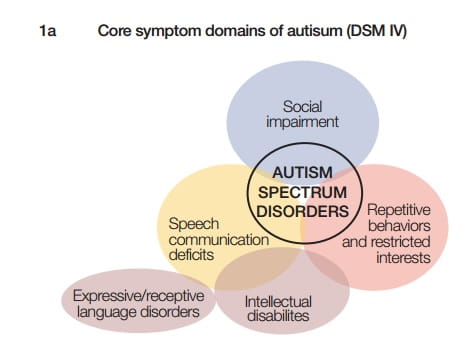
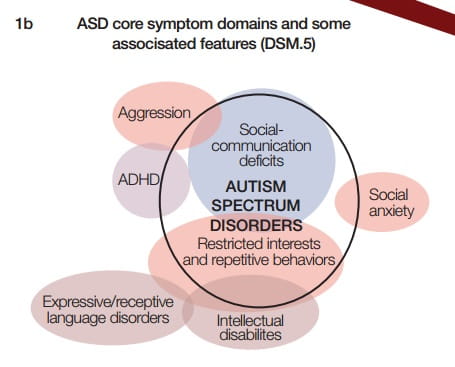
Unlike DSM-IV, the new diagnostic criteria have been rearranged into two areas: 1) social communication/interaction, and 2) restricted and repetitive behaviors. The diagnosis will be based on symptoms, currently or by history, in these two areas. In DSM-IV, symptoms were divided into three areas viz., social reciprocity, and communicative intent, restricted and repetitive behaviors.2
Onset of symptoms must be early childhood; however, the symptoms may not be completely recognized until social demands surpass individual capability.2
In addition, children with ASD should be evaluated for a speech and language diagnosis in order to receive appropriate therapy.2
The following criteria for symptoms that describe persistent insufficiency in social communication / interaction across contexts must be complied with:
- “Problems reciprocating social or emotional interaction, including difficulty establishing or maintaining back-and-forth conversations and interactions, inability to initiate an interaction, and problems with shared attention or sharing of emotions and interests with others.”2
- “Severe problems maintaining relationships — ranges from lack of interest in other people to difficulties in pretend play and engaging in age-appropriate social activities, and problems adjusting to different social expectations.”2
- “Nonverbal communication problems such as abnormal eye contact, posture, facial expressions, tone of voice and gestures, as well as an inability to understand these.”2
Of the four symptoms related to restricted and repetitive behavior, two symptoms need to be present:2
- “Stereotyped or repetitive speech, motor movements or use of objects.”2
- “Excessive adherence to routines, ritualized patterns of verbal or nonverbal behavior, or excessive resistance to change.”2
- “Highly restricted interests that are abnormal in intensity or focus.”2
- “Hyper or hypo reactivity to sensory input or unusual interest in sensory aspects of the environment.”2
These above mentioned symptoms must lead to functional impairment. Further, these should not be better described by any another DSM-5 diagnosis.
Rett syndrome is no longer a subdiagnosis under ASD but a separate neurologic disorder. However, patients with Rett syndrome may be diagnosed additionally with ASD.
A new diagnostic category called social communication disorder has been introduced. This disorder would comprise of children with social difficulty and practical language differences affecting comprehension, production and awareness in conversation that cannot be attributed to any delayed cognition or other language delays.
Issues in the Use of DSM-5’s Revision of ASD1, 3, 4
“Critics believe that narrowing the definition of autism would result in lot of children missing their diagnosis”
Some of the changes employed in the new DSM-5 approach are commendable. However, several others are much more complicated and have received the following criticism: First, patients with Asperger syndrome will no longer be denied services reserved for people with ASD. However, patients deemed as having Asperger syndrome and not autism may be given an inappropriate diagnosis. This is particularly true for adults for whom a developmental history may be unavailable.3
Second, some of these studies indicate that the specificity is likely to improve using DSM-5 criteria but instead the narrow definition of autism would result in a lot of children missing their diagnosis. A recent study has demonstrated that only 60% of patients meet criteria for DSM-IV autism when they are assessed using the criteria of DSM-5 autism. Another example is that of a recent clinical evidences, which suggest that at least 12% and probably as many as 40% of children currently classified in one of the PDD subcategories will be reclassified or lose their diagnosis. These changes in DSM-5 in relation to autism are radical and will lead to patients losing their diagnosis and services.3, 4
Critics have also pointed out the potential impact of these changes, especially the loss of the subtypes, on the validity of findings from ongoing research cohorts. This is not inconsequential or trivial given the large number of ongoing autism research since the publication of DSM-III. Others have warned that changing diagnostic criteria in the middle of an “epidemic” will automatically undercut any sort of analysis because epidemiologists will now be compelled to make comparisons between very different disorders.
Critics have also pointed out that the shift will have negative ramifications for clinical service delivery. This includes concerns that radically changing the diagnosis on social communication and repetitive behaviors may not be clinically constructive. This is because these factors seem to be inadequately associated with clinical outcomes and response to treatment, which appear to be more closely related to cognitive and language abilities.3
The changes in DSM-5 have implications for the pediatricians, who are increasingly on the front lines of autism care. While using DSM-5, they need to consider the new differential diagnoses, changes in terminology, and accordingly develop the new narratives to explain to parents. Therefore, for them, it is critical that the diagnostic process be clear and workable in a practice setting.3
Suggested Modifications to DSM Revisions
“Critics suggest relaxing the onset criteria for ASD to improve the ability to detect early social interaction problems, thus improving sensitivity”
Amendments to the DSM-5 criteria were suggested to address the concerns of sensitivity. The first suggestion was to decrease the criteria for social communication and interaction from three to two. Similarly, there were proposals to change the number of restrictive, repetitive behaviors criteria from two to one. Lastly, critics suggested relaxing the onset criteria for ASD may improve the ability to detect early social interaction problems, thus improving sensitivity. These changes would likely increase sensitivity while maintaining acceptable specificity.1
Conclusion
As mentioned earlier, there are some very sensible and praiseworthy aspects of DSM-5. How-ever, the decision to eliminate subcategories is controversial. These changes have impacted ongoing studies; for example, those with epidemiological or longitudinal samples, or studies of treatments that span decades. Further, evidence based on several studies notes that many children might no longer meet the diagnostic criteria of ASD. On the other hand, citing evidence from clinical trials, advocates of the new DSM-5 ASD classification argue that the changes made in the new manual provide more specific criteria to evaluate the dimensions of behavioral function. The utility and validity of these changes will only be revealed once DSM-5 is used in practice. Clinicians and researchers would hope that these issues will be clarified then and if need be, suitable revisions can rapidly be made. As for now, pediatricians, and other caregivers of this growing population of vulnerable children must adapt to this new reality and remain vigilant in advocating for optimal care.3, 5
References
- Lohr W, Tanguay P. DSM-5 and Proposed Changes to the Diagnosis of Autism. Pediatr Ann. 2013; 42: 161-166. doi: 10.3928/00904481-20130326-12
- Hyman SL. New DSM-5 includes changes to autism criteria. AAP news E130604; published ahead of print June 4, 2013. Available from: http://aapnews.aappublications.org/content/early/2013/06/04/aapnews.20130604-1.full?sid=072a3fbb-5355-4710-81db-dd43bbc2507c. Last assessed on 14th July 2014.
- Halfon N, Kuo AA. What DSM-5 Could Mean to Children With Autism and Their Families. JAMA Pediatr 2013; 167(7): 608-613. doi:10.1001/jamapediatrics.2013.2188
- Fitzgerald M. Loss of autism in DSM-5. Br J Psychiatry. 2012 Jul; 201(1):74-5. doi: 10.1192/bjp.201.1.74b.
- Volkmar FR, Reichow B. Autism in DSM-5: progress and challenges. Mol Autism. 2013 May 15; 4(1):13. doi: 10.1186/2040-2392-4-13.