

Doxi-Emperics Newsletter - Issue 2

Case Study: Role of Doxycycline in the Treatment of Hospitalized Patients With Mild-to–Moderately Severe Community-Acquired Pneumonia
Community-acquired pneumonia is an acute lung infection involving the alveoli, which develops in patients who have not recently been exposed to health care. The clinical spectrum of CAP ranges from walking pneumonia in a patient who is otherwise healthy to necrotizing or multilobar illness with septic shock. Pneumonia is the third most common reason for hospitalization worldwide.1
Given the increasing prevalence of antibiotic resistance among organisms usually associated with CAP, there is cause for concern regarding the efficacy of routinely used empiric antibiotics, such as macrolides, in the treatment of CAP.2 Recent evidence suggests that up to 50% of Streptococcus pneumoniae and Mycoplasma strains, two of the most frequent CAP-causing bacteria, are now resistant to macrolides.2
The 2019 American Thoracic Society and Infectious Diseases Society of America (ATS/IDSA) guidelines recommend empiric antibiotic therapy consisting of a beta-lactam (e.g. ceftriaxone) and doxycycline for inpatients with CAP who are not in the intensive care unit.2
A retrospective cohort study assessing the effectiveness of beta-lactam plus doxycycline for patients hospitalized with CAP revealed the following results:2
- 30-day mortality was 6.4% in those who received a beta-lactam with doxycycline compared to 9.1% in those who did not (p<0.0001), and 90-day mortality was 13.8% in those who received doxycycline compared to 16.8% in those who did not (p<0.0001).
- Receiving beta-lactam plus doxycycline was also related to decreased 30-day (odds ratio [OR], 0.75; 95% confidence interval [CI], 0.65–0.87) and 90-day (OR, 0.86; 95% CI, 0.77–0.96) mortality among individuals who did not receive antibiotics before hospital admission.
According to the ATS/IDSA guidelines, doxycycline has a number of benefits when administered as a part of guideline-compliant CAP therapy:2
- Doxycycline is highly active against numerous respiratory infections, such as anaerobes and atypical organisms. This broad-spectrum coverage is reinforced by the drug's quick absorption, high bioavailability (up to 90%), and capacity to concentrate in lung tissues, particularly in alveolar macrophages.
- Beta-lactams and fluoroquinolones, two of the most prescribed antibiotics for CAP, are usually related to Clostridium difficile infections (CDI). Therefore, the administration of doxycycline reduces the risk of CDI in CAP patients receiving beta-lactams.
Case presentation
A 62-year–old woman presented with a cough with expectoration and a history of high-grade fever for the last 3 days.
The patient had no significant medical history.
Physical examination
The patient appeared to be conscious on inspection.
Vital signs
- ●Blood pressure: 100/70 mmHg
- ●Heart rate: 130 beats/minute
- ●Respiratory rate: 24 breaths/minute
- ●Temperature: 104°F
Systemic examination
- ●Cardiovascular system: No heart murmurs.
- ●Respiratory system: Tachypnea and crepitations on the left lung heard on auscultation.
- ●Abdomen: No abnormalities detected.
- ●Perianal and rectal examinations: Normal.
- ●Neurologic examination: No neurologic deficits were detected.
- ●Clinical finding on admission: High-grade fever observed on admission, requiring oxygen support.
Laboratory investigations
The patient was directed for further assessment and treatment. Other laboratory investigations of the patient are detailed in Table 1.
Table 1: Laboratory investigations
|
Parameter |
Value |
|
Hemoglobin |
10 g/dL |
|
Hematocrit |
41% |
|
Total leukocyte count |
16,000 mm3 |
|
Erythrocyte sedimentation rate |
93 mm/h |
|
C-reactive protein |
26 mg/L |
Other investigations conducted included a chest X-ray that revealed prominent bronchovascular markings with moderate pleural effusion in the left lung.
Diagnosis
The patient was diagnosed with acute community-acquired pneumonia (CAP) with a sympneumonic effusion.
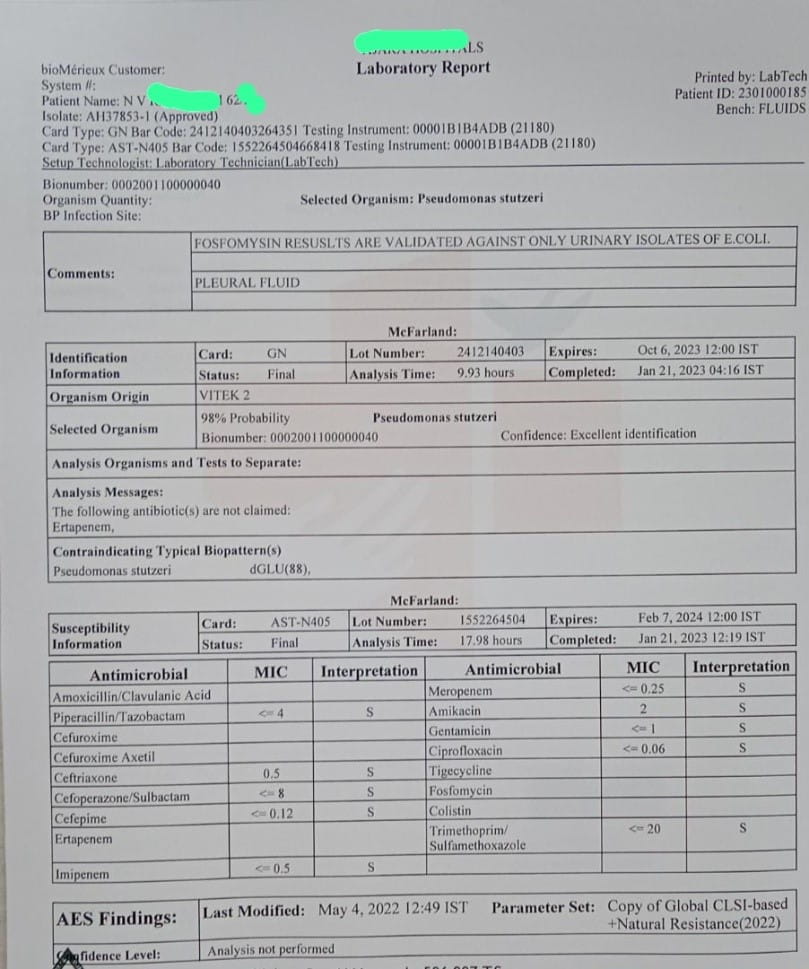
A culture report conducted on the pathogen Pseudomonas stutzeri revealed them to be sensitive to ceftriaxone, piperacillin, meropenem, and ciprofloxacin antibiotics, as shown in Figure 1.
Figure 1: Microbiology culture report of antibiotic sensitivity and resistance.
Management
Treatment plan
The patient was subsequently started on the following empirical antibiotics for 5 days.
- Inj. ceftriaxone 1 g intravenous (IV) BD
- Inj. doxycycline 200 mg IV stat followed by 100 mg IV BD
- Inj. doxycycline was administered to the patient for 5 days over 1 hour, twice a day, every day. In addition, inj. ceftriaxone was combined with doxycycline to enable rapid reduction of bacterial load in the patient. Normal saline was used as a diluent to administer both IV antibiotics to the patient.
- The patient was administered oxygen for 10 hours a day to aid in the improvement of the patient's breathing.
- There were no significant medication-related side effects noted.
Follow-up outcomes
There was a significant improvement in the patient’s condition after 5 days of intensive medical therapy.
- Clinical improvement: Clinical assessment revealed that the patient’s high fever reduced significantly; a follow-up complete blood count after 3 days revealed a reduction in total leukocyte count.
- Symptomatic cure: Oxygen was tapered down in 5 days owing to improvement in the patient’s respiration.
- Microbiological eradication: Pleural tapping was performed on the patient on day 1. No further tapping was required.
Case Discussion
Community-acquired pneumonia is an acute lung infection involving the alveoli, which develops in patients who have not recently been exposed to health care. The clinical spectrum of CAP ranges from walking pneumonia in a patient who is otherwise healthy to necrotizing or multilobar illness with septic shock. Pneumonia is the third most common reason for hospitalization worldwide.1 Given the increasing prevalence of antibiotic resistance among organisms usually associated with CAP, there is cause for concern regarding the efficacy of routinely used empiric antibiotics, such as macrolides, in the treatment of CAP.2 Recent evidence suggests that up to 50% of Streptococcus pneumoniae and Mycoplasma strains, two of the most frequent CAP-causing bacteria, are now resistant to macrolides.2 The 2019 American Thoracic Society and Infectious Diseases Society of America (ATS/IDSA) guidelines recommend empiric antibiotic therapy consisting of a beta-lactam (e.g. ceftriaxone) and doxycycline for inpatients with CAP who are not in the intensive care unit.2
A retrospective cohort study assessing the effectiveness of beta-lactam plus doxycycline for patients hospitalized with CAP revealed the following results:2
- Receiving beta-lactam plus doxycycline was also related to decreased 30-day (odds ratio [OR], 0.75; 95% confidence interval [CI], 0.65–0.87) and 90-day (OR, 0.86; 95% CI, 0.77–0.96) mortality among individuals who did not receive antibiotics before hospital admission. According to the ATS/IDSA guidelines, doxycycline has a number of benefits when administered as a part of guideline-compliant CAP therapy:2
- Doxycycline is highly active against numerous respiratory infections, such as anaerobes and atypical organisms. This broad-spectrum coverage is reinforced by the drug's quick absorption, high bioavailability (up to 90%), and capacity to concentrate in lung tissues, particularly in alveolar macrophages. Beta-lactams and fluoroquinolones, two of the most prescribed antibiotics for CAP, are usually related to Clostridium difficile infections (CDI). Therefore, the administration of doxycycline reduces the risk of CDI in CAP patients receiving beta-lactams
A culture report conducted on the pathogen Pseudomonas stutzeri revealed them to be sensitive to ceftriaxone, piperacillin, meropenem, and ciprofloxacin antibiotics, as shown in Figure 1
Conclusion
This case shows that for the empirical treatment of hospitalized patients diagnosed with mild-to–moderately severe CAP, doxycycline provides a treatment option that is both effective and affordable. Additionally, the broad spectrum coverage of doxycycline not only prevents antibiotic resistance against atypical bacteria but also helps in reducing the risk of CDI in CAP patients.
References
- Rider AC, Frazee BW. Community-acquired pneumonia. Emerg Med Clin North Am. 2018;36:665–683.
- Uddin M, Mohammed T, Metersky M, et al. Effectiveness of beta-lactam plus doxycycline for patients hospitalized with community-acquired pneumonia. Clin Inf Dis. 2022;75:118–124.