

Doxi-Emperics Newsletter - Issue 1


Case Study on Role of Doxycycline in the Treatment of Hospitalized Patients with Mild to Moderately Severe Community-Acquired Pneumonia
Community-acquired pneumonia (CAP) can range in severity from mild, which can be treated in the outpatient department, to severe, which requires hospitalization in an intensive care unit.2 In 2022, the Infectious Disease Society of America (IDSA) and the American Thoracic Society (ATS) updated their guidelines on the diagnosis and management of CAP, in which they recommended beginning empiric therapy with a ß-lactam (cefotaxime, ceftriaxone, ampicillin, or meropenem) and a macrolide or a respiratory fluoroquinolone.2 When macrolides are contraindicated, the recommended antibiotic is doxycycline. It is active against a wide range of pneumococcal bacteria, both aerobic and anaerobic, such as Klebsiella pneumoniae and Streptococcus pneumoniae.2
Doxycycline's bacteriostatic effect is designed to inhibit bacterial cell growth by binding allosterically to the 30S ribosomal subunit, hence decreasing protein synthesis.2 A regimen containing doxycycline was considerably more cost-effective than a regimen containing comparators, with hospitalization expenses more than 20% lower in a randomized prospective study of 87 patients (43 in the doxycycline group and 44 in the control group [p=0.04]).2
Case Presentation
A 65-year─old female presented with fever for the past 1 week, cough with expectoration, and decreased urine output.
Medical History
The patient has a history of chronic obstructive pulmonary disease (COPD), which was diagnosed 5 years ago.
Physical Examination
The patient appeared to be conscious on inspection.
Vital signs
- ●Blood pressure: 90/60 mmHg
- ●Heart rate: 130 beats/minute
- ●Respiratory rate: 24 breaths/min
- ●Temperature: 104○F
Systemic examination
- ●Cardiovascular system: No heart murmurs.
- ●Respiratory system: Tachypnea and bilateral crepitations heard on auscultation.
- ●Abdomen: No abnormalities detected.
- ●Perianal exam and rectal exam were normal.
- ●Neurologic examination: No neurologic deficits were detected.
- ●Clinical finding on admission: High-grade fever and decreased urine output was observed on admission, requiring 8─10 liters of oxygen. In addition, minimal hemodynamic instability was diagnosed, which required noradrenaline infusion.
Laboratory Investigations
The patient was directed for further assessment and treatment. Other laboratory investigations of the patient are detailed in Table 1.
Table 1: Laboratory investigations
|
Parameter |
Value |
|
Hemoglobin |
10 g/dL |
|
Hematocrit |
41% |
|
Total leukocyte count (TLC) |
28,000 mm3 |
|
Erythrocyte sedimentation rate |
93 mm/h |
|
C-reactive protein |
112 mg/L |
|
Lactate levels |
3.5 mmol/L |
|
Sodium |
139 mEq/L |
|
Potassium |
3.9 mEq/L |
|
Chloride |
100 mEq/L |
|
Bicarbonate |
26 mEq/L |
|
Creatinine |
2.1 mg/dL |
|
Albumin |
2.9 g/dL |
|
Total protein |
4.7 g/dL |
Other investigations included a high-resolution (HR) chest and abdominal computed tomography (CT) scan, a 2D echocardiogram, and abdominal ultrasound.
These investigations revealed the following:
- HR chest and abdominal CT scan: Chest CT revealed bilateral pleural effusion indicating a diagnosis of pneumonia.
- 2D Echocardiogram: Revealed mild left ventricular dysfunction.
- Abdominal ultrasound: Revealed no abnormalities.
Diagnosis
The patient was diagnosed with acute exacerbation of already existing COPD (AECOPDS) with bilateral pneumonia, in addition to septic shock. She was also diagnosed with pre-renal acute kidney injury (AKI).
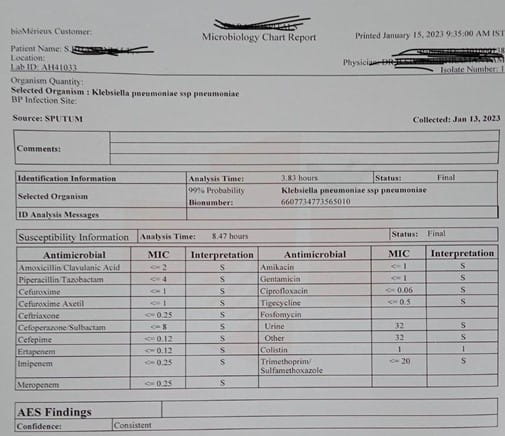
The culture report conducted for pathogens Klebsiella pneumoniae and Streptococcus pneumoniae revealed them to be sensitive to the antibiotics given in the figure below (Figure 1):
Figure 1: Microbiology culture report of antibiotic sensitivity and resistance.
Management
Treatment plan:
The patient was started on the following empirical antibiotics for 7 days.
- Inj. meropenem 2 gm intravenous (IV) stat followed by 1 gm IV BD
- Inj. doxycycline 200 mg IV stat followed by 100 mg IV BD
- Inj. doxycycline was administered to the patient for 7 days (one hour every day). In addition, inj. meropenem was combined with doxycycline to enable rapid reduction of bacterial load in the patient. Normal saline was used as a diluent to administer both IV antibiotics to the patient.
- Infusion of inj. noradrenaline was also administered to reduce septic shock-induced hemodynamic instability.
- The patient was administered oxygen for 10 hours a day to improve her urine output.
- No medication-related significant side effects were noted.
Follow-up outcomes:
There was a significant improvement in the patient’s condition after 7 days of intensive medical therapy.
- Clinical improvement: Clinical assessment revealed that the patient’s high fever reduced significantly; a follow-up complete blood count revealed a reduction in total leukocyte count.
- Symptomatic cure: Both oxygen and noradrenaline were tapered down and slowly stopped with improvement in renal output and reduction of hemodynamic instability.
- Laboratory investigations: Reports revealed a reduction in TLC from 28,000 to 10,400 cells/mm3 at discharge.
Sputum cultures were not repeated owing to significant symptomatic improvement of the patient.
Case Discussion
Most patients suffering from COPD undergo exacerbations. More than 80% of exacerbations are treated ambulatorily.1 A recent meta-analysis found that antibiotic-treated outpatient exacerbations had a lower rate of treatment failure within four weeks (21.2%) compared to placebo-treated exacerbations (29.0%). This indicates that 12–13 individuals must be treated with antibiotics in order to prevent one treatment failure.1
In a randomized trial, Anthonisen et al. found that patients with increased dyspnea, increased sputum volume, and higher sputum purulence had statistically and significantly reduced treatment failure within 21 days when treated with antibiotics versus placebo.1
The Global Initiative for Chronic Obstructive Lung Disease (GOLD) proposes treating patients with antibiotics if they have two or three severe symptoms (increased dyspnea, sputum volume, and sputum purulence).1
The C-reactive protein-guided prescribing of antibiotics for COPD exacerbations in primary care reduces antibiotic use without any evidence of damage, according to studies.1
A randomized, placebo-controlled trial comparing doxycycline and placebo for the treatment of COPD exacerbations in outpatients conducted by Van Velzen et al. reported the following results:1
- Treatment failure rates at day 21 of the experiment were much lower (16%) in the doxycycline group compared to the placebo group (26.5%) (p=0.03, n=301).
- No patients in the doxycycline group were admitted to the hospital compared to eight admissions in the placebo group.
Conclusion
This case study shows that infections of the respiratory tract are responsible for most exacerbations of COPD. Those patients who are critically ill and those who are most likely to have a bacterial infection resulting in exacerbations benefit the most from empiric antibiotic therapy with doxycycline since it results in a considerable improvement for both groups.
References
- Velzen P van, Riet G.ter, Brinkman P, et al. Doxycycline for exacerbations of chronic obstructive pulmonary disease in outpatients: Who benefits? ERJ Open Research. 2020;6.
- Aldhahri RK, Gabb SG, Shoaib OA, et al. Doxycycline vs. macrolides in combination with a β-lactam antibiotic for the treatment of community-acquired pneumonia in inpatients. Eur J Med Res. 2022;27(1):279.