The CYP Complex'
Dietary Supplement Increases Anagen Hair Rate in Women with Telogen Effluvium: A Double-Blind, Placebo-Controlled Trial
Telogen effluvium represents exaggerated hair shedding or teloptosis which is a result of progressive shortening of the anagen phase of the hair cycle. In one third of women with persistent telogen effluvium, no precipitating cause can be found. Complex etiologies underlie this type of hair loss, in which several factors interact to cause the hair loss. Nutritional factors play a role in increased hair shedding.
Dietary supplements based on combination of L-cystine and vitamins, usually the B-complex group, including pantothenic acid are used for the treatment or prevention of hair loss. Various studies on such dietary supplements containing L-cystine, in combination with B-complex vitamins and medicinal yeast were published, demonstrating improvements in the trichogram (hair pluck test), in hair quality and in the tensile strength of the hair fibre.
- Dietary supplements, such as L-cystine, medicinal yeast and pantothenic acid (CYP complex) are used for the treatment or prevention of hair loss.
- This is the first randomized, double-blind, placebo-controlled study performed using TrichoScan to demonstrate that a CYP complex-based dietary supplement influences hair growth.
- CYP complex-based dietary supplement led to a statistically significant improvement and normalization of the mean anagen hair rate within 6 months of treatment in otherwise healthy women with telogen effluvium.
Trichogram and global photographic assessment techniques for evaluating hair loss are of limited use owing to poor reproducibility and are useful only in a minority of patients who show clinically distinct improvement of hair growth. TrichoScan, which combines epiluminescence (ELM) with digital image analysis, is a simple to perform, noninvasive, reproducible method for objective measurement of hair growth parameters. It measures anagen hair rate, hair count, hair density and cumulative hair shaft diameter.
To investigate the effects of L-cystine. medicinal yeast and pantothenic acid (CYP) complex-based dietary supplement on hair growth a single-centre, randomized, double-blind, controlled, parallel-group study was conducted in healthy women with telogen effluvium using the TrichoScan.
47 healthy women (aged 25-65 years) suffering from telogen effluvium were recruited in the study. The study duration was of 6 months.
The patients were randomized into one of the two treatment arms and supplied with active compound or placebo. The dosage was one capsule three-times daily with meals for the 6-month study duration.
The measures of outcome were the anagen hair rate at baseline, and after 3 and 6 months of treatment and also the hair count, hair density and cumulative hair shaft diameter at baseline and at the end of the study (6 months). Standardized Polaroid photographs were taken for documentation of clinical outcome at baseline and close-out. Assessment of the serial photographs was made independently and in a blinded manner by each of the three investigators.
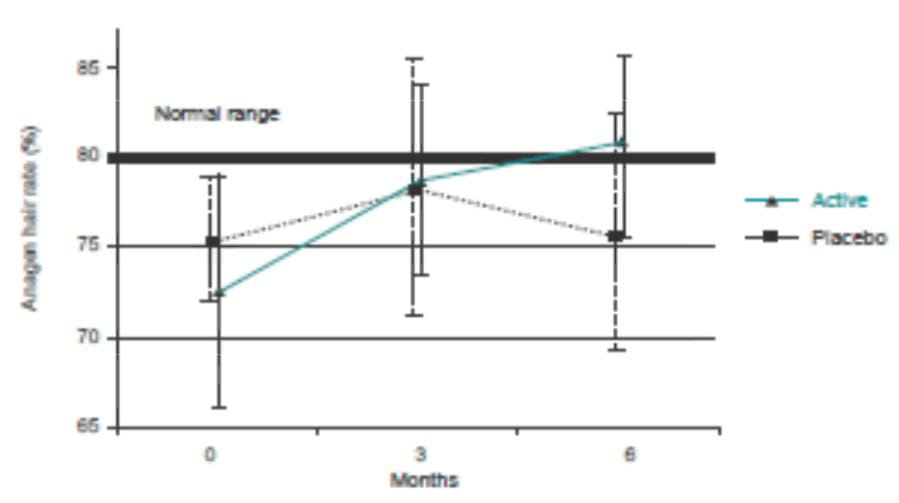
30 patients completed the study: 15 in the active compound (CYP based dietary supplement) group and 15 in the placebo group. In 12 patients, no thinning of hair was visible (seven in the active compound group and five in the placebo group). 15 women showed Ludwig type I FPHL (seven in the active compound group and eight in the placebo group) and three patients had Ludwig type II FPHL (one in the active compound group and two in the placebo group). Baseline mean anagen hair rate was similar between the active compound (73%) and placebo groups (75%). At 6 months, the benefit from active treatment showed an additional increment of the mean anagen hair rate to 81%, in contrast with placebo, which practically fell back to baseline. The appearance of hair growth in the global photographic assessment was judged better in the active compound than in the placebo group. The active compound was generally well tolerated.
Improvement of anagen hair rate after treatment
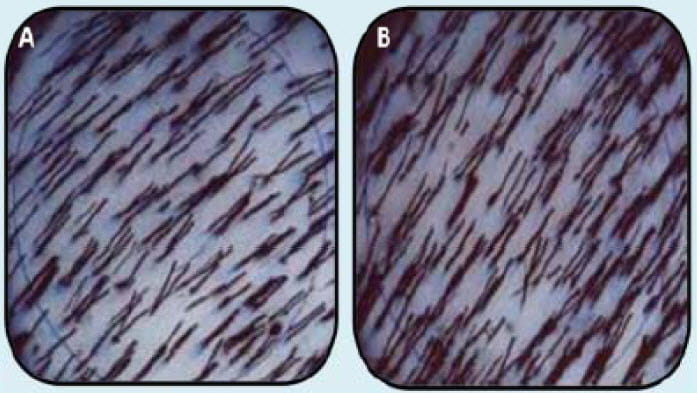
Increase in proportion of anagen hair in the active compound group (A) before and (B) 6 months after treatment
This is the first study performed with the TrichoScan to demonstrate that a CYP complex-based dietary supplement influences hair growth. After 6 months of treatment, the active compound group showed a statistical significant improvement in anagen hair rate, while the placebo group did not. Nevertheless, the increase in anagen hair rate was reflected in clinical outcome, since the appearance of hair in the global photographic assessment was also judged better in the active compound group compared with placebo. Data suggest that the CYP complex-based active compound has a therapeutic effect owing to an induction of anagen.
In summary, CYP complex-based dietaiy supplement leads to an increase of anagen hair rate and an improvement of the overall photographic appearance within 6 months in otherwise healthy women with telogen effluvium. Due to its action on synchronization phenomena of hair cycling, indications for CYP complex-based dietary supplementation would include postpartum effluvium, seasonal effluvium and diffuse cyclic hair loss. Lastly. CYP complex-based dietary supplementation may be useful in addition to minoxidil therapy in the treatment of FPHL, whenever there is partial synclironization in telogen.
Adapted from Therapy 2007; 4(1)59-65