

VALENCE Study: Role of Sofosbuvir and Ribavirin in HCV Genotypes 2 and 3

Introduction
Sofosbuvir, an oral nucleotide analogue inhibitor of the HCV (hepatitis C virus) NS5B polymerase, when administered in combination with ribavirin, is effective against HCV genotypes 2 and 3. HCV genotypes 2 and 3 consist of approximately 30% of the 6 main genotypes worldwide.
Aim
To evaluate the efficacy of sofosbuvir–ribavirin therapy in patients with HCV genotype 3 infection for 24 weeks and to establish prior results in patients with HCV genotype 2 infection with respect to 12-week therapy.
Patient Profile
- The study was a randomized, multi-centre and Phase-III trial with patients infected with HCV genotype-2 (n=91) and HCV genotype-3 (n=328).
- The patients enrolled were 18 years of age or older and had serum HCV RNA levels of 10,000 IU per milliliter or higher.
- Some of these patients had undergone previous interferon-based treatment regimen.
Method
Study Design
- The patients were randomized to receive sofosbuvir–ribavirin or placebo (in 4:1 ratio), initially only for 12 weeks.
- However, the newly derived results from FUSION phase 3 study of sofosbuvir strongly recommended that HCV genotype-3 infected patients benefit from treatment after 12 weeks.
- Thus, based on this data, the study design was modified and extended for 24 weeks; the study was unblinded with termination of placebo group. The aim of the study was revised to be descriptive and not include hypothesis testing.
Dosing
Patients were administered with sofosbuvir orally at a dose of 400 mg once daily and ribavirin orally twice daily as per the body weight (1000 mg daily in patients with a body weight of <75 kg and 1200 mg daily in patients with a body weight of ≥75 kg).
Primary Efficacy End Point
The primary efficacy end point was defined as a sustained virologic response (defined as a level of HCV RNA below the lower limit of quantification i.e. 25 IU per milliliter) at 12 weeks after the end of treatment.
Results
Efficacy
Efficacy on HCV RNA Levels during Treatment Period
- Substantial reductions in circulating HCV RNA levels during the first weeks of treatment
- 99% of the patients had an HCV RNA level of > 25 IU per milliliter by 4 weeks of treatment.
- No patients in the placebo group had an HCV RNA level of > 25 IU per milliliter at any time point.
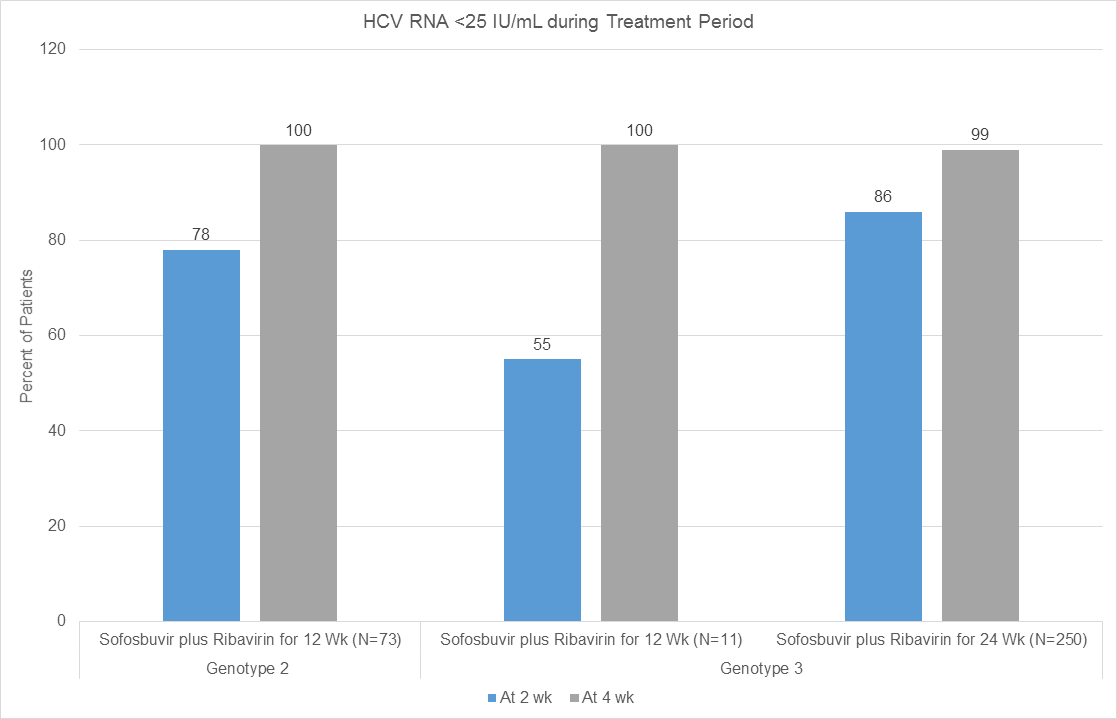
Efficacy on HCV RNA Levels after Treatment Period
- Among patients with HCV genotype 2 infection who were treated with sofosbuvir–ribavirin for 12 weeks had a sustained virologic response 12 and 24 weeks after the cessation of treatment.
- Among patients with HCV genotype 3 who received sofosbuvir–ribavirin for 24 weeks, 85 % of patients (213 out of 250 patients) had a sustained virologic response 12 weeks after the cessation of treatment, out if which 206 patients showed virologic response 24 weeks after the treatment.
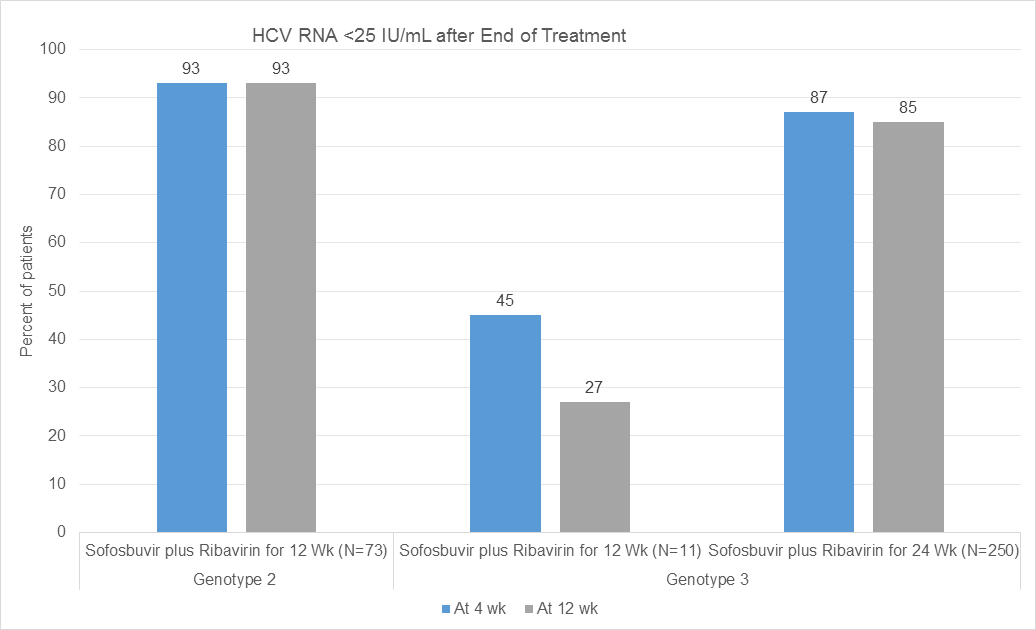
Virologic Failure
- In HCV genotype-3 cohort, 2 patients had a virologic relapse, 4 were lost to follow-up after post-treatment week 12, and 1 had an invalid HCV RNA result because the visit occurred outside the window of 24 weeks after treatment.
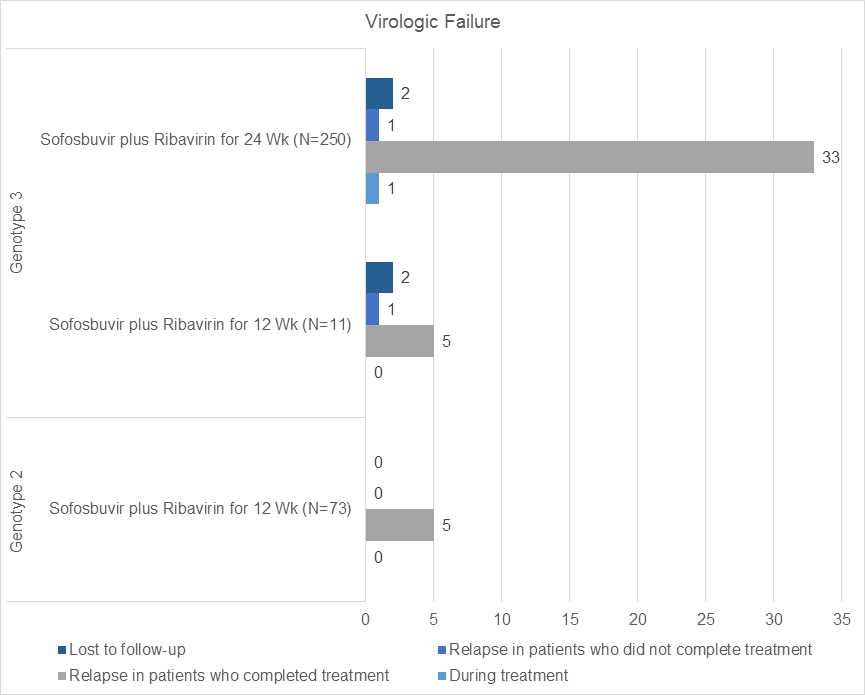
- The treatment success was evaluated in an exploratory multivariate regression analysis of patients with genotype 3 infection, which showed 4 factors which were independently associated with a sustained virologic response:
- Baseline HCV RNA level of less than 6 log10 IU per milliliter (p=0.02)
- Female sex (p = 0.02)
- Absence of cirrhosis (p = 0.002)
- Age of less than 50 years (p = 0.02)
Safety
Headache, fatigue, and pruritus are some of the most common adverse events.
Conclusion
- High rates of sustained virologic response in both HCV genotype-2 and -3 infected patients was associated with oral sofosbuvir-ribavirin therapy.
- The oral sofosbuvir-ribavirin therapy may be considered a good alternative to a peg-interferon-based regimen or to HCV infected patients who are ineligible to interferon therapy because of absolute or relative contraindications.
N Engl J Med. 2014;370(21):1993-2001.