




To assess the efficacy of the OCP containing 3 mg drospirenone/20 mcg ethinyl estradiol (D+EE) administered as 24 consecutive days followed by a 4-day hormone-free interval (24/4 regimen) compared with placebo for the treatment of moderate acne vulgaris.
Treatment of Acne using Drospirenone 3 mg and Ethinylestradiol 20 mcg in 24-4 Regimen

6 Nov, 10
Treatment of Acne Using A 3 mg Drospirenone/20 mcg Ethinyl Estradiol OCP Administered in a 24/4 Regimen: A Randomized Controlled Trial.
Aim
Methods
- A double-blind, randomized study conducted at 28 centers in the United States
- Treatment period - 6 cycles, N = 538
D+EE - n = 270
Placebo - n = 268 - Inclusion
- Girls and women aged 14-45 years (inclusive) with a minimum of 20 inflammatory and 20 non-inflammatory facial lesions
- Classified as grade 3, 4, or 5 on the Investigator Static Global Assessment (ISGA*) scale
- Normal Pap test within the last 6 months
- At least 1 menstruation during the last 3 months before screening
- Primary efficacy
- Percentage change from baseline in inflammatory and noninflammatory lesion counts
- Percentage of participants classified as clear or almost clear on the ISGA scale
- Other efficacy assessments - based on age (split into age groups of 14-22 years, 22-26 years, 27-30 years, 31-34 years and 35-45 years)
Results
- Percentage reduction from baseline to end-point for total lesions
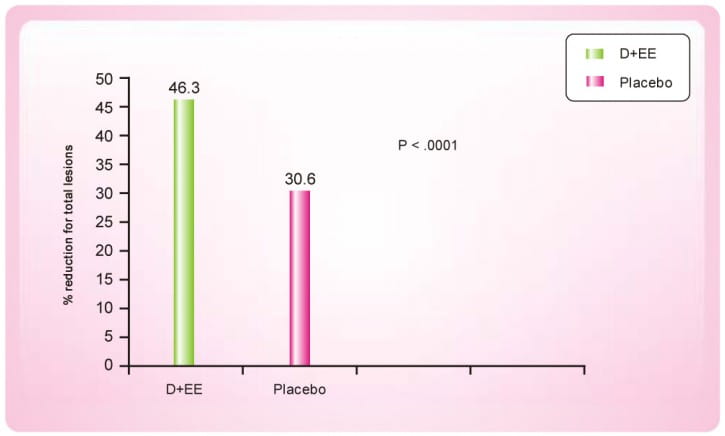
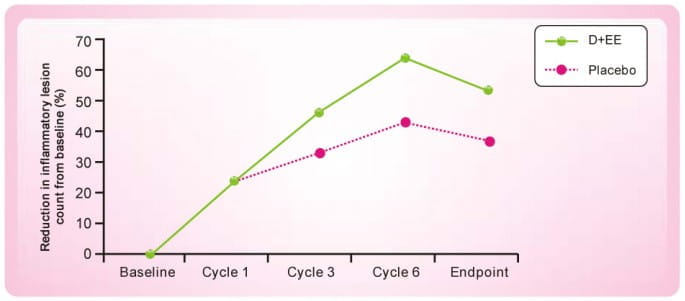
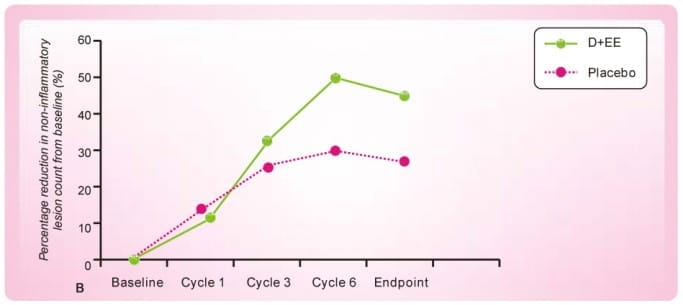
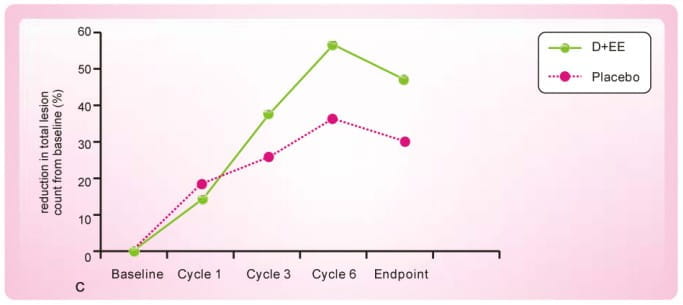
- Greater percentage reduction in all lesion counts in D+EE compared with placebo group observed by cycle 3, and maintained throughout rest of the study duration
- Percentage reduction in inflammatory lesion count (P = 0.001)
- Percentage reduction in non-inflammatory lesion count (P = 0.001)
- Percentage reduction in total lesion count (P = 0.001)
- Percentage of participants rated 'clear' or 'almost clear' on ISGA (P = 0.001)
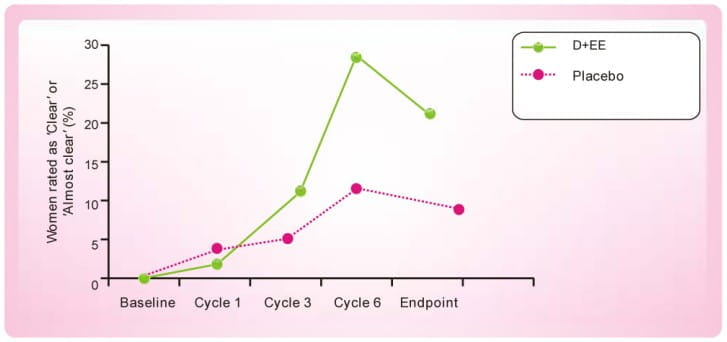
- In all age groups - mean percentage change in inflammatory, non-inflammatory and total lesion count greater in D+EE group
- In 14-22 years age group - highest reduction in inflammatory lesion count (P<0.001) and highest % of participants rated as clear or almost clear on ISGA scale (P<0.001) in D+EE group
- No indication of increased risk of hyperkalaemia and no thromboembolic adverse events.
Conclusion
- D+EE -
- Was significantly more effective in the treatment of moderate acne vulgaris as determined by lesion counting and ISGA rating
- Showed significantly greater % decrease in acne lesion counts observed by cycle 3 of treatment
- Was well tolerated and its safety profile was consistent with that of other low-dose OCPs
Contraception. 2009;80(1):18-24
Related Topics
More From Area Of Interest
You may also like

12 Nov, 26

12 Oct, 26

21 Sep, 26

21 Sep, 26

21 Sep, 26

13 May, 26
Latest Items

20 Nov, 26
Journal Scans
20 Nov, 26

20 Nov, 26
Journal Scans
19 Nov, 26

19 Nov, 26


