Tamsulosin More Effective than Tadalafil in Expulsion of Distal Ureteral Stones: Results from a Randomized Clinical Trial


Introduction
A high proportion of ureteral stones (68%) are found in the distal part. The current treatment modalities for ureteral stones range from medical therapies to surgical interventions. American and European guidelines recommend medical expulsive therapy (MET) to increase the chance of stone passage. Tamsulosin is the most widely used drug in MET. Several studies suggest tadalafil for the treatment of lower urinary tract symptoms (LUTS) secondary to benign prostatic hyperplasia (BPH). However, there are no studies comparing the rate and time of stone expulsion and analgesic requirement with tamsulosin and tadalafil.
Aim
The efficacy of tadalafil has been compared with tamsulosin as a MET among patients with distal ureteral calculi.
Method
Study Design
- Double-blind, prospective, randomized clinical trial
Treatment Strategy
- This study enrolled 132 patients with renal colic pain and distal ureteric stones (≤10mm) over a period of 12 months.
- diagnosis of colic and distal ureteral calculi was confirmed by ultrasound of computerized tomography (CT) scans.
- The cohort was randomized into 3 groups.
- Group A received tamsulosin 0.4mg once daily
- Group B received tadalafil 10mg once daily
- Group C received placebo once daily
- Medication was continued till stone expulsion or upto 4 weeks.
- CT scan without contrast was performed to confirm stone expulsion at the end of 4 weeks.
Endpoints
- Rate of stone expulsion
- Duration of stone expulsion
- Dose and the duration of nonsteroidal anti-inflammatory drugs (NSAIDs)
- Use of analgesic
- Adverse effects (AEs)
Results
- The baseline characteristics of all the 3 groups were comparable.
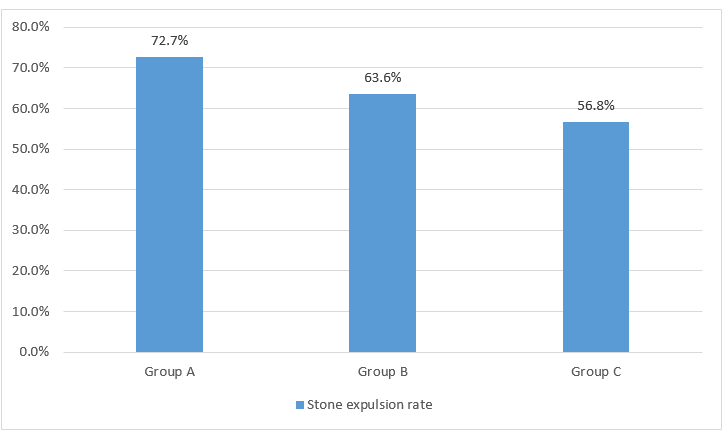
- There was no significant difference in the rate of stone expulsion rate although it was higher in group A; p=0.294, as seen in Figure 1.
- The duration of stone expulsion was significantly lower in group A as seen in Table 1.
- The mean analgesic requirement time and dose was also lower in Group A.
|
|
Group A |
Group B |
Group C |
P value |
|
Time to stone expulsion in days (Mean+SD) |
17.75+75 |
21.13+1.17 |
22.25+1.18 |
0.046 |
|
Mean NSAIDs requirement (mg) |
818.18+618.05 |
1068.2+503.3 |
1095+503.3 |
0.038 |
|
Mean pethidine requirement (mg) |
165.9+219.6 |
270.45+170.9 |
254.54+54 |
0.04 |
|
Mean analgesic requirement in days |
9.8+5.09 |
14.6+7.9 |
12.6+22.25 |
0.004 |
|
Side effects (%) |
31.8% |
31.8% |
4.5% |
0.002 |
- The proportion of people reporting headaches was significantly higher in group B as compared to groups A and C (15.9% vs 4.5% and 0% respectively); p=0.011.
Conclusion
- Tamsulosin as medical expulsive therapy is more effective in reducing the stone expulsion time with lesser need for analgesics than tadalafil in the treatment of distal ureteral calculi.
Int Braz J Urol. 2021;47982-8.