

Scandinavian Cohort Study: Ascertaining the Renoprotection rendered by SGLT2 Inhibitors in the Real World


Background
Type-2 diabetes mellitus (T2DM) is a major cause of kidney failure. Recently, CREDENCE had demonstrated the renoprotective effect of sodium glucose co-transporter-2 (SGLT2) inhibitor canagliflozin among patients with T2DM and established nephropathy. Since the patient population receiving SGLT2 inhibitors is generally heterogeneous it is not known whether the findings from these clinical trials can be generalized to broad unselected group of patients encountered in routine clinical practice.
Aim
To assess whether use of SGLT2 inhibitors vs. an active comparator [dipeptidyl peptidase-4 (DPP-4) inhibitors], would be associated with a reduced risk of serious renal events in routine clinical practice
Patient Profile
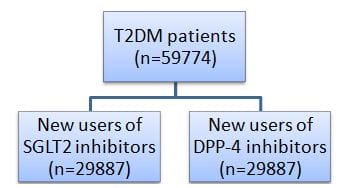
- Type-2 diabetes mellitus patients (age 35-84 years) with new prescription of an SGLT2 inhibitor (n=29887) or DPP-4 inhibitor (n=29887) as second line of treatment
Method
Study Design
- Nationwide cohort study conducted across three countries (Sweden, Denmark and Norway) using a novel active comparator design
Treatment Strategy
Follow-up Time
- Mean period of 1.7 years
Outcomes
Primary Outcomes
- Serious renal events (a composite of renal replacement therapy, death from renal causes, and hospitalization for renal events)
Secondary Outcomes
- The individual components of the primary outcome
Results
- The mean age of the study population was 61.3 years; 18.6% patients (n=11108) had a history of major cardiovascular disease (CVD) and 3.3% (n=1974) had a history had chronic kidney disease (CKD).
- As per a propensity score matched analysis adjusted for 57 variables, patients treated with SGLT2 inhibitors had a significant 58% reduction in the risk of serious renal events as compared with those treated with DPP-4 inhibitors (Table 1).
- This lower risk of serious renal events associated with SGLT2 inhibitors was largely driven by the first two years of follow-up with a significant 66% risk reduction in the first year after cohort entry [hazard ratio (HR); 0.34, 95% confidence interval (CI); 0.25 to 0.47], 57% risk reduction at two years (HR; 0.43, 95% CI; 0.30 to 0.64) and a non-significant 26% risk reduction at 3 years (HR; 0.74, 95% CI; 0.46 to 1.17).
- With regards to the secondary outcomes, patients treated with SGLT2 inhibitors had a significantly lower risk for renal replacement therapy and for hospitalization for renal events, but not for death from renal causes as compared with patients treated with DPP-4 inhibitors (Table 1).
|
Outcome |
Events/1000 person years |
Absolute difference in events/1000 person years |
HR |
95% CI |
Risk Reduction | |
|
SGLT2 Inhibitor |
DPP-4 inhibitor | |||||
|
Primary Outcome (serious renal events) |
2.6 |
6.2 |
-3.6 |
0.42
|
0.34 to 0.53
|
58% |
|
Secondary Outcomes | ||||||
|
Renal replacement therapy |
0.8 |
2.5 |
-1.7 |
0.32 |
0.22 to 0.47 |
68% |
|
Hospitalization for renal events |
2.0 |
4.9 |
-2.9 |
0.41 |
0.32 to 0.52 |
59% |
- As per sensitivity analyses conducted in the Swedish and Danish parts of the cohort and adjusted for glycated hemoglobin and estimated glomerular filtration rate [(eGFR) in Sweden and Denmark] and for blood pressure, body mass index, and smoking (in Sweden only); the HR increased from 0.41 (95% CI; 0.26 to 0.66) to 0.50 (95% CI; 0.31 to 0.81) in Sweden and from 0.42 (95% CI; 0.32 to 0.56) to 0.55 (95% CI; 0.41 to 0.74) in Denmark, but still remained statistically significant.
- Patients with a history of CVD had lower HRs than those without a history of CVD (HR; 0.30, 95% CI; 0.21 to 0.44 vs. HR; 0.52, 95% CI; 0.40 to 0.67, Pfor interaction=0.022). Similarly, patients with a history of CKD also had lower HRs as compared to those without CKD (HR; 0.18, 95% CI; 0.10 to 0.31 vs. HR; 0.52, 95% CI; 0.41 to 0.65; Pfor interaction<0.001).
Conclusions
- Type-2 diabetes mellitus patients newly treated with SGLT2 inhibitors had a significantly reduced risk of serious renal events as compared with those treated with DPP-4 inhibitors.
- Benefits for SGLT2 inhibitor initiators were consistent across gender, age groups, and individual drugs, though greater risk reductions were observed in patients with CVD and those with CKD.
- The findings support the use of SGLT2 inhibitors in a broad range of T2DM patients.
BMJ. Apr 29, 2020 (Published Online);369:m1186. doi: 10.1136/bmj.m1186.
BMJ April 29, 2020 (Published Online);369:m1584. doi: 10.1136/bmj.m1584.