Safety, Feasibility, and Clinical Efficacy of ERAS in Patients Undergoing Radical Gastrectomy

Introduction
Enhanced recovery after surgery (ERAS) uses evidence-based medical strategies to minimize the effects of the stress associated with surgery. It attempts to restore normal physiological function in the shortest possible time, with the ultimate aim of reducing postoperative complications, shortening hospitalization duration, and promoting rapid recovery
Aim
To determine the safety, feasibility, and clinical efficacy of ERAS in patients undergoing radical gastrectomy and to explore the impact of ERAS on the inflammatory response, immune system, and postoperative recovery.
Patient Profile
- Gastric cancer patients who underwent radical gastrectomy
- Age <75 years,
- Gastric cancer diagnosed by preoperative gastroscopic biopsy
- Non-emergency surgery
- No preoperative radio or chemotherapy
Methods
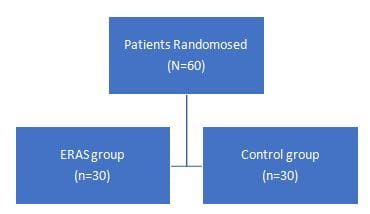
- N= 60
- Patients were randomly assigned to the ERAS group or the control group using the sealed envelope method.
ERAS Group
ERAS protocol
|
Time point |
Protocol |
|
On admission |
1. Preoperative health education 2. No smoking or alcohol 3. Preoperative physical examination to assess nutritional status and rule out contraindications to surgery |
|
Day before surgery |
1. No routine bowel preparation (except in case of constipation) 2. Oral administration of 1000 mL of 10% glucose solution at 10 PM on the night before surgery, with another 300 mL at 6 AM the next morning (replaced by saline in patients with diabetes) 3. No solid food 6 h before surgery, and no oral fluids 2 h before surgery 4. Anesthesia consultation, skin preparation, blood examination, insertion of indwelling gastric tube and urinary catheter, and prophylactic antibiotics |
|
Day of surgery |
1. General anesthesia alone or in combination with thoracic epidural anesthesia 2. Electric blanket and abdominal-temperature saline irrigation to maintain body temperature during surgery 3. Decision to use abdominal drainage tubes depended on the surgical conditions 4. Intravenous infusion of fluid, calculated as 15–20 mL/kg + volume of blood loss during surgery 5. Subcutaneous infiltration anesthesia + intravenous/epidural analgesic pump anesthesia + intravenous nonsteroidal anti-inflammatory drug (e.g., 50 mg flurbiprofen) + 100 mg tramadol orally 6. Attempt to drink warm water (B50 mL/h) 6 h after surgery 7. Routine prevention of nausea and vomiting for 2–3 days |
|
Postoperative day 1 |
1. Early mobilization encouraged 2. Oral fluid intake increased to 500 mL, intravenous fluid volume reduced, total caloric intake limited to 25–30 kcal/kg per day 3. Gastric tube removed according to accepted criteria for extubationa 4. Intermittent urinary catheterization started to train the bladder and stopped when bladder sensation returned to normal 5. Oral lactulose administered for 2 days (in general) and stopped after passing of flatus 6. Chewing gum to stimulate return of normal gastrointestinal function |
|
Postoperative day 2 |
1. Encouragement to continue and prolong out-of-bed activities 2. Oral fluid intake increased to 1000 mL, liquid diet (such as small amounts of rice soup) started, intravenous fluids reduced so that total intake was unaffected 3. Antibiotics stopped if there was no evidence of infection 4. Gastric tube removed if not obstructeda 5. If urinary catheter was not obstructed, it was removed after completion of bladder training |
|
Postoperative day 3 |
1. Encouragement to continue and prolong out-of-bed activities 2. Oral fluid intake gradually increased to 1500 mL gradually, amount of liquid diet increased, intravenous fluid volume gradually reduced so that total intake remained the same 3. Abdominal drainage tube removedb after evaluation for 2 days |
|
Postoperative day 4 |
1. Encouragement to continue and prolong out-of-bed activities 2. Frequent small amounts of oral fluids, small amounts of semi-liquid foods (porridge, noodles, or other soft foods), intravenous fluids stopped if possible, and oral intake increased to maintain the total intake |
|
Postoperative day 5 to discharge |
1. Encouragement to continue and prolong out-of-bed activities 2. Frequent small amounts of oral fluids, with gradual transition to total semi-liquid diet and soft foods; amount of total intake amount maintained |
aThe gastric tube could be removed when the amount of drainage was o100 mL/d; the drained fluid was not blood-tinged, and flatus had been passed. bThe abdominal drainage tube could be removed when abdominal infection, anastomotic fistula, and other post-operative complications were ruled out, and the drainage volume was o10 mL/d for 2 days.
Control group
- The control group received conventional perioperative treatment, which included routine preoperative health education, preoperative intestinal preparation with the oral administration of polyethylene glycol-electrolyte powder, fasting for 8 h before surgery, and no water for 6 h before surgery
Study Endpoints
- The primary endpoint was the duration of postoperative hospital stay, measured from the day of surgery to the day of discharge.
- The secondary outcomes included postoperative clinical, economic, and laboratory indices.
Results
- There were no significant differences between the ERAS and control groups in terms of the mean age, gender ratio, ASA grade, TNM stage, type of gastrectomy, laparoscopic resection, operation time, and intraoperative blood loss
- ERAS patients showed faster recovery and shorter postoperative hospital stays than the controls (P<0.05).
- The time to first flatus and defecation after surgery, time to removal of drainage tubes, time to resumption of oral fluids and semi-liquid nutrition, and time to postoperative mobilization were all significantly shorter in the ERAS group than in the control group
|
Item |
ERAS group |
Control group |
P |
|
Postoperative hospital stay (days) |
8.89 |
10.76 |
0.039 |
|
Time to first flatus, days |
2.63 |
3.35 |
0.024 |
|
Time to first defecation, days |
4.25 |
5.68 |
0.045 |
|
Time to removal of drainage tubes, days |
|
|
|
|
Gastric tube |
1.56 |
3.22 |
<0.01 |
|
Urinary catheter |
1.22 |
3.86 |
<0.01 |
|
Abdominal drainage tube |
4.47 |
6.46 |
<0.01 |
|
Time to resumption of oral intake, days |
|
|
|
|
Time to complete transition to liquid diet |
3.82 |
5.15 |
0.014 |
|
Time to complete transition to semi-liquid diet |
5.67 |
7.21 |
0.032 |
|
Postoperative mobilization, n |
|
|
<0.01 |
|
Postoperative day 1 |
15 |
2 |
|
|
Postoperative day 3 |
9 |
10 |
|
|
Postoperative complications, n |
7 |
9 |
0.559 |
|
Mild |
6 |
7 |
0.754 |
|
Nausea and vomiting |
3 |
2 |
|
|
Incision infection |
1 |
2 |
|
|
Acute urinary retention |
2 |
1 |
|
|
Urinary tract infection |
0 |
2 |
|
|
Severe |
2 |
3 |
0.641 |
|
Gastrointestinal stasis |
1 |
1 |
|
|
Anastomotic fistula |
0 |
0 |
|
|
Intestinal obstruction |
1 |
2 |
|
|
Pulmonary infection |
0 |
0 |
|
|
Deep vein thrombosis |
0 |
0 |
|
- In ERAS patients
- serum albumin and prealbumin were higher on postoperative day 7
- C-reactive protein was lower on postoperative days 3 and 7,
- Neutrophil count was lower on a postoperative day 3 compared to the values in controls (P<0.05 for all).
- IgM levels were higher in ERAS patients on postoperative days 3 and 7 (P<0.05), while IgG levels were higher on a postoperative day 3 (P<0.05).
- Total T lymphocytes were higher in ERAS patients on postoperative day 3, while helper T-cells and CD4+/CD8+ ratio were higher on postoperative days 3 and 7 (P<0.05 for all).
|
Item |
ERAS group |
Control group |
P | ||
|
Nutritional Indicators |
|
|
| ||
|
Serum albumin, g/L |
|
|
| ||
|
At admission |
39.13 |
38.83 |
0.870 | ||
|
Postoperative day 1 |
32.34 |
30.59 |
0.194 | ||
|
Postoperative day 3 |
34.93 |
32.28 |
0.093 | ||
|
Postoperative day 7 |
36.91 |
34.09 |
0.043 | ||
|
Serum prealbumin, mg/L |
|
|
| ||
|
At admission |
223.54 |
227.91 |
0.482 | ||
|
Postoperative day 1 |
183.32 |
177.39 |
0.314 | ||
|
Postoperative day 3 |
204.79 |
193.66 |
0.089 | ||
|
Postoperative day 7 |
213.99 |
203.55 |
0.047 | ||
|
|
Inflammatory indicators |
|
|
| |
|
|
CRP, mg/L |
|
|
| |
|
|
At admission |
3.36 |
3.20 |
0.654 | |
|
|
Postoperative day 1 |
59.22 |
62.57 |
0.278 | |
|
|
Postoperative day 3 |
79.31 |
90.23 |
0.040 | |
|
|
Postoperative day 7 |
23.14 |
32.78 |
0.012 | |
|
|
Neutrophil, % |
|
|
| |
|
|
At admission |
65.56 |
67.32 |
0.741 | |
|
|
Postoperative day 1 |
86.36 |
89.87 |
0.451 | |
|
|
Postoperative day 3 |
76.05 |
84.59 |
0.043 | |
|
|
Postoperative day 7 |
68.06 |
73.25 |
0.204 | |
Conclusion
- The study demonstrated that ERAS can provide significant clinical and economic benefits in control group in gastric cancer patients undergoing radical gastrectomy
- Compared to patients in control group, ERAS patients sustained less damage to cellular immune function and showed faster recovery after surgery.
- ERAS may help reduce the consumption of T lymphocytes (especially helper T cells) and hasten the recovery of T lymphocyte function.
Reference
Braz J Med Biol Res .2020; 53(4): e9175