

Sacubitril/Valsartan Outperforms Enalapril in Reducing the Risk of Clinical Progression in Surviving HF Patients


Introduction
Improvement in heart failure (HF) symptoms or alleviating the risk of death and other cardiovascular (CV) events has been the prime focus of the HF clinical trials. The impact of drugs on the risk of clinical deterioration in surviving patients has however not been studied in-depth.
Aim
To determine the incremental impact of sacubitril/valsartan (an angiotensin receptor-neprilysin inhibitor) over enalapril on the nonfatal progression of HF in surviving HF patients
Patient Profile
- Patients (age ≥18 years; n=8422) with New York Heart Association (NYHA) class II to IV symptoms having an ejection fraction of ≤40% (changed to ≤35% by protocol amendment) and plasma B-type natriuretic peptide (BNP) ≥150 pg/mL (or N-terminal pro-BNP [NTproBNP] ≥600 pg/mL)
- Patients with lower levels of natriuretic peptides were eligible only if they had been hospitalized for heart failure within 12 months.
- Patients on ongoing therapy were required to tolerate angiotensin converting enzyme inhibitor (ACEI) or angiotensin receptor blocker (ARB) equivalent to at least enalapril 10 mg daily for at least 4 weeks before screening along with stable doses of a ?-blocker (unless contraindicated or not tolerated) and a mineralocorticoid antagonist (if indicated).
Method
Study Design
- Multicenter, randomized, double blind trial with a single blind run-in period
Treatment Strategy
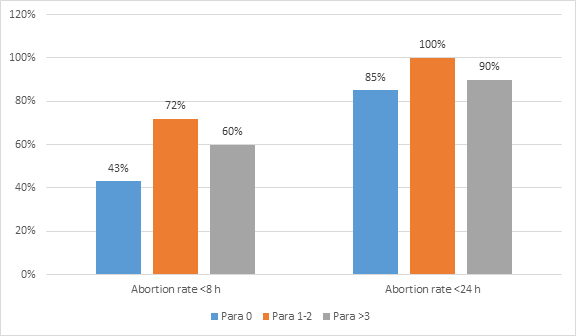
- The ongoing treatment with ACEI or ARB was stopped at trial entry (the other HF medications were continued) and the following treatment strategy was employed thereafter:
Outcomes
- Periodic evaluation for worsening of NYHA functional class
- Worsening of the Kansas City Cardiomyopathy Questionnaire (KCCQ) score (a measure of quality of life)
- Worsening HF requiring an increase in the dose of diuretic for >1 month, the addition of a new drug for HF, or the use of intravenous therapy
- Worsening HF leading to an emergency department (ED) visit
- Worsening HF requiring hospitalization, with a prespecified analysis at 30 days after randomization
- The use of interventions for advancing HF
- Changes in biomarkers reflecting cardiac injury, wall stress, and the effects of neprilysin inhibition
Results
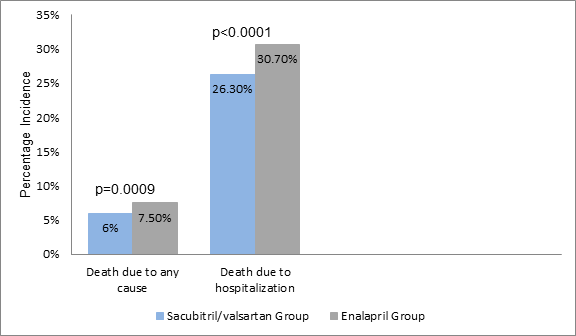
- Fewer deaths due to any cause were recorded in the sacubitril/valsartan group vs. the enalapril group (711 vs. 835; 6.0% vs. 7.5%; hazard ratio [HR], 0.84; relative risk reduction [RRR], 16%; P=0.0009). Similarly, deaths due to hospitalization were also lesser in the sacubitril/valsartan group (26.3% vs. 30.7%; HR, 0.87; RRR, 13%; P<0.0001) vs. the enalapril group (Figure 1)
- As compared to the enalapril group, fewer patients treated with sacubitril/valsartan required intensification of medical treatment for HF or an ED visit for worsening HF. Sacubitril/valsartan treatment also resulted in fewer hospitalizations for worsening HF and a reduced requirement for intensive care unit (ICU) admission (Table 1).
|
Outcome |
Sacubitril/ valsartan Group (n) |
Enalapril Group (n) |
HR |
RRR with sacubitril/ valsartan |
P value |
|
Intensification of HF medical treatment |
520 |
604 |
0.84 |
16% |
0.003 |
|
ED visit for worsening HF |
102 |
150 |
0.66 |
34% |
0.001 |
|
Hospitalization for worsening HF |
851 |
1079 |
0.77 |
23% |
<0.001 |
|
ICU admission |
768 |
879 |
0.82 |
18% |
0.005 |
- Patients treated with sacubitril/valsartan were less likely to receive intravenous positive inotropic agents (RRR; 31%, P<0.001), and to have implantation of an HF device or cardiac transplantation (RRR; 22%; P=0.07) vs. enalapril group.
- The reduction in HF hospitalization with sacubitril/valsartan was evident within the first 30 days after randomization. Worsening of symptom scores in surviving patients was consistently more common in the enalapril group.
- An early and sustained reduction in biomarkers of myocardial wall stress and injury (N-terminal pro-BNP and troponin) was evident with sacubitril/valsartan vs. enalapril.
Conclusion
- Sacubitril/valsartan treatment (angiotensin receptor-neprilysin inhibition) is superior to enalapril (angiotensin-converting enzyme inhibition) in preventing the clinical progression of surviving HF patients.
Circulation. 2015; 131: 54–61.