




Rate of Intra-operative Hyponatraemia Following Use of Intravenous Fluids in Children Undergoing Surgical Procedures

28 Oct, 20
Introduction
Development of iatrogenic hyponatraemia with increased morbidity and mortality and Post-operative post deaths have been reported following hypotonic fluid therapy.
Aim
To evaluate the relative incidence of intra-operative hyponatraemia administration of different intravenous fluids. Randomised studies focusing on the appropriate intravenous fluids for the paediatric age group are limited.
Patient Profile
Children with American Society of Anesthesiologists (ASA) physical health status Class I or II aged between 6 months and 17 years scheduled for various minor elective surgical procedures
Methods
- Randomised double-blind clinical trial
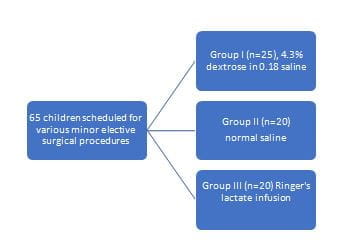
- Estimation of serum electrolytes was carried out at the end of surgery
- The total volume of intravenous fluid administered was recorded
- Hyponatraemia was defined as moderate when serum sodium was <130 mmol/L without symptoms as this concentration will require close monitoring and treatment
Results
- General surgical procedures (41.6% cases) which included procedures such as herniotomies and soft tissue exploration accounted
- Orthorynolaryngological cases (27.69% cases) while orthopaedic and maxillofacial surgeries (3.08% cases each )
- The distributions of fluid type among patients undergoing the various types of surgery were similar (P = 0.078)
- Intraoperatively, moderate hyponatraemia was reported in 1 patient in each group
Figure 1: Incidence of intra-operative hyponatremia
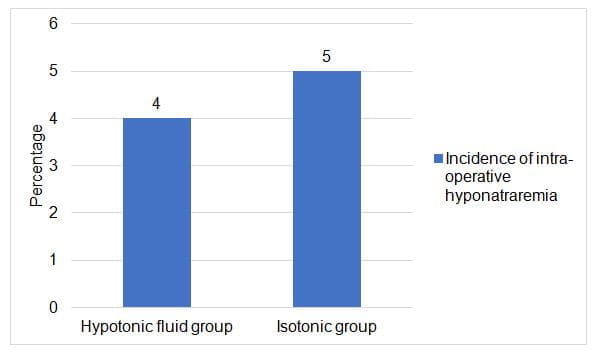
- In patients who had hypotonic and isotonic intra-operative maintenance fluids, no significant difference in the incidence of hyponatraemia was reported (P = 1.000)
- The pre- and post-operative serum sodium were comparable for the Ringer's lactate, normal saline groups and 4.3% dextrose in 0.18 saline groups (P = 0.2754, 0.2850 and 0.2472, respectively).
Conclusion
- The study data suggest that healthy children who have manged with intraoperative hypotonic maintenance fluids during minor elective surgeries are not associated with an additional risk of hyponatraemia compared to those who have isotonic fluids
- The incidence of hyponatraemia is comparable between apparently healthy children who have hypotonic or isotonic maintenance fluid during minor elective surgical procedures.
- The findings do not support a preference for isotonic maintenance fluids for the intra-operative care of paediatric patients.
Reference
Afr J Paediatr Surg. 2018.15;2: 69–72
Related Topics
More From Area Of Interest
You may also like

12 Nov, 26

12 Oct, 26

21 Sep, 26

21 Sep, 26

21 Sep, 26

13 May, 26
Latest Items

20 Nov, 26
Journal Scans
20 Nov, 26

20 Nov, 26
Journal Scans
19 Nov, 26

19 Nov, 26


