

QLB versus TAPB for Postoperative Pain Relief in Patients Undergoing Laparoscopic Colorectal Surgery


Introduction
Currently, laparoscopic radical resection of colorectal cancer is the mainstay treatment for colorectal cancer. The transversus abdominis plane block (TAPB) exerts analgesic effects on the skin, muscle and parietal peritoneum of the anterior abdominal wall. The quadratus lumborum block (QLB) is a new posterior abdominal trunk block which produces analgesic effects through local anaesthetic that covers thoracolumbar fascia and thoracic paravertebral space.
Aim
To compare the QLB with TAPB for postoperative pain relief in patients undergoing laparoscopic colorectal surgery
Patient Profile
- 74 patients were enrolled in the study
- Inclusion criteria
- According to the American Society of Anesthesiologists (ASA) physical status I or II and age of 18 to 70 years
- Exclusion criteria
- body mass index (BMI) ≥30kg/m2 or <15kg/m2
- colorectal tumor TNM stage III or IV, allergic to ropivacaine
- localized infection, anatomic anomalies, a history of alcohol or
- analgesics dependence
- language communication impairment
- and coagulation abnormalities
Methods
- Randomized
- Double-blind clinical trial
- Seventy-four patients scheduled for laparoscopic colorectal surgery were randomly assigned into two groups. QLB and TAPB
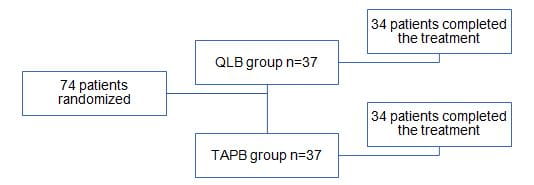
Six patients withdrew from the study before completion: withdrawal was due to lost to follow up in 2 patients from QLP group and 1 patient in TAPB group, surgery was cancelled in 1 patient in QLB group and consent withdrawal in 2 patients in TAPB group.
- General anesthesia was induced and maintained by the same procedure in both groups, using IV propofol (1.5 to 2.0 mg/kg) and sufentanil (0.3mg/kg).
- Endotracheal intubation was facilitated by IV administration of cisatracurium (0.2 mg/kg).
- Anesthesia was maintained with a combined IV–inhaled anesthesia (propofol, remifentanil, and sevoflurane in oxygen), cisatracurium (0.1 mg/kg/hour) was applied to maintain muscle relaxation
- The bispectral index (BIS) value was maintained at 40 to 60
- After surgery, patients received bilateral ultrasound-guided single-dose of QLB or TAPB
- For the posterior QLB
- The transducer was placed at the level of the anterosuperior iliac spine, and moved cranially until the 3 abdominal wall muscles were clearly visible
- According to the characteristics of quadratus lumborum with tendon attached muscle pointed by the transverse process was the quadratus lumborum.
- The probe was tilted down to identify the posterior side of the quadratus lumborum
- A short oblique needle (20 gauge, 100mm) was inserted in plane from the ventral side to the dorsal side followed by a negative aspiration test with 2ml normal saline to confirm the position
- An injection of 20 ml 0.375% ropivacaine on each side was applied between the quadratus lumborum and the thoracolumbar fascia
- For the posterior TAPB
- The probe was positioned across the posterior axillary area, and 3 typical abdominal wall muscles were identified.
- The same needle was directed in plane from anterolateral side to posteromedial side followed by a negative aspiration test with 2 ml normal saline to confirm the position.
- Next, 20 ml 0.375% ropivacaine was injected on each side between the posterior junction of transversus abdominous muscle and the anterolateral border of quadratus lumborum
- The blocks were considered successful when dissection of the fascia plane appeared smooth under the sonographic image with a good spread of the local anesthesia
- In all patients, pain management was achieved using multimodal analgesia regimen
- All patients received sufentanil as patient-controlled intravenous analgesia (PCIA)
- Resting and moving numeric rating scale (NRS) were assessed at 2, 4, 6, 24, 48hours postoperatively
- All patients were followed up for 48hours by the same resident anesthesiology who was blinded to the group allocation
Study Outcomes
- The primary outcome measure was sufentanil consumption at predetermined time intervals after surgery
- Secondary outcomes included resting or moving (dynamic) NRS scores at 2, 4, 6, 24, and 48hours postoperatively and postoperative side effects
Results
|
Variable |
QLB (n =34) |
TAPB (n =34) |
P-value |
|
Age (year) |
51.1 ±13.8 |
53.5 ±10.6 |
.42 |
|
Sex ratio (female/male) |
14/20 |
12/22 |
.62 |
|
BMI (kg/m2) |
26.1 ±6.4 |
27.3 ±7.3 |
.47 |
|
ASA (I/II) |
7/27 |
10/24 |
.40 |
|
Duration of surgery (min) |
169.5 ±22.7 |
175.8 ±19.3 |
.22 |
|
Surgery |
|
|
|
|
Right hemicolectomy |
14 |
16 |
– |
|
Left hemicolectomy |
4 |
5 |
– |
|
Anterior resection |
10 |
10 |
– |
|
Sigmoid colectomy |
4 |
2 |
– |
|
Ileocolic resection |
2 |
1 |
– |
Note: Data are presented as mean ± SD or the number of cases. ASA =American Society of Anesthesiologists, BMI =body mass index, QLB =quadratus lumborum block, TAPB =transversus abdominis plane block.
|
Measurement time (hours) |
QLB (n =34) |
TAPB (n =34) |
P value |
|
6 h |
8.1 ±1.9 |
9.3 ±1.6 |
.33 |
|
24 h |
27.5 ±9.2 |
43.7 ±14.1 |
<.001 |
|
48 h |
52.1 ±11.6 |
81.3 ±16.4 |
<.001 |
QLB =quadratus lumborum block, TAPB =transversus abdominis plane block
- The patients in the QLB group used significantly less sufentanil at 24 and 48hours (P<.05) than in the TAPB group
- However, no significant difference was noted at 6 hours after surgery between the two groups (P=.33)
Table 3: Numeric rating scale scores at rest and during movement
|
Numeric rating scale scores at rest. |
Numeric rating scale scores during movement | |||||
|
Measurement time (hours) |
QLB (n =34) |
TAPB (n =34) |
P value |
QLB (n =34) |
TAPB (n =34) |
P value |
|
2 H |
1.4 ±0.6 |
1.5 ±0.7 |
.53 |
2.6 ±0.7 |
2.9 ±0.8 |
.10 |
|
4 H |
1.6 ±0.5 |
1.7 ±0.6 |
.46 |
3.6 ±0.9 |
3.8 ±0.8 |
.34 |
|
6 H |
1.8 ±0.8 |
1.9 ±0.6 |
.56 |
4.1 ±0.6 |
4.3 ±0.7 |
.21 |
|
24 H |
2.2 ±0.9 |
2.4 ±0.9 |
.36 |
4.4 ±0.9 |
4.7 ±1.2 |
.25 |
|
48 H |
1.9 ±0.8 |
2.1 ±1.1 |
.39 |
5.2 ±1.3 |
5.5 ±1.1 |
.31 |
Note: Data are presented as mean ± SD.
QLB=quadratus lumborum block, TAPB=transversus abdominis plane block.
- No significant differences in NRS results were found between the two groups at rest or during movement (P>.05)
|
Postoperative side effects |
QLB (n =34) |
TAPB (n =34) |
P value |
|
Dizziness |
2 |
8 |
.04 |
|
Nausea and vomiting |
4 |
4 |
.74 |
|
Pruritus |
2 |
3 |
1.00 |
- Incidence of dizziness in the QLB group was lower than in the TAPB group (P<.05)
- The occurrence of pruritus, nausea and vomiting were not significantly different between the two groups (P>.05)
- No other complications were observed, such as arrhythmia or hypotension
Conclusions
- The QLB is a more effective postoperative analgesia as it reduces sufentanil consumption compared to TAPB in patients undergoing laparoscopic colorectal surgery
- Application of QLB produced a significant reduction in sufentanil consumption at 24 and 48hours compared to the TAPB
- QLB is an effective, reliable, and safe analgesic procedure and does not produce any adverse reaction
Reference
Medicine (Baltimore). 2019;98;52: e18448