PTC Trial: Need for Additional 5-day Course of ?-lactam Treatment Among Patients Admitted to Hospital for CAP Clinically Stable After 3 Days of ?-lactam Treatment


Introduction
Adults with community-acquired pneumonia (CAP) are recommend no less than 5 days of antibiotic treatment, with discontinuation based on clinical stability criteria, However, the optimal duration of antibiotic therapy is not well established, and in daily practice most physicians usually treat their patients for 7–10 days
Aim
To assess the need for an additional 5-day course of treatment with ?-lactam therapy among patients admitted to hospital for CAP, who were clinically stable after 3 days of ?-lactam treatment
Patient Profile
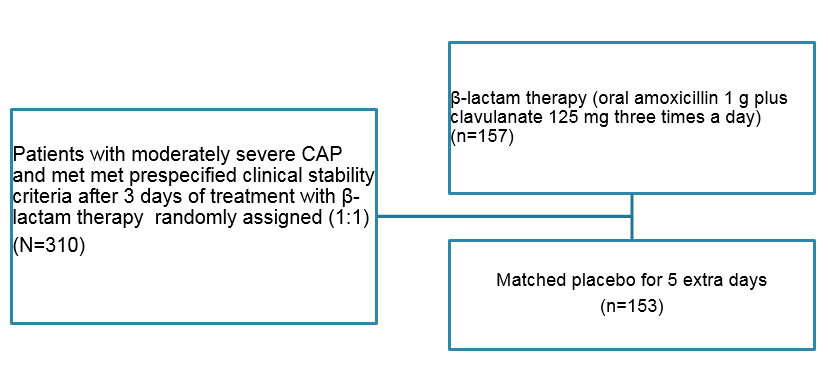
Patients were aged 18 years or older, with moderately severe community-acquired pneumonia, treated with ?-lactam monotherapy
Method
Study Design
- Double blind, randomised, placebo-controlled, non-inferiority trial
Study Endpoints
Primary Endpoint
- The primary outcome was cure 15 days after the start of antibiotic treatment with ?-lactam therapy
- Cure was defined by the following criteria: apyrexia (temperature ≤37·8°C); resolution or improvement of clinical signs or symptoms (coughing frequency or severity, sputum production, dyspnoea, crackles); and no additional antibiotic treatment (for CAP or any reason) since the last follow-up visit
- Patients not fulfilling all the above criteria were classified as not being cured
Secondary Endpoint
The secondary outcomes were
- Cure at day 30; all-cause mortality on day 30; frequency and severity of adverse events during follow-up (with severity defined as serious vs non-serious)
- Patient’s pneumonia symptoms and quality of life assessed using the CAP score at days 0, 3, 8, 15, and 30; and length of hospital stay assessed at day 15
- Recovery time (ie, delay to return to usual activities) was self-assessed at day 30
- Compliance to treatment, assessed at day 15, was added as a post-hoc outcome in all patients who were cured by day 15
Results
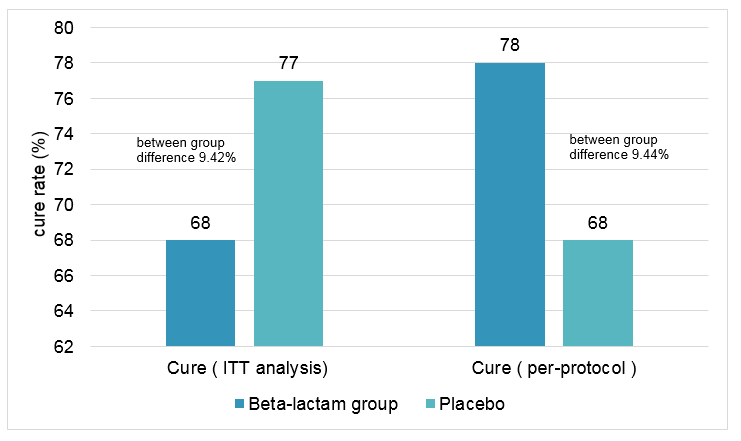
- 3 days of ?-lactam therapy was non-inferior to 8 days of treatment
|
|
Placebo group |
?-lactam group |
Difference |
p value |
|
Cure at day 30 |
|
|
|
|
|
ITT analysis |
109/152 (72%) |
109/151 (72%) |
–0·47 |
>0·99 |
|
Per-protocol analysis |
105/141 (74%) |
107/141 (76%) |
–1·42 |
0·89 |
|
Mortality at day 30 |
3/152 (2%) |
2/151 (1%) |
0·60 |
>0·99 |
|
Patients with at least one adverse event related to treatment |
22/152 (14%) |
29/151 (19%) |
–4·70 |
0·29 |
|
Patients with at least one serious adverse event related to treatment |
1/152 (1%) |
1/151 (1%) |
0·00 |
>0·99 |
|
Length of hospital stay, days |
5·00 |
6·00 |
–1·00 |
0·74 |
|
Recovery time, days |
15·00 |
15·50 |
–0·50 |
0·33 |
Data are n/N (%), median (IQR) or between-group difference in percentage points, with 95% CI in parentheses. Unless otherwise stated, analyses are in the ITT population. ?² test was used to compare the distributions of categorical variables and Student’s t tests to compare the distributions of quantitative continuous variables. ITT=intention-to-treat.
- Post-hoc subgroup analyses showed no significant difference in the cure rate at day 15 between treatment groups among
- patients younger or older than 65 years or 75 years
- patients with PSI scores of < 70 or >70
- patients with PSI scores of <91 or > 91
- No difference was seen in the proportion of participants reporting at least one adverse event linked to treatment
|
|
Placebo group (n=152) |
?-lactam group (n=151) |
|
Patients |
22 (1) |
29 (1) |
|
Digestive disorders |
17 |
28 |
|
Diarrhoea |
13 |
18 |
|
Mycosis |
1 |
1 |
|
Skin rash |
0 |
3 (1) |
|
Headache |
2 |
0 |
|
Hypoxia |
0 |
1 |
|
Clostridioides difficile infection |
1 |
0 |
|
Hepatitis |
2 (1) |
1 |
|
Epistaxis |
1 |
0 |
|
Total |
24 (1) |
34 (1) |
- No difference was seen in the death rate at day 30
- By day 30, three (2%) patients had died in the placebo group (one due to bacteraemia due to Staphylococcus aureus, one due to cardiogenic shock after acute pulmonary oedema, and one due to heart failure associated with acute renal failure) and two (1%) in the ?-lactam group (due to pneumonia recurrence and possible acute pulmonary oedema)
Conclusion
- The study proved that discontinuing ?-lactam treatment after 3 days in patients with CAP who were clinical stable resulted in outcomes that were similar and non-inferior to those in patients who continued their treatment for an additional 5 days
- CAP, lower respiratory tract infection is some of the most common indications for antibiotic use, the data supports safe discontinuation of ?-lactam treatment after 3 days if the patient meets clinical stability criteria.
Reference
Lancet 2021; 397: 1195–203