




Prevalence, Phenotype and Characteristics of Rhinitis in Urban Pediatric Patients Affected with Asthma

8 May, 19
Background
Rhinitis and asthma are linked in several ways, but all these links have not been explored completely till date. It is not known if factors such as seasonal variation or rhinitis phenotype would influence the link between rhinitis and asthma. Although rhinitis is highly prevalent in asthma patients, this prevalence has varied from study to study.
Aim
To ascertain the prevalence of rhinitis and its phenotypes in children and adolescents with asthma. The study also ascertained symptom severity and medication requirements for rhinitis control, while elucidating the link between rhinitis and asthma.
Patient Profile
- Pediatric asthma patients who had participated in the Asthma Phenotypes in the Inner-City (APIC) study (n=749, age; 6-17 years)
- All patients had received baseline evaluations and were managed for 1 year with algorithm-based treatments for rhinitis and asthma.
Methods
Study Design
- Prospective, longitudinal study
Follow-up Visits
- Baseline visit followed by visits every two months, for 12 months (total; 6 visits)
Assessments
- All patients underwent comprehensive evaluations, including skin prick tests, aeroallergen-specific IgE measurements
- Diagnosis of rhinitis was based on two standardized questionnaires that focused on individual symptoms
- Based on the combination of symptom pattern, skin tests and measurement of serum specific IgE levels, rhinitis was pheno typed as follows:
- Seasonal allergic rhinitis (SAR)
- Perennial allergic rhinitis (PAR)
- Perennial allergic rhinitis with seasonal exacerbations (PARSE)
- Indeterminate atopic rhinitis (IAR)
- Nonallergic rhinitis (NAR)
Endpoints
- Comparison of the rhinoconjunctivitis symptom score and the percentage of children requiring nasal corticosteroids (with or without and antihistamine) over the entire observation/ management year between the easy-to-control vs. difficult-to-control asthma groups
Results
- Final analyses included 619 children with asthma who completed at least 4 of 6 visits. Majority (93.5%) of the study subjects had rhinitis. The prevalence and phenotypes of rhinitis identified at baseline were confirmed during the observation/management year.
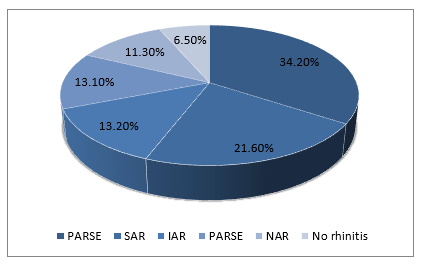
- PARSE was the most common type of phenotype (34.2%) followed by SAR (21.6%), this was followed by IAR (13.2%), and PAR (13.1%), NAR (11.3%) was the least common type and 6.5% subjects had no rhinitis (figure 1).
- There were no differences in the five phenotypes with regards to age, gender, ethnicity or race (P > 0.05).
Figure 1: Prevalence of rhinitis phenotypes in the study population
- With regards to the seasonal pattern of the symptoms of rhinitis, a significant seasonal oscillation was evident in patients with PARSE and SAR (P < 0.001), with peaks in the spring and early fall and troughs in the summer and winter. Seasonal oscillations were also evident in patients with PAR, though they were smaller in magnitude and insignificant (p=0.36). Patients with IAR also had seasonal peaks similar to those seen in PARSE and SAR patients (p=0.021). Seasonality was not confirmed statistically in NAR patients, though a trend differing from the other phenotypes was evident. Patients in the no rhinitis group also exhibited a non-significant seasonal pattern with a symptom magnitude less than that seen in rhinitis phenotype.
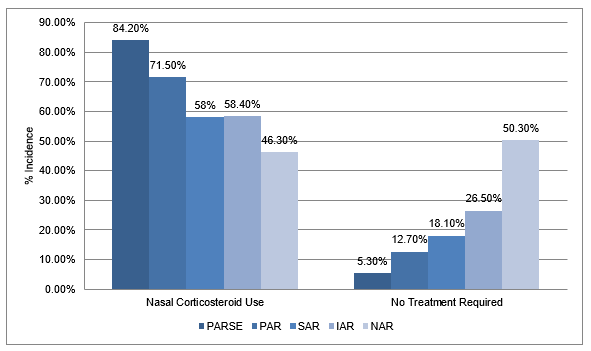
- The requirement of nasal corticosteroid with or without an antihistamine was highest in the PARSE group (84.2%) followed by PAR group (71.5%). Nearly 58% SAR patients and 58.4% IAR patients required a nasal corticosteroid (with or without an antihistamine). The requirement for nasal corticosteroids was least in the NAR group (46.3%) (Figure 2).
- The proportion of patients not requiring any treatment was greatest in NAR group (50.3%; P < 0.001) followed by IAR (26.5%), SAR (18.1%), PAR (12.7%) and PARSE group (5.3%) (Figure 2).
Figure 2: Requirement of medications as per the rhinitis phenotype
- The mean rhinoconjunctivitis symptom score was greater in the children with difficult-to-control asthma vs. those with easy-to-control asthma (P < 0.001). Greater proportion of patients with difficult-to control asthma (range, 80% to 86%) rather than those with easy-to-control asthma required nasal corticosteroids (with or without an antihistamine) (57% to 63%; P < 0.001).
- Children with difficult-to-control asthma had greater adherence to nasal corticosteroids vs. those with easy-to control disease (66.3% vs. 57.9%, P =0.027).
- Patients with difficult-to-control vs. those with easy-to-control asthma had worse rhinitis, with its seasonal patterns partially corresponding to those of difficult–to-control asthma.
Conclusions
- Rhinitis is almost omnipresent in urban pediatric asthma patients and can be easily phenotyped in them based on their symptom seasonality and temporally relevant allergen sensitization.
- Perennial allergic rhinitis with seasonal exacerbations is the most severe phenotype and is most likely to be associated with difficult-to-control asthma. Rhinitis symptoms are more severe and more difficult to control in children and adolescents with difficult-to-control asthma.
- Rhinitis and asthma represent the manifestations of a single disease in two parts of the airways. Clinicians should therefore check for rhinitis symptoms in their pediatric asthma patients and should keep in mind that these symptoms would frequently remain uncontrolled with conventional treatment.
J Allergy Clin Immunol. 2019; 143 (3): 1003-11.
Related Topics
More From Area Of Interest
You may also like

12 Nov, 26

12 Oct, 26

21 Sep, 26

21 Sep, 26

21 Sep, 26

13 May, 26
Latest Items
Journal Scans
9 Nov, 26

9 Nov, 26

6 Nov, 26
Journal Scans
5 Nov, 26

5 Nov, 26


