

PRADAR Study: Virological Efficacy of Abacavir/Lamivudine + DRV/r vs Abacavir/ Lamivudine + RAL in Treatment -naive HIV Patients with CD4<200 cells/?L


Introduction
Late presentation represents one of the major obstacles to HIV eradication. Treatment in HIV late presenter population represents a clinical challenge, especially if they are symptomatic or with a diagnosis of one or more opportunistic infections.
Aim
To evaluate the virological efficacy of two drug regimens: abacavir/lamivudine plus either raltegravir (RAL) 400 mg twice a day or darunavir/r (DRV/r) 800/100 mg once a day in subjects with a diagnosis of HIV infection, CD4 count <200 cells/?L, and HIV-RNA <500,000 cp/mL.
Patient Profile
- Antiretroviral naive HIV+ individuals
- HLA B5701 negative
- Presenting for care with CD4+ cell count < 200/mm3
- Viral load (VL) < 500,000 copies/mL
Methods
- Prospective, multicenter, randomized open-label, 2 arms, phase-3 trial
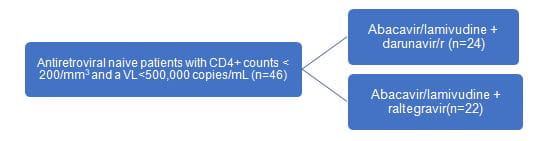
- The primary endpoint: The proportion of patients with undetectable viremia (VL<50 copies/mL) after 48 weeks
- Secondary endpoints: Change in CD4+ cell count from baseline through week 48 and time to virological rebound.
Results
|
|
Raltegravir |
Darunavir/ritonavir |
|
Gender, male/female, number (%) |
19/3 (86.4/13.6) |
19/5 (79.2/20.8) |
|
Age, years, median (IQR) |
41 (32.5–45.5) |
35 (30–46) |
|
Risk factor for HIV, number (%) |
|
|
|
MSM |
9 (41.0) |
11 (45.9) |
|
Heterosexual contacts |
11 (50.0) |
10 (41.8) |
|
IVDU |
1 (4.5) |
1 (4.1) |
|
Other |
1 (4.5) |
1 (4.1) |
|
Unknown |
0 |
1 (4.1) |
|
CDC stage, number (%) |
|
|
|
A |
10 (45.5) |
15(62.5) |
|
B |
5 (22.7) |
3 (12.5) |
|
C |
7 (31.8) |
6 (25.0) |
|
HIV-RNA, copies/ml, Median (IQR) |
89731 (54319–153675) |
112250 (71316–275554) |
|
CD4, cells/mcL, median (IQR) |
108 (44–172) |
107 (35–170) |
|
CD8, cells/mcL, median (IQR) |
629 (352–992) |
771 (562–1068) |
MSM, men who have sex with men; IVDU, intravenous drug users; CDC, Center for Diseases Control
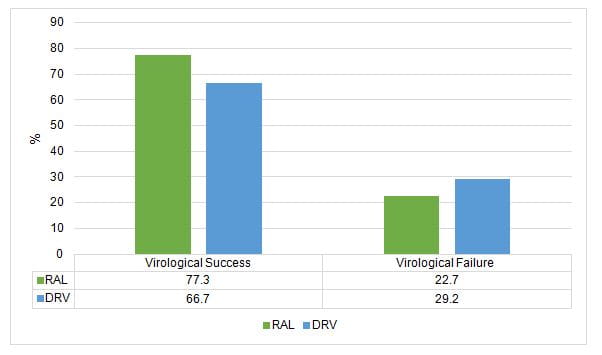
- Virologic response was faster in the RAL group than in the DRV/r group
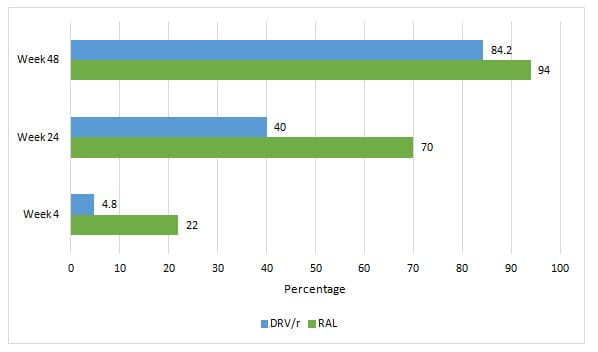
- The median CD4+ cell count raised to 297 cell/uL in the RAL arm and to 239 cell/uL in the DRV/r group
- Increase in CD4 cell count was slightly higher in the RAL arm (189 vs 112 cells/uL)
- No clinically significant changes, from baseline to week 48 were reported for
- Haematological parameters
- Hepatic markers
- Lactate dehydrogenase (LDH)
- Creatine phosphokinase (CPK)
- Grade 3–4 laboratory abnormalities for any considered parameter
- No difference in total cholesterol, while triglycerides were higher in the darunavir/r arm
- Two patients (one in each group) stopped treatment because of adverse events: acute renal failure in the RAL arm and allergic reaction in the DRV/r group
- In the DRV/r arm 19/24 patients reported between 1 and 7 adverse events
- In the RAL arm 11/22 patients reported between 1 and 4 adverse events
- A pregnancy was observed in the RAL arm, but the woman continued the study and gave birth to a healthy child
Conclusion
The study demonstrated that the rate of virologic success was higher than 65% in both arms with a median CD4 cell count >200/?L at week 48.
References
PLoS One. 2019;;14(9): e0222650