




PERMIT Study: Perampanel Effective and Well-tolerated in Patients with Focal Epilepsy

6 Sep, 21
Introduction
Perampanel (PER) is widely indicated for focal onset seizure.
Aim
To determine the effectiveness, safety and tolerability of PER in everyday clinical practice
Patient Profile
- Patients with epilepsy (PWE; focal and generalized) who were treated with PER
Methods
Study Design
- The PERaMpanel pooled analysIs of effecTiveness and tolerability (PERMIT) was a pooled analysis of individual patient data from 44 real-world studies conducted across 17 countries
Outcomes
Effectiveness Outcomes
- Change from baseline in seizure frequency (by seizure type)
- 50% responder rate (response defined as ≥50% reduction in seizure frequency from baseline)
- Seizure freedom rate (seizure freedom defined as no seizures since at least the prior visit)
- The proportion of PWE with worsened seizure frequency
- Long-term retention (>12 months)
Safety and Tolerability Outcomes
- The number and type of adverse events (AEs)
Assessments
- Retention and effectiveness were assessed after 3, 6 and 12 months of PER treatment and at the last visit
Results
- The final study population comprised of 5193 individual PWE; of these, 2698 (57.1%) completed at least 12 months of PER treatment.
- The Effectiveness Population comprised of 4392 PWE and the Tolerability Population comprised of 4617 PWE.
- The mean PER dose at baseline was 2.4 mg/day, and at the end of the observation period was 6.3 mg/day. At baseline, 5.6% patients received PER monotherapy and at the last visit 4.1% patients received PER monotherapy.
- Retention rate for PER treatment at 3, 6 and 12 months was 90.5%, 79.8%, and 64.2% respectively. The mean retention time for PER treatment was 10.8 months.
- With respect to long-term retention, the same was observed in 29.5% PWE, and the mean retention time on PER treatment for these patients was 18.7 months.
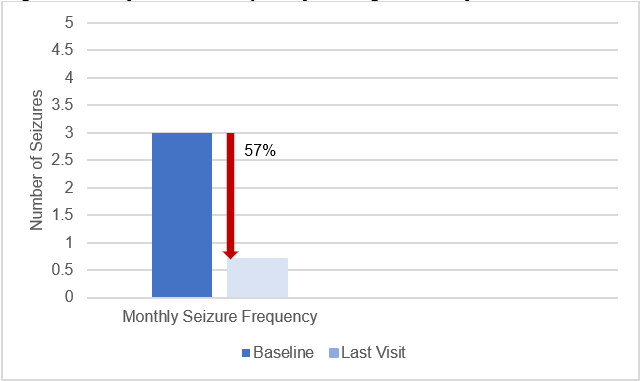
- The total monthly seizure frequency decreased significantly by 57.3% from baseline to the last visit (Fig 1).
Fig 1: Monthly seizure frequency during the study
- The proportion of patients with focal seizures, those with focal aware seizures, focal impaired awareness seizure, and focal to bilateral tonic–clonic seizures decreased significantly from baseline to the last visit (Table 1).
Table 1: Change in the proportion of patients with various seizure types during the study
|
Type of seizure |
Baseline (% of patients) |
Last Visit (% of patients) |
P value |
|
Focal seizures |
71.8% |
51.9% |
<0.001 |
|
Focal aware seizures |
30.2% |
20.1% |
<0.001 |
|
Focal impaired awareness seizures |
55.4% |
40.3% |
<0.001 |
|
Focal to bilateral tonic-clonic seizure |
41.6% |
20.8% |
<0.001 |
- The monthly frequencies of focal, focal aware, focal impaired awareness, and focal to bilateral tonic–clonic seizures also decreased significantly from baseline to the last visit (mean reductions, 46.8%, 47.1%, 44.0%, and 65.4%, respectively; p for all <0.001)
- The responder rate at 12 months was 58.2% and that at the last visit was 50.0%.
- The seizure freedom rate at 12 months was 23.2% and that at the last visit was 20.5%.
- The proportion of PWE with worsened seizure frequency remained stable from baseline at all time points with the same being 6.6% and 10.1% at the 12-month and the last visit, respectively.
- Of the total Effectiveness population, 74 had status epilepticus, of these; 52.7% (n=39) responded to PER treatment (status epilepticus was controlled by PER treatment).
- Overall, 49.9% reported AEs at some point during the follow-up, the incidence being higher amongst the PWE who underwent fast PER titration vs. those with slow titration (61.9% vs. 46.4%; p=0.002)
Conclusions
- The permit study demonstrated long-term PER treatment to be effective and generally well tolerated in patients with focal epilepsy in everyday clinical practice.
- Nearly half of the PWE, including those with status epilepticus responded to PER therapy, and almost a quarter of PWE remained seizure free for at least 6 months after 12 months of treatment.
- The findings from the study strengthen the role of PER for treating focal epilepsy.
J Neurol. 24 Aug, 2021 (Published Online); DOI: 10.1007/s00415-021-10751-y.

More From Area Of Interest
You may also like

12 Oct, 26

21 Sep, 26

21 Sep, 26

21 Sep, 26

13 May, 26
17 Apr, 26
Latest Items

6 Nov, 26
Journal Scans
5 Nov, 26

5 Nov, 26

3 Nov, 26


