




Partners PrEP Study: Oral TDF or TDF - FTC Significantly Reduces the Risk of HIV-1 Acquisition among Heterosexual Men and Women in Serodiscordant Relationships

12 Jan, 17


Introduction
Pre-exposure antiretroviral prophylaxis is a potential HIV-1–prevention strategy for those not yet infected with HIV-1.
Aim
To study the effect of daily oral tenofovir disoproxil fumarate (TDF) or tenofovir disoproxil fumarate–emtricitabine(TDF-FTC) for pre-exposure prophylaxis (PrEP) against HIV-1 acquisition among East African heterosexual men and women in HIV-1–serodiscordant relationships.
Patient Profile
- For the HIV-1–seronegative partners
- Age greater than or equal to 18 and less than or equal to 65 years
- Satisfactory renal function
- No infection with hepatitis B virus
- Satisfactory hepatic function
- Sexually active and
- Not pregnant or breast-feeding
- Seronegative participants for HIV-1 had monthly visits.
- For HIV-1–seropositive partners
- Age more than or equal to 18 years
- Sexually active
- CD4 cell as per the then guidelines and were not receiving antiretroviral therapy (ART) as per the national guidelines
- Partners seropositive for HIV-1 were followed quarterly
- CD4 counts were acquired every 6 months
- Once eligible for the initiation of ART according to national guidelines they were actively counseled to initiate treatment and referred to local clinics.
- Additionally, all couples received a comprehensive package of HIV-1 prevention services
Methods
- Multisite
- Phase 3
- Randomized, double-blind, three-group, placebo-controlled trial
- Enrolled 4,758 couples and followed 4,747 couples from July 2008 through November 2010 from nine sites in Kenya and Uganda
- Partners seronegative for HIV-1 were randomized in a 1:1:1 ratio as follows:
- Once-daily TDF 300 mg, (n=1584)
- TDF–FTC(300-200mg), (n=1579)
- Placebo (n=1584)
Study End Points
- The primary end point was seropositivity in partners previously seronegative for HIV-1
Results
Baseline characteristics were similar across the three study groups.
- Among participants seropositive for HIV-1
- The median CD4 count was 495 cells/ mm3
- 80% had a CD4 count of 350 cells or more per mm3
- The median plasma HIV-1 RNA level was 3.9 log10 copies/mL
- Of the 82 HIV-1 infections that occurred after randomization
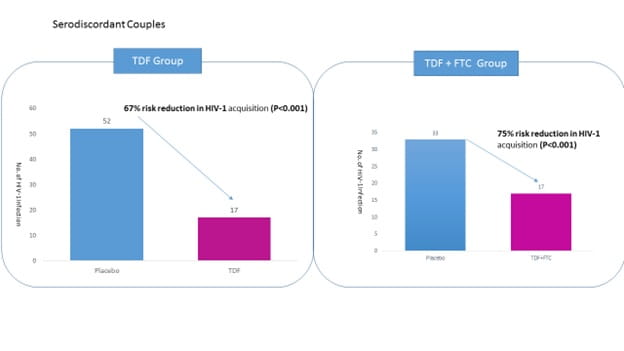
- 17 in TDF arm
- 13 in TDF/FTC arm
- 52 in placebo arm
- In the TDF group, HIV-1 acquisition risk reduced by 67% (P < .0001) and 75% in the TDF/FTC group (P < .0001) which is illustrated in the graph below.
Figure 1: Relative Risk Reduction in HIV-1 acquisition in TDF and TDF-FTC group versus placebo in serodiscordant couples
- Both, the single-drug and 2-drug regimens were associated with significant reduction in HIV-1 acquisition vs placebo in both men and women
- Efficacy with TDF was 71% in women (P = .002) and 63% in men (P = .01)
- Efficacy with TDF/FTC was 66% in women (P = .005) and 84% in men (P<.001)
- No HIV resistance developed after randomization
- Retention and pill-count adherence were high
- TDF was detected in 82% of samples from randomly selected participants
- Detectable TDF levels were associated with a reduction in the relative risk of HIV-1 infection of more than 85%
- No significant differences in key safety parameters were observed between PrEP regimens and placebo
- At enrollment, 27% HIV-1uninfected partner reported having sex without a condom with their HIV-1 infected partner during the prior month which decreased during the follow-up period to 13% at 12 months and 9% at 24 months, respectively and was similar across the study groups
- There were no significant differences in the frequency of deaths, serious adverse events, or serum creatinine or phosphorus abnormalities across the study groups
- Neutropenia was seen more commonly in the TDF–FTC group (17% of participants with a grade 1 or 2 event and 1% with a grade 3 or 4 event) than in the TDF group (15% of participants with a grade 1 or 2 event and 1% with a grade 3 or 4 event) or the placebo group (12% of participants with a grade 1 or 2 event and 1% with a grade 3 or 4 event)
- Active study medications were associated with modestly increased reports of gastrointestinal side effects and fatigue as compared with placebo, primarily during the first month of administration
Conclusion
- In this study of heterosexual serodiscordant couples, once-daily oral TDF and TDF–FTC was associated with risk reductions against HIV-1 infection when provided in combination with other HIV-1 prevention services.
- Both TDF and TDF–FTC showed significantly, and a comparable degree of, HIV-1 protection for both women and men.
N Engl J Med; 2012; 367:399-410
Related Topics
More From Area Of Interest
You may also like

13 May, 26

17 Apr, 26
Our Research
23 Feb, 26
23 Feb, 26
11 Feb, 26
11 Feb, 26
11 Feb, 26
Latest Items

21 Aug, 26
Journal Scans
18 Aug, 26
18 Aug, 26
Journal Scans
18 Aug, 26

18 Aug, 26


