PALETTE Trial: Efficacy and Safety of Pazopanib with Placebo for Soft-tissue Sarcoma

Introduction
Pazopanib is a multitargeted tyrosine kinase inhibitor, has single-agent activity in patients with advanced non-adipocytic soft-tissue sarcoma.
Aim
PALETTE trial (Pazopanib expLorEd in SofT-Tisue Sarcoma—a phasE 3 study; PALETTE) compared the effect of pazopanib on progression-free survival in patients with metastatic non-adipocytic soft-tissue sarcoma (excluding gastrointestinal stromal tumours and adipocytic sarcomas) after failure of standard chemotherapy
Patient Profile
- Patients with angiogenesis inhibitor naive, metastatic soft-tissue sarcoma, progressing despite previous standard chemotherapy
- Patients were 18 years or older, with metastatic soft-tissue sarcoma and progressive disease according to Response Evaluation Criteria In Solid Tumors (version 1.0)
- Patients had at least one regimen containing anthracycline and a maximum of four previous lines of systemic therapy for metastatic disease (no more than two lines of combination regimens).
Methods
Study Design
- Multicentre phase 3 study
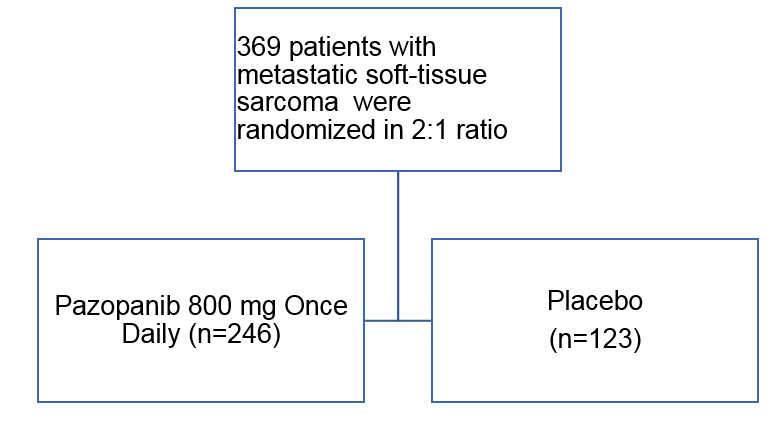
- Clinical assessments of safety, including medical history and physical examination, and laboratory assessment, were done at baseline, and week 4, 8, 12, and at 8-week intervals thereafter
- Treatment was continued until disease progression (according to Response Evaluation Criteria In Solid Tumors, version 1.0), unacceptable toxic effects, withdrawal of consent, or death
Endpoints
- The primary endpoint was progression-free survival
- Progression-free survival was defined as time from randomisation to either first disease progression
Results
- The median treatment duration was 8·1 weeks for placebo and 16·4 weeks for pazopanib.
- The median relative dose intensity was 100% for placebo and 96% for pazopanib
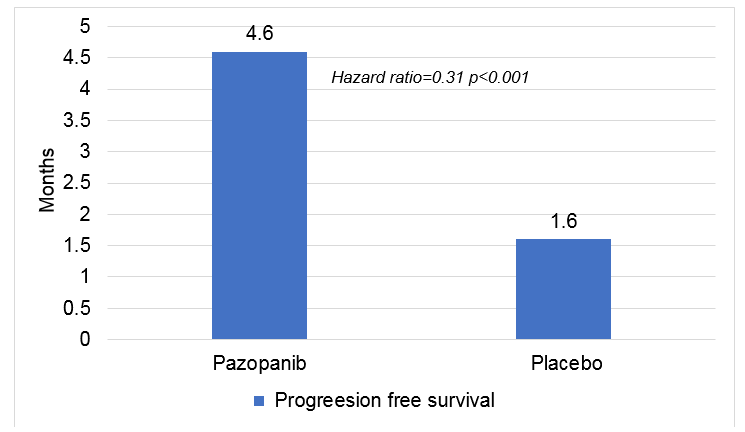
- Median progression-free survival was longer for pazopanib compared with placebo
- Overall survival did not diff er significantly between groups
- Overall survival was 12·5 months with pazopanib versus 10·7 months with placebo (HR 0·86; p=0·25)
- Disease progression was reported in 274 patients (106 with placebo vs 168 with pazopanib) and 215 patients had died (78 vs 137)
Safety
|
|
Placebo group (n=123) |
Pazopanib group (n=239) | ||||
|
|
All grades |
Grade 3 |
Grade 4 |
All grades |
Grade 3 |
Grade 4 |
|
Fatigue |
60 (49%) |
6 (5%) |
1 (1%) |
155 (65%) |
30 (13%) |
1 (<1%) |
|
Diarrhoea |
20 (16%) |
1 (1%) |
0 |
138 (58%) |
11 (5%) |
0 |
|
Nausea |
34 (28%) |
2 (2%) |
0 |
129 (54%) |
8 (3%) |
0 |
|
Weight loss |
25 (20%) |
0 |
0 |
115 (48%) |
0 |
0 |
|
Hypertension |
8 (7%) |
4 (3%) |
0 |
99 (41%) |
16 (7%) |
0 |
|
Anorexia |
24 (20%) |
0 |
0 |
95 (40%) |
14 (6%) |
0 |
|
Hair hypopigmentation |
3 (2%) |
0 |
0 |
92 (38%) |
0 |
0 |
|
Vomiting |
14 (11%) |
1 (1%) |
0 |
80 (33%) |
8 (3%) |
0 |
|
Dysgeusia |
5 (4%) |
0 |
0 |
64 (27%) |
0 |
0 |
|
Rash or desquamation |
13 (11%) |
0 |
0 |
43 (18%) |
1 (<1%) |
0 |
|
Mucositis |
4 (3%) |
0 |
0 |
29 (12%) |
3 (1%) |
0 |
Data are n (%)
Conclusion
- Pazopanib demonstrated significantly improved progression-free survival by a median of 3 months compared with placebo, showing the activity of pazopanib after second-line treatment
- The study data indicate that pazopanib is a meaningful addition to the treatment armamentarium for patients with this rare group of tumours
Reference
Lancet 2012; 379: 1879–86