Overall Survival Outcomes with Lenvatinib versus Sorafenib as a First-line Treatment for Unresectable Hepatocellular Carcinoma

Introduction
Lenvatinib, an inhibitor of VEGF receptors 1–3, FGF receptors 1–4, PDGF receptor ?, RET, and KIT, showed activity in hepatocellular carcinoma.
Aim
To compare overall survival in patients treated with lenvatinib versus sorafenib as a first-line treatment for unresectable hepatocellular carcinoma
Patient profile
Patients with unresectable hepatocellular carcinoma, who had not received treatment for advanced disease
Methods
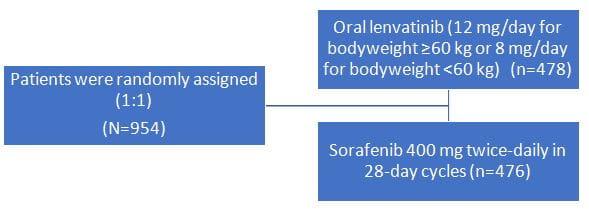
- Open-label, phase 3, multicentre, non-inferiority trial
- 154 sites in 20 countries throughout the Asia-Pacific, European, and North American regions
Study Endpoint
- The primary endpoint was overall survival, measured from the date of randomisation until the date of death
- Secondary endpoints were progression-free survival, time to progression, objective response rate, quality-of-life measurements, and plasma pharmacokinetics lenvatinib exposure parameters
Results
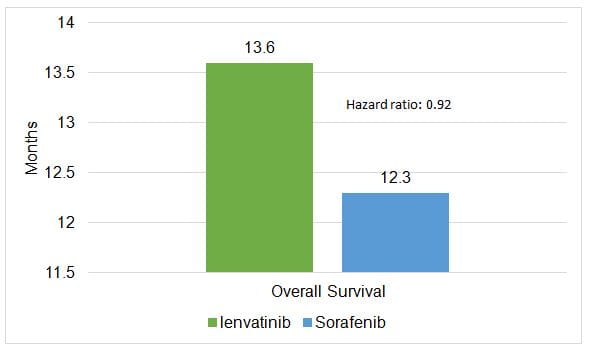
- Lenvatinib showed non-inferiority in terms of overall survival compared with sorafenib
- Lenvatinib showed a statistically significant improvement compared with sorafenib for all secondary efficacy endpoints
|
|
Lenvatinib (n=478) |
Sorafenib (n=476) |
Effect size |
p value |
|
Investigator review according to mRECIST | ||||
|
Overall survival (months) |
13·6 |
12·3 |
HR 0·92 |
·· |
|
Progression-free survival (months) |
7·4 |
3·7 |
HR 0·66 |
<0·0001 |
|
Time to progression (months) |
8·9 |
3·7 |
HR 0·63 |
<0·0001 |
|
Objective response (%) |
115 (24·1%) |
44 (9·2%,) |
OR 3·13 |
<0·0001 |
|
Complete response |
6 (1%) |
2 (<1%) |
·· |
·· |
|
Partial response |
109 (23%) |
42 (9%) |
·· |
·· |
|
Stable disease |
246 (51%) |
244 (51%) |
·· |
·· |
|
Durable stable disease lasting ≥23 weeks |
167 (35%) |
139 (29%) |
·· |
·· |
|
Progressive disease |
71 (15%) |
147 (31%) |
·· |
·· |
|
Unknown or not evaluable |
46 (10%) |
41 (9%) |
·· |
·· |
|
Disease control rate |
361 (75·5%) |
288 (60·5%) |
·· |
·· |
|
Masked independent imaging review according to mRECIST | ||||
|
Progression-free survival (months) |
7·3 |
3·6 |
HR 0·64 |
<0·0001 |
|
Time to progression (months) |
7·4 |
3·7 |
HR 0·60 |
<0·0001 |
|
Objective response |
194 (40·6%) |
59 (12·4%) |
OR 5·01 |
<0·0001 |
|
Complete response |
10 (2%) |
4 (1%) |
·· |
·· |
|
Partial response |
184 (38%) |
55 (12%) |
·· |
·· |
|
Stable disease |
159 (33%) |
219 (46%) |
·· |
·· |
|
Durable stable disease lasting ≥23 weeks |
84 (18%) |
90 (19%) |
·· |
·· |
|
Progressive disease |
79 (17%) |
152 (32%) |
·· |
·· |
|
Unknown or not evaluable |
46 (10%) |
46 (10%) |
·· |
·· |
|
Disease control rate (%) |
353 (73·8%) |
278 (58·4%) |
·· |
·· |
|
Masked independent imaging review according to RECIST 1.1 | ||||
|
Progression-free survival (months) |
7·3 |
3·6 |
HR 0·65 |
<0·0001 |
|
Time to progression (months) |
7·4 |
3·7 |
HR 0·61 |
<0·0001 |
|
Objective response (%,) |
90 (18·8%) |
31 (6·5%) |
OR 3·34 |
<0·0001 |
|
Complete response |
2 (<1%) |
1 (<1%) |
·· |
·· |
|
Partial response |
88 (18%) |
30 (6%) |
·· |
·· |
|
Stable disease |
258 (54%) |
250 (53%) |
·· |
·· |
|
Durable stable disease lasting ≥23 weeks |
163 (34%) |
118 (25%) |
·· |
·· |
|
Progressive disease |
84 (18%) |
152 (32%) |
·· |
·· |
|
Unknown or not evaluable |
46 (10%) |
43 (9%) |
·· |
·· |
|
Disease control rate (%) |
348 (72·8%) |
281 (59·0%) |
·· |
·· |
Safety
- Treatment-emergent adverse events of grade 3 or higher occurred at similar rates in the lenvatinib and sorafenib arms (episodes per patient-year 3·2 vs 3·3)
- The most common any-grade adverse events in
- Lenvatinib arm: hypertension (42%), diarrhoea (39%), decreased appetite (34%), and decreased weight (31%)
- Sorafenib arm: Palmar-plantar erythrodysaesthesia (52%), diarrhoea (46%), hypertension (30%), and decreased appetite (27%)
Conclusion
- Lenvatinib was non-inferior to sorafenib in overall survival as well as statistically significant and clinically meaningful improvement in progression-free survival, time to progression, and objective response rate
- The safety profiles of lenvatinib and sorafenib appeared consistent with the known safety profiles of these drugs in hepatocellular carcinoma, and no new safety signals were identified
- The study supports lenvatinib as a first-line treatment option for patients with unresectable hepatocellular carcinoma
Reference
Lancet 2018; 391: 1163–73