ORAL STRATEGY Study: Comparative Efficacy of Tofacitinib Monotherapy versus Tofacitinib in Combination with MTX in RA Patients with a Previous Inadequate Response to MTX

Introduction
Tofacitinib is an oral Janus kinase inhibitor for the treatment of rheumatoid arthritis (RA).
Aim
Oral Rheumatoid Arthritis trial [ORAL] Strategy assessed the comparative efficacy of tofacitinib monotherapy, tofacitinib plus methotrexate, and adalimumab plus methotrexate for the treatment of rheumatoid arthritis in patients with a previous inadequate response to methotrexate
Patient Profile
Patients aged 18 years or older with active rheumatoid arthritis despite methotrexate therapy
Methods
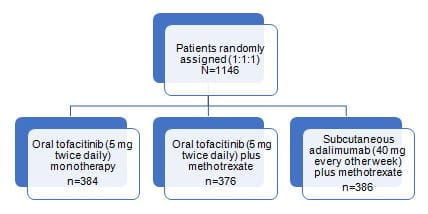
- 1 year, double-blind, phase 3b/4, head-to-head, non-inferiority, randomised controlled trial
Endpoint
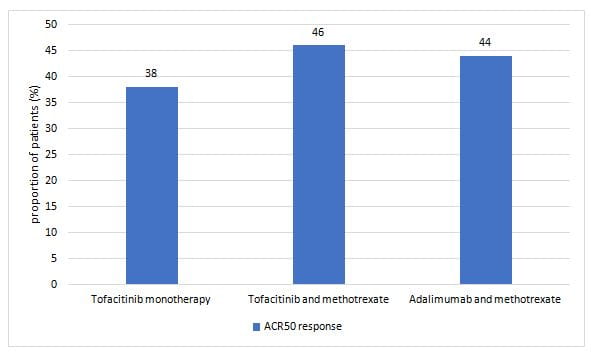
- The primary endpoint was the proportion of patients who attained an American College of Rheumatology response of at least 50% (ACR50) at month 6 in the full analysis set (patients who were randomly assigned to a group and received at least one dose of the study treatment)
- Secondary efficacy endpoints included
- the proportion of patients attaining an ACR response of at least 20% (ACR20) and an ACR response of at least 70% (ACR70) at 6 months
- the proportion of patients achieving low disease activity at 6 months;
- the proportion of patients attaining remission at 6 months
- the proportion of patients attaining a Health Assessment Questionnaire- Disability Index (HAQ-DI) response (improvement of ≥0·22 compared with baseline) at 6 months
- least squares mean change from baseline for SDAI, CDAI, DAS28-4(ESR), DAS28-4(CRP), and HAQ-DI at 6 months
Result
- Non-inferiority of achieving an ACR50 response at 6 months was met for tofacitinib and methotrexate compared with adalimumab and methotrexate, with both achieving clinically meaningful responses
- The proportion of patients who had an ACR20 response at 6 months was similar for those receiving tofacitinib and methotrexate or adalimumab and methotrexate for the treatment of rheumatoid arthritis
- Compared to patients who received tofacitinib monotherapy, the mean changes from baseline in SDAI, CDAI, DAS28-4(ESR), and DAS28-4(CRP) at months 6 and 12 were greater in patients who received tofacitinib and methotrexate or those who received adalimumab and methotrexate
|
|
Tofacitinib monotherapy (n=384) |
Tofacitinib and methotrexate (n=376) |
Adalimumab and methotrexate (n=386) |
|
Proportion of patients achieving ACR criteria | |||
|
ACR20 |
|
|
|
|
6 months |
249 (65%) |
275 (73%) |
274 (71%) |
|
12 months |
237 (62%) |
264 (70%) |
261 (68%) |
|
ACR50 |
|
|
|
|
6 months |
147 (38%) |
173 (46%) |
169 (44%) |
|
12 months |
151 (39%) |
179 (48%) |
177 (46%) |
|
ACR70 |
|
|
|
|
6 months |
70 (18%) |
94 (25%) |
80 (21%) |
|
12 months |
81 (21%) |
109 (29%) |
100 (26%) |
|
Proportion of patients who had low disease activity | |||
|
SDAI (≤11) |
|
|
|
|
6 months |
167 (43%) |
187 (50%) |
182 (47%) |
|
12 months |
169 (44%) |
187 (50%) |
204 (53%) |
|
CDAI (≤10) |
|
|
|
|
6 months |
163 (42%) |
183 (49%) |
179 (46%) |
|
12 months |
173 (45%) |
188 (50%) |
202 (52%) |
|
DAS28-4(ESR) (<3·2) |
|
|
|
|
6 months |
79 (21%) |
100 (27%) |
106 (27%) |
|
12 months |
87 (23%) |
102 (27%) |
128 (33%) |
|
DAS28-4(CRP) (<3·2)* |
|
|
|
|
6 months |
159 (41%) |
174 (46%) |
181 (47%) |
|
12 months |
157 (41%) |
175 (47%) |
201 (52%) |
|
Proportion of patients achieving remission | |||
|
SDAI (≤3·3) |
|
|
|
|
6 months |
38 (10%) |
50 (13%) |
50 (13%) |
|
12 months |
53 (14%) |
61 (16%) |
62 (16%) |
|
CDAI (≤2·8) |
|
|
|
|
6 months |
39 (10%) |
52 (14%) |
51 (13%) |
|
12 months |
54 (14%) |
70 (19%) |
65 (17%) |
|
DAS28-4(ESR) (<2·6) |
|
|
|
|
6 months |
40 (10%) |
45 (12%) |
48 (12%) |
|
12 months |
43 (11%) |
55 (15%) |
66 (17%) |
|
DAS28-4(CRP) (<2·6)* |
|
|
|
|
6 months |
81 (21%) |
115 (31%) |
108 (28%) |
|
12 months |
92 (24%) |
114 (30%) |
136 (35%) |
|
ACR–EULAR Boolean criteria |
|
| |
|
6 months |
27 (7%) |
31 (8%) |
34 (9%) |
|
12 months |
37 (10%) |
49 (13%) |
47 (12%) |
*Remission (<2?6) and low disease activity (<3?2) values for DAS28-4(CRP) have not been validated, but are often used in rheumatology
Safety
- No new or unexpected safety issues were reported for either treatment in this study for up to 1 year
- Proportion of patients who discontinued due to adverse events were
- tofacitinib monotherapy =23 (6%)
- tofacitinib plus methotrexate group 26(7%)
- adalimumab plus methotrexate group 36 (9%)
- Two (1%) of the 384 patients receiving tofacitinib monotherapy died
Conclusion
- The study demonstrated that tofacitinib 5 mg twice daily with methotrexate showed efficacy and safety similar to adalimumab with methotrexate in patients with rheumatoid arthritis who had an inadequate response to methotrexate therapy.
- Tofacitinib monotherapy was not shown to be non-inferior to either combination
- The findings suggested that in RA patients with an inadequate response to methotrexate, the addition of tofacitinib or adalimumab is equally efficacious as combination therapy along with methotrexate
Reference
Lancet 2017; 390: 457–68