Oral Step: Efficacy and Safety of Tofacitinib with Methotrexate in Adult Patients with Active Moderate to Severe RA and An Inadequate Response to TNFi

Introduction
Tofacitinib is a novel oral Janus kinase (JAK) inhibitor a novel oral Janus kinase inhibitor, as a targeted immunomodulator and disease-modifying therapy for rheumatoid arthritis
Aim
To determine efficacy and safety of tofacitinib with methotrexate in adult patients with active moderate to severe RA and an inadequate response to tumour necrosis factor inhibitors (TNFi)
Patient Profile
Patients aged 18 years or older with moderate-to-severe rheumatoid arthritis and inadequate response to TNFi
Methods
- Phase 3, randomised, 6-month, double-blind, placebo-controlled parallel-group study
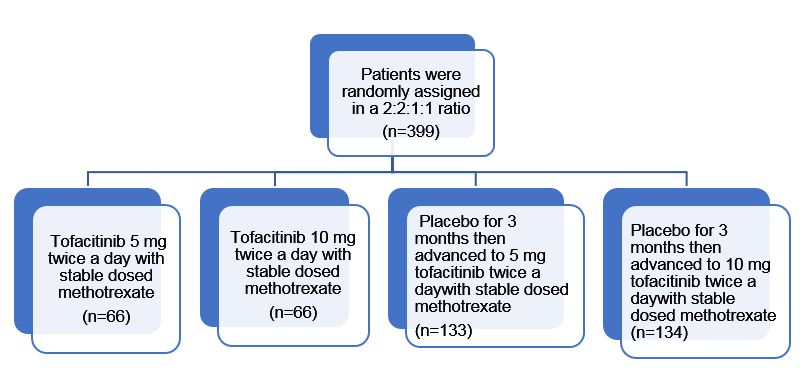
Stable dose of 7.5–25 mg per Week
Results
- All primary and secondary outcomes improved with both doses versus placebo at month 3
- Time to onset of a significant ACR20 response was 2 weeks for both tofacitinib groups
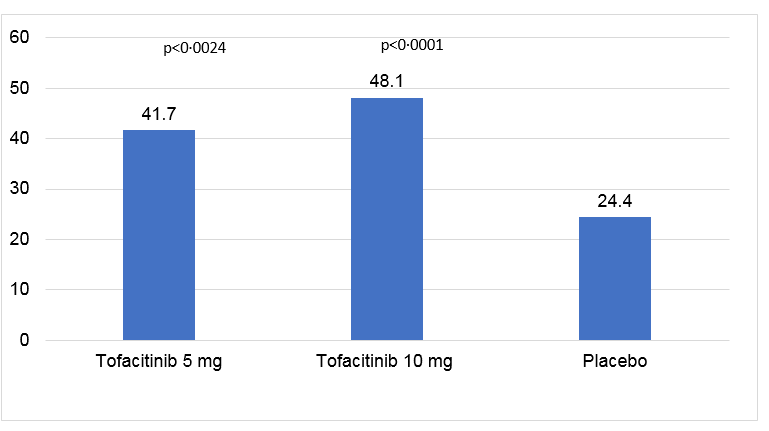
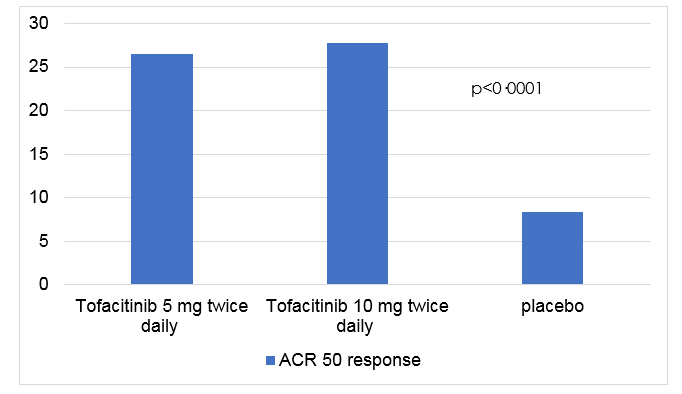
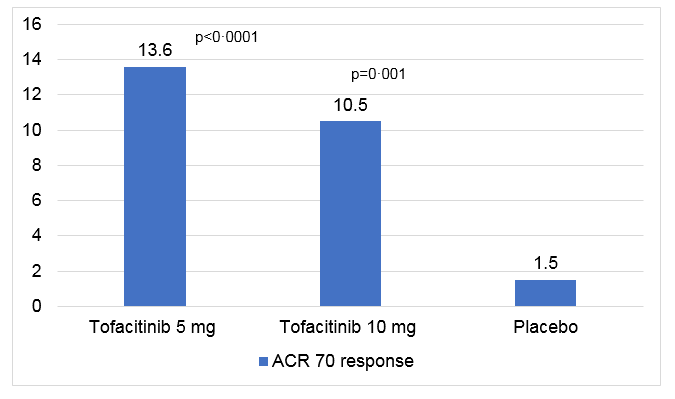
- At month 3, least squares mean (LSM) changes from baseline in HAQ-DI were
- tofacitinib 5 mg twice a day −0?43 (p<0?0001)
- tofacitinib 10 mg twice a day −0?46 (p<0?0001)
- placebo −0?18
- LSM changes from baseline in HAQ-DI were significant for 10 mg twice a day versus placebo at all visits up to month 3 and continued to improve through month 6
- For 5 mg twice a day tofacitinib, LSM changes from baseline were significant at month 3 and were maintained through to month 6
|
|
Tofacitinib 5 mg |
Tofacitinib 10 mg |
Placebo |
P-value |
|
Secondary endpoints |
|
|
|
|
|
DAS28<2·6 rates |
6·7% |
8·8% |
1·7% |
p=0·0105 |
|
DAS28-4(ESR)≤3?2 |
14?3% |
20?8% |
5?0% |
p=0?0138* p=0?0001** |
|
Boolean-based defi ned Remission at month 3 |
6?1% |
4?5% |
0% |
|
|
Boolean-based defi ned Remission at month 6 |
6?1% |
9?0% |
- |
|
|
Proportion of patients achieving index-based defined remission (SDAI ≤3?3) at month 3 |
6?1% |
8?3% |
0% |
|
|
Proportion of patients achieving index-based defined remission (SDAI ≤3?3) at month 6 |
8?3% |
12% |
|
|
|
LSM changes from baseline in DAS28-4(ESR) at month 3 |
−1?8 |
−2?1 |
−0?7 |
p<0?0001* p<0?0001** |
|
, LSM changes from baseline in patient assessment of arthritis pain at month 3 |
−27?2 |
−25?0 |
−8?3 |
p<0?0001 * p<0?0001** |
|
Improvements in FACIT-F at month 3 |
6?3 |
4?6 |
1?1 |
p<0?0001* p=0?0043 ** |
*Tofacitinib 5 mg
** Tofacitinib 10 mg
- Safety was consistent with phase 2 and 3 studies
- No new safety signals were detected
- The most common adverse events in months 0–3 were
- diarrhoea (4·9%)
- nasopharyngitis (4·1%)
- headache (4·1%)
- urinary tract infection (3·0%) across tofacitinib groups
- nausea (nine of 132; 6·8%) in the placebo group
- Changes in laboratory parameters were observed for tofacitinib 5 and 10 mg twice a day versus placebo, including decreases in mean neutrophil counts, and increases in mean HDL and LDL concentrations
|
|
Months 0–3 |
Months 3–6 | |||||
|
|
Placebo (n=132) |
Tofacitinib 5 mg(n=133) |
Tofacitinib10 mg (n=134) |
Placebo then tofacitinib5 mg (n=66) |
Placebo then tofacitinib10 mg (n=66) |
Tofacitinib 5 mg (n=133) |
Tofacitinib10 mg (n=134) |
|
Adverse events |
167 |
145 |
165 |
57 |
59 |
96 |
123 |
|
Patients with adverse events |
75 (56·8%) |
71 (53·4%) |
76 (56·7%) |
24 (36·4%) |
28 (42·4%) |
57 (42·9%) |
58 (43·3%) |
|
Serious adverse events |
6(4·5%) |
2(1·5%) |
2(1·5%) |
3(4·5%) |
2 (3·0%) |
5(3·8%) |
6(4·5%) |
|
Serious infections* |
0 |
0 |
0 |
1 (1·5%) |
0 |
2(1·5%) |
2(1·5%) |
|
Discontinuations because of adverse events |
7(5·3%) |
8(6·0%) |
6(4·5%) |
1 (1·5%) |
2 (3·0%) |
4 (3·0%) |
7 (5·2%) |
|
Deaths |
0 |
0 |
0 |
0 |
1 (1·5%) |
0 |
0 |
Data are number or number (%). *No cases of opportunistic infection were reported. All treatments were given twice a day
Conclusion
- Tofacitinib with methotrexate demonstrated rapid and clinically meaningful improvements in signs and symptoms of rheumatoid arthritis and physical function over 6 months with manageable safety in treatment-refractory population
- Tofacitinib could provide an effective treatment option in patients with an inadequate response to TNFi
Reference
Lancet 2013; 381: 451–60