Oral Dimethyl Fumarate-A Potential Initial Treatment for Relapsing-Remitting Multiple Sclerosis

Background
Dimethyl fumarate is in development as an oral treatment for relapsing–remitting multiple sclerosis that is commonly treated with parenteral agents such as interferon or glatiramer acetate.
Aim
The Comparator and an Oral Fumarate in Relapsing–Remitting Multiple Sclerosis (CONFIRM) trial evaluated the efficacy and safety of dimethyl fumarate vs. placebo in patients with relapsing–remitting multiple sclerosis.
Patient Profile
- Patients with relapsing–remitting multiple sclerosis (McDonald criteria), (age; 18-55 years)
- All patients had the Expanded Disability Status Scale (EDSS) score between 0 to 5, and at least one clinically documented relapse in the previous 12 months or at least one gadolinium-enhancing lesion 0 to 6 weeks before randomization.
- Patients with progressive forms of multiple sclerosis or other clinically significant illness were excluded.
Methods
Study Design
- A randomized, multicenter, double-blind study conducted across 200 sites in 28 countries
Treatment Strategy
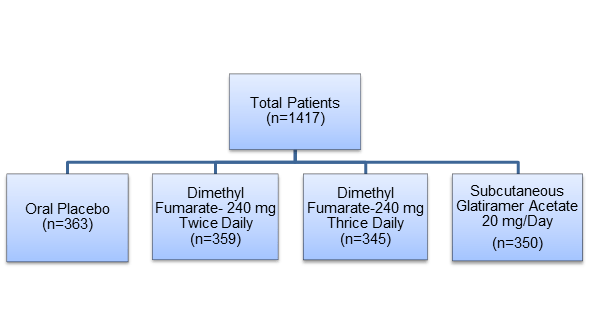
Patients were randomized 1:1:1:1 for two years as follows:
Assessments
- Standardized neurologic assessments including EDSS assessment were performed every 12 weeks and at the time of suspected relapse (evaluated during unscheduled visits).
- MRI scans were obtained for subset of patients at sites with MRI facilities at screening and 24, 48, and 96 weeks.
Outcomes
Primary Efficacy Outcome
- The annualized relapse rate at 2 years (new or recurrent neurologic symptoms not associated with fever or infection, lasting at least 24 hours, accompanied by new objective neurologic findings, and separated from the onset of other confirmed relapses by at least 30 days)
Secondary Efficacy Outcomes
- The number of new or enlarging hyperintense lesions on T2-weighted images
- The number of new hypointense lesions on T1-weighted images
- The proportion of patients with a relapse
- The time to disability progression (increase in the EDSS score of at least 1.0 point in patients with a baseline score of ≥1.0 or an increase of ≥1.5 points in patients with a baseline score of 0, confirmed at least 12 weeks later), each at 2 years
Follow-Up
- 2 years
Results
- The completion rates were similar in all the four study groups.
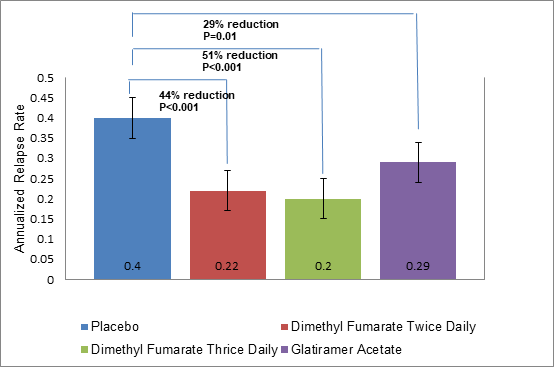
- Patients randomized to twice daily and thrice daily dimethyl fumarate had a significant reduction in annualized relapse rate at two years (relative reduction of 44% and 51%, respectively) as compared to those treated with placebo, respectively. Patients treated with glatiramer acetate also had a relative reduction of 29% in the annualized relapse rate as compared to placebo (Figure 1).
- There was no significant reduction in the rate of disability progression in the dimethyl fumarate twice daily and thrice daily group and glatiramer acetate group vs. placebo group [relative reduction 21% (p=0.25), 24% (p=0.20), and 7% (p=0.70), respectively] during the period of two years.
- There was a significant reduction in the mean number of new or enlarging T2-weighted hyperintense lesions and new T1-weighted hypointense lesions in patients treated with twice daily and thrice daily dimethyl fumarate and glatiramer acetate vs. placebo (Table 1).
|
Parameter |
Dimethyl Fumarate Twice Daily |
Dimethyl Fumarate Thrice Daily |
Glatiramer Acetate | |||
|
|
% reduction in lesions |
P value |
% reduction in lesions |
P value |
% reduction in lesions |
P value |
|
T2-weighted hyperintense lesions |
71% |
<0.001 |
73% |
<0.001 |
54% |
<0.001 |
|
T1-weighted hypointense lesions |
57% |
<0.001 |
65% |
<0.001 |
41% |
0.002 |
- The odds for having greater number of gadolinium-enhancing lesions at two years were significantly reduced in patients treated with twice and thrice daily dimethyl fumarate and glatiramer acetate vs. those treated with placebo (74%, 65% and 61%; p<0.001)
- The incidence of adverse events was higher in the active treatment groups rather than the placebo group and included flushing and gastrointestinal events (with dimethyl fumarate) and injection-related events (with glatiramer acetate).
- Treatment with dimethyl fumarate was not associated with increased risk of malignant neoplasms, serious infections or opportunistic infections. A decreased lymphocyte count was reported in few patients treated with dimethyl fumarate.
Conclusions
- Oral dimethyl fumarate administered twice daily and thrice daily as well as glatiramer acetate reduced the incidence of relapsing–remitting multiple sclerosis during a period of two years.
- All the three treatment strategies were also associated with improved neuroradiologic outcomes as compared to placebo.
- Oral dimethyl fumarate offers a potential initial treatment for patients affected with relapsing-remitting multiple sclerosis or as an alternative to the current treatment alternatives.
N Engl J Med 2012; 367: 1087-97.