Nebulized Glycopyrrolate Reduces the Risk of Clinically Important Deterioration in Moderate-to-Severe COPD


Introduction
The efficacy of glycopyrrolate (GLY) was evaluated in two 12-week phase 3 trials in the US – Glycopyrrolate for Obstructive Lung Disease via Electronic Nebulizer (GOLDEN) 3 and GOLDEN 4 in patients with moderate-to-very severe chronic obstructive pulmonary disease (COPD). GLY significantly improved forced expiratory volume in 1 sec (FEV1), forced vital capacity (FVC) and the St. George Respiratory Questionnaire (SGRQ) total score. To complement the efficacy assessments, a composite endpoint for clinically important deterioration (CID) has been used in this study to achieve a more comprehensive assessment of treatment efficacy. The CID captures changes in pulmonary function, health status and exacerbations that can reflect the worsening of the disease.
Aim
This post-hoc analysis of GOLDEN 3 and 4 trials evaluated whether nebulized GLY 25 mcg and 50 mcg BID administered for 12 weeks reduced the risk of CID in patients with moderate-to-very severe COPD.
Methods
Study Design
- Post-hoc analysis of pooled data from 2 randomized phase 3 trials
Patient Profile
- Patients aged >40 years with moderate-to-very-severe COPD as per GOLD classification
- Current or past smokers (>10 pack-year)
- FEV1 <80% of predicted normal and FEV1/FVC ratio <0.70
Treatment Strategy
- The patients were evaluated at baseline and week 12
- The relative treatment efficacy of GLY versus placebo on the odds of CID (any and by component endpoints) was expressed as the odds ratio (OR) and 95% confidence interval (CI)
- Subgroups categorized by age (<65/≥65 years), sex, smoking status (current/former), long-acting beta agonist (LABA) use, FEV1 (<50%/≥50%), and peak inspiratory flow rate (PIFR) (<60 L/min/≥60 L/min) were assessed
Endpoints
- CID defined as
- ≥ 100-mL decrease from baseline in post-bronchodilator trough forced expiratory volume in one second (FEV1), or
- ≥ 4-unit increase in baseline St. George’s Respiratory Questionnaire (SGRQ) total score, or
- moderate/severe exacerbation
Results
- The overall study population comprised 1293 patients randomized to GLY 25 mcg BID (n=431), GLY 50 mcg BID (n=432) and placebo (n=430)
- Fewer patients in the GLY groups experienced >1 qualifying CID event as compared to placebo as seen in figure 1.
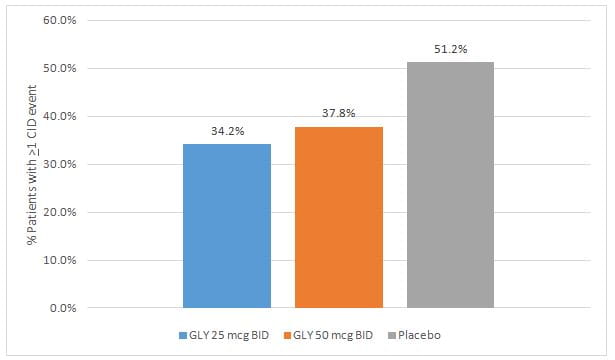
- The risk of CID was significantly reduced by 50% (OR 0.50) and 40% (OR 0.40) in GLY 25 mcg and 50 mcg groups respectively as compared to placebo
- Subjects treated with GLY 25 mcg BID and GLY 50 mcg BID were 59% and 52% less likely to experience CID in FEV1 (OR: 0.41 and 0.48) respectively
- The risk of worsening in the total SGRQ score was significantly reduced by 48% and 37% in the GLY 25 mcg and GLY 50 mcg groups respectively (OR: 0.52 and 0.67)
- The incidence of moderate/severe exacerbations was low and comparable among the cohorts
- The risk of CID was significantly lower for GLY 25 mcg BID than placebo (p< 0.05) irrespective of age, smoking status, LABA use, COPD severity, or PIFR.
- The most pronounced reductions were seen in subjects < 65 years (OR 0.45) and those with PIFR < 60 L/min (OR 0.36)
- Treatment with higher dose also demonstrated significant decreases in the risk of CID except for the subgroup aged >65 years and females
Conclusion
- Nebulized glycopyrrolate (GLY) 25 mcg BID and 50 mcg BID significantly reduced the risk of clinically important deterioration in patients with moderate-to-severe COPD.
- Treatment with GLY prevented clinically meaningful worsening in forced expiratory volume in 1 sec (FEV1) and patient-reported health status.
Int J Chron Obstruct Pulm Dis. 2020 Sep; 15:2309-18.