Long Term Treatment with Omalizumab May be Helpful in Patients with Severe Allergic Asthma


Introduction
The IgE-specific immunomodulation therapy (ESIT) with the administration of monoclonal antibodies (mAbs) for the treatment of severe allergic asthma has been in practice in several countries. Humanized monoclonal anti-IgE antibody, omalizumab, has been shown to reduce the levels of monomeric serum IgE by as much as 96% followed by a 73% decrease in Fc?RI expression on basophils. However, it is difficult for the physicians to decide on the appropriate duration of the treatment. Only one study has evaluated the clinical and immunological parameters in patients after 1 year of withdrawal post treatment with omalizumab for 6 years. The current study reported the follow up for an additional 2 years of withdrawal.
Aim
To evaluate the clinical and immunological state during the withdrawal period of 3 years in patients with severe allergic asthma treated with omalizumab for 6 years.
Methods
Study design
- Prospective, clinical trial
- The patients were followed up for 3 years after Omalizumab was withdrawn after a 6-year treatment
Patient inclusion
- Out of the total of 22 patients enrolled in the initial trial, 18 participated in the study
- 15 were allergic to cats and 3 were allergic to mites
- Median age of 50 years
- Received omalizumab for 6 years as a part of the prospective clinical trial.
- High doses of inhaled corticosteroids but no per-oral corticosteroids were given during the treatment period
Endpoints
- Basophil allergen sensitivity, CD-sens
- Forced expiratory volume in 1 sec (FEV1)
- Asthma symptoms, medication use and emergency hospital visits evaluated by a questionnaire
- Number of IgE molecules per basophil
- Total IgE and IgG4 antibodies to cat dander (e1) and house dust mite (d1)
Results
- The patients did not have any significant changes in FEV1 at the end of 3 years
- Improved or unchanged asthma was reported by 12 patients
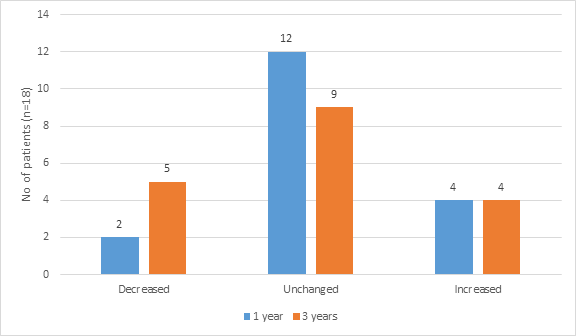
- Asthma symptoms improved in 8 patients at the end of 3 years as compared to 3 patients evaluated at the end of 1 year of withdrawal as seen in figure 1.
- Nightly asthma attacks were not increased in 16 patients as seen in figure 2
- 14 patients had little or no increase in the medications as seen in figure 3.
- The patients had a significantly lower CD-sens as compared to controls (p<0.02)
- The median CD-sens was higher in patients reporting worse asthma, increase in nightly asthma attacks and need for more medications as shown in table 1.
|
|
Asthma Condition |
Nightly Asthma |
Change in Medication | ||||
|
|
Improved or Unchanged |
Worse |
Decreased or Unchanged |
Increased |
Decreased or Unchanged |
Increased | |
|
No of patients |
10 |
5 |
13 |
2 |
12 |
3 | |
|
Median CD-sens |
0.9 |
1.9 |
0.9 |
4.6 |
0.9 |
1.4 | |
- There was no significant difference in the allergen binding activity (ABA) between patients and controls
- The ESIT-treated patients had a significantly larger IgE antibody fraction than those with the low (p<0.001), but not significantly different to that of those with large IgE antibody fraction
- However, the latter group had a significant more than 10 times higher median CD-sens to cat (p<0.001)
- The levels of IgG4 antibodies to cat, which were highest before the treatment, remained almost the same during the 3 years of follow up
Conclusion
- Most of the patients had mild and stable asthma at the end of 3 years of withdrawal of omalizumab after treatment for 6 years
- The reported downregulation of basophil allergen sensitivity and mast cell allergen sensitivity contributed to the clinical improvement in the patients
- Omalizumab might help patients to ‘grow out’ of their allergy more quickly
Allergy. 2010 Jan;65(1):56-60. Doi: 10.1111/j.1398-9995.2009. 02144.x.