

Long Acting Injectables (CAB+RPV) for HIV Maintenance Therapy: Week 48 Pooled Analysis of Phase III ATLAS and FLAIR Studies

Introduction
Long-acting (LA) injectable regimens are a potential therapeutic option in people living with HIV-1. ATLAS and FLAIR are ongoing randomized, open-label, multinational phase 3 studies. These studies demonstrated that monthly injections of cabotegravir (CAB) + rilpivirine (RPV) LA was noninferior based on the primary endpoint (participants with plasma HIV-1 RNA >50 copies/mL at week 48) compared with a control group who continued their oral current antiretroviral regimen (CAR).
Aim
To report the results of pooled analyses of the efficacy (noninferiority), viral resistance, pharmacokinetic analysis, safety and tolerability, and preference findings observed in participants enrolled in the ATLAS and FLAIR studies
Patient Profile
- Participants enrolled in ATLAS and FLAIR trials
- Participants with suppressed plasma HIV-1 RNA (< 50 copies/mL)
Methods
- Pooled Analysis of ATLAS and FLAIR trial
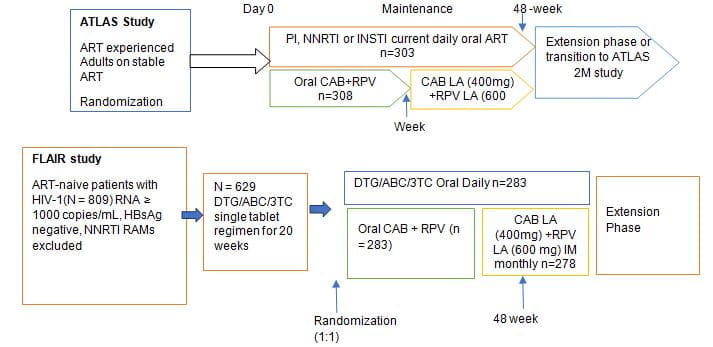

Endpoints
- Primary endpoints
- The primary endpoint of this pooled analysis was the proportion of participants with plasma HIV-1 RNA levels 50 copies/mL at week 48 by FDA Snapshot algorithm
- Secondary endpoints
- The key secondary endpoint was the proportion of participants with plasma HIV-1 RNA <50 copies/mL at week 48
- Selected secondary and exploratory endpoints included virologic outcomes by randomization strata and baseline subgroups, resistance analysis of participants with CVF through week 48, pharmacokinetic analysis, safety and tolerability, laboratory abnormalities, and participant preference
Results
|
|
LA (n = 591) |
CAR (n = 591) |
|
Median age, years |
38 |
38 |
|
Age >50 years, n (%) |
99 (17) |
125 (21) |
|
Women (sex at birth), n (%) |
162 (27) |
168 (28) |
|
Race, n (%) |
|
|
|
White |
430 (73) |
408 (69) |
|
Black or African American |
109 (18) |
133 (23) |
|
Other |
52 (9) |
50 (8) |
|
Mean weight (SD), kg |
77 (15.30) |
77 (16.98) |
|
Median BMI (range), kg/m2 |
25 (15–51) |
25 (13–58) |
|
BMI 30, (%) |
100 (17) |
103 (17) |
|
Median CD4+ cell count (IQR), cells/mm3 |
645 (487–824) |
641 (480–821) |
|
HIV-1–HCV co-infection, n (%) |
42 (7) |
40 (7) |
BMI, body mass index; CAR, current antiretroviral therapy; IQR, interquartile range; HCV, hepatitis C.
- Monthly IM injections of CAB + RPV LA are noninferior to CAR in maintaining HIV-1 virologic suppression in treatment-experienced participants
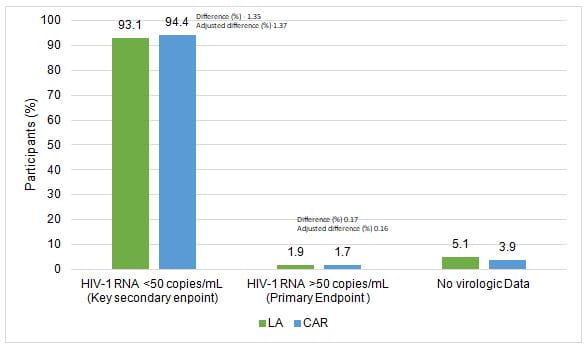
- Seven individuals in each arm (1.2%) developed confirmed virologic failure; 6/7 (LA) and 3/7 (CAR) had resistance-associated mutations
Safety and Tolerability
- Overall, excluding injection site reactions (ISRs), the observed AE profile with CAB + RPV LA therapy was similar to that in the CAR arm
- Adverse events were reported by 86% and 75% of participants in the LA and CAR arms, respectively
o Most of these were grade 1 or 2, AE of grade > 3 were reported in 7% and 6% of participants in the LA and CAR arms, respectively
o Drug-related AEs (excluding ISRs) occurred in 28% of participants in the LA arm compared with 6% in the CAR arm
o AEs leading to withdrawal were reported for 22 (4%) participants in the LA arm and 9 (2%) participants in the CAR arm
- Serious AEs were similar in both arms.
o Two serious AE occurrences were considered by investigators to be related to the study treatment: right knee mono-arthritis in the LA arm and suicidal ideation in the CAR arm.
Conclusion
- This combined analysis demonstrated that monthly injections of CAB + RPV LA were noninferior to daily oral CAR for maintaining HIV-1 suppression in individuals with a prior treatment history of 20 weeks to many years of suppressive ART
- These efficacy and safety data indicate CAB + RPV LA can be a potential therapeutic approach for virologically suppressed PLWH-1
Reference
J Acquir Immune Defic Syndr 2020; 85:498–506