LIFT Alone Verses LIFT with the Adjunct Injection of PRP Treatment of Fistula-in-ano

Introduction
Fistulotomy is the procedure of choice in intersphincteric and low trans-sphincteric anal fistula; however, if used in high trans-sphincteric fistula, continence might be seriously affected. Several procedures have been developed to maintain continence, like advancement flap procedures, fibrin glue sealant, anal collagen plug, and ligation of the intersphincteric fistula tract (LIFT).
Aim
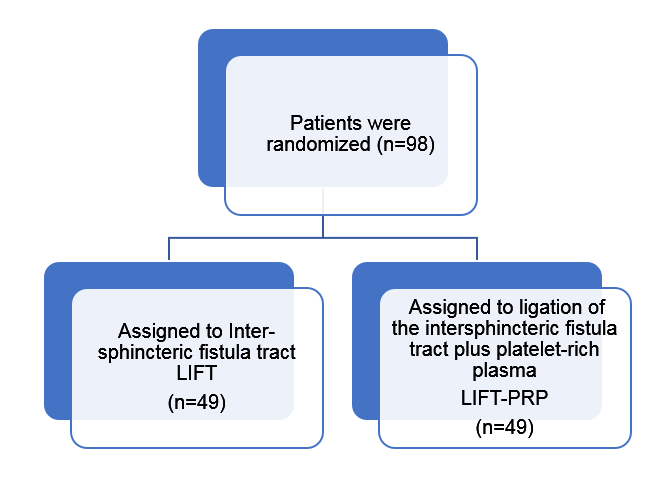
To compare the efficacy and outcome of LIFT plus platelet-rich plasma (PRP) local injection versus ligation of the inter-sphincteric fistula tract alone in the management of high trans-sphincteric anal fistula
Patient Profile
- Patients having high trans-sphincteric fistula-in-ano (trans-sphincteric fistula involving >50% of anal sphincter on magnetic resonance imaging) of cryptoglandular origin
Methods
- Prospective randomized trial
- Study Endpoints
- The primary endpoints were successful complete fistula closure and duration needed for healing
- Secondary endpoints were morbidity, recurrence after 1 year of follow-up, postoperative pain, and quality of life
Results
Healing and Recurrences
Figure 1: Healing and Recurrences
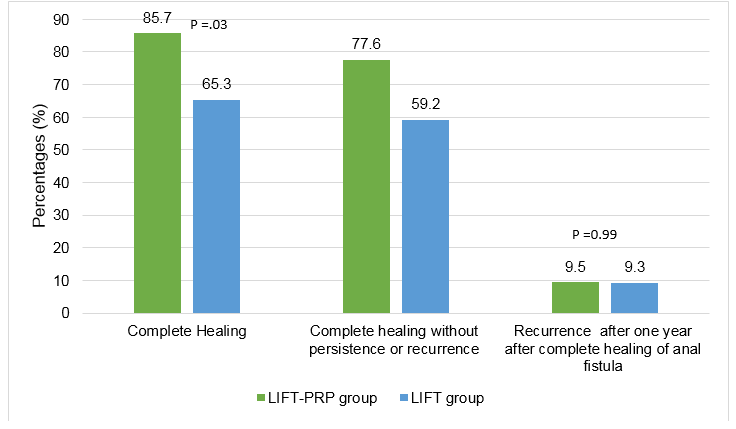
- The mean time to complete healing after ligation of the inter-sphincteric fistula tract plus platelet-rich plasma was significantly shorter than after ligation of the inter-sphincteric fistula tract alone (15.7 ± 4 days vs 21.6 ± 5.4 days; P =.03)
- Patients in the ligation of the inter-sphincteric fistula tract plus platelet-rich plasma group had significantly lower pain scores after both 1 and 7 days
Postoperative pain and complications
- Patients who underwent LIFT-PRP had significantly lower pain scores at day 1 (3.6 ± 1.01 vs 2.0 ± 1.1; P =.01) and day 7 (2.7 ± 1.3 vs 1.2 ± 0.71; P =.01) than patients who underwent LIFT alone
- None of the patients in either group complained of new-onset fecal incontinence (FI)
Table 1: Postoperative pain and complications in both groups
|
Variable |
LIFT |
LIFT-PRP |
P value |
|
Pain VAS at d 1 (mean ± SD) * |
3.6 ± 1.01 |
2.0 ± 1.1 |
.01 |
|
Pain VAS at d 7 (mean ± SD) * |
2.7 ± 1.34 |
1.2 ± 0.71 |
.01 |
|
Postoperative complications (%) y |
0 |
3 (6.1%) |
.24 |
|
Fecal incontinence (%) y |
7 (14.3%) |
2 (4.0%) |
.16 |
|
Median postoperative Wexner incontinence score z |
0 (0-5) |
0 (0-5) |
.36 |
|
Bolded values indicate significant results. LIFT, ligation of inter-sphincteric fistula tract; PRP, platelet-rich plasma; SD, standard deviation; VAS, visual analog scale *Student’s t test y Fisher exact test z Mann-Whitney U test | |||
Quality of life
- Quality of life and level of happiness were significantly better 1 month after ligation of the inter-sphincteric fistula tract plus platelet-rich plasma
Conclusion
- Ligation of the inter-sphincteric fistula tract plus platelet-rich plasma for the treatment of high trans-sphincteric fistula-in-ano demonstrated significantly higher successful healing rate, shorter healing time, less postoperative pain and safe compared with ligation of the inter-sphincteric fistula tract alone
Reference
Surger. 2021:170: 61e66