Landmark Studies in Glaucoma
Treat Early Treat Aggressively Think Long Term
Lowering intraocular pressure (IOP) by even just 1 mmHg can improve a glaucoma patient's prognosis, according to Dr. Robert J. Noecker, M.D. "Lowering IOP has been the backbone of glaucoma therapy for many years. But it's only in the past several years that we have gotten good evidence that regardless of the patient's disease state, lowering IOP is a good thing to do" Noecker said.
Several National Institutes of Health (NIH) and Glaucoma Research Foundation studies have confirmed the one-time assumption that lowering IOP benefits glaucoma patients. Noecker reported on key findings of these glaucoma trials at an Educational Symposium on simplifying glaucoma management.
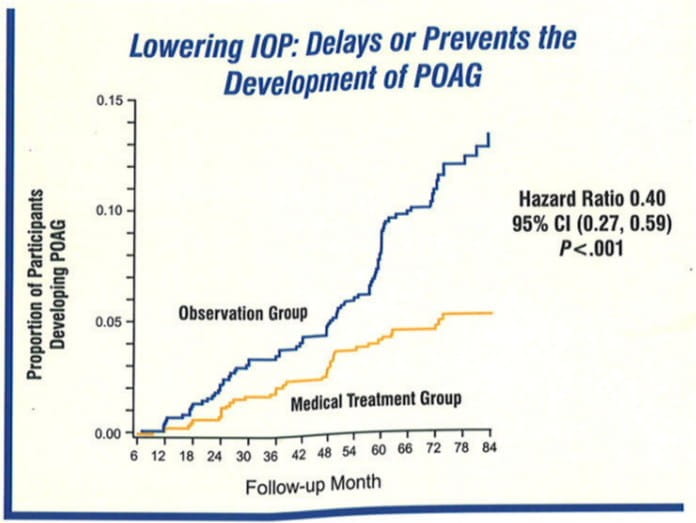
The lower the intraocular pressure is, the less the risk of developing glaucoma and visual field loss," he said.
Noecker reviewed the findings of the Ocular Hypertension Study (OHTS); the Early Manifest Glaucoma Trial (EMGT); the Collaborative Initial Glaucoma Treatment Study (CIGTS); the Collaborative Normal-Tension Glaucoma Trial (CNTG); and the Advanced Glaucoma Intervention Study (AGIS) "Study after study has shown that we need to get the pressure down to significantly lower levels to prevent progression - whether we do it surgically or medically," Noecker said. The collective take-home message from the glaucoma trials, according to Noecker, is: "Treat early, treat aggressively, think long-term."
The Ocular Hypertension Treatment Study's finding that central corneal thickness is directly related to disease progression represents a major shift in the glaucoma treatment paradigm. "One of the major findings of this study was that the thinner the patients' cornea, the more likely they are to have progression to glaucoma," Noecker said.
"We don't know whether it's due to the way we measure intraocular pressure - typically with Goldmann Applanation Tonometry - or if it's due to some kind of structural aspect of eyes with thinner corneas. OHTS shows us that we should routinely measure pachymetry in our patients to assess risk and to normalize intraocular pressure readings," he said.
"When you account for the fact that African-Americans have thinner central corneas and increased cup/disk ratios than those in the Caucasian population, pachymetry measurement actually takes away the issue of race." OHTS aimed to determine the safety and efficacy of topical medication in delaying or preventing the onset of glaucoma. More than 1,600 patients were randomized to observation or treatment with topical glaucoma medications. "On average, the patients had their IOP pressures lowered by 20%," Noecker said.
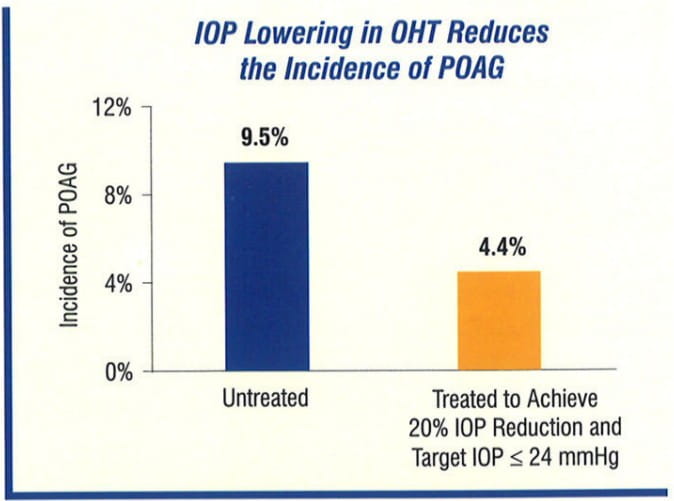
The observation group had a much higher rate of progression during the course of the study compared to the medical treatment group. "In the untreated arm, over a five-year period, there was a 9.5% chance of developing a progressive visual field defect, or having a change in the optic nerve," he said.
"In comparison, the risk of progression over five years in those patients who had their lOPs reduced by at least 20% went down to 4.4%."
"A lot of the patients that progressed onto glaucoma did so by the criteria of optic nerve changes," Noecker said. "As a result, we have recognized that if we wait for patients to have visual field changes, the disease may be quite advanced."
The Early Manifest Glaucoma Trial addressed the next level of glaucoma severity. Its aim was to compare the effect of immediate therapy to lower IOP vs. no treatment on the progression of newly detected open angle glaucoma. The trial randomized 255 patients to either laser trabeculoplasty plus topical betaxolol or to no initial treatment. Treatment was well tolerated but there was a slight increase in cataract formation.
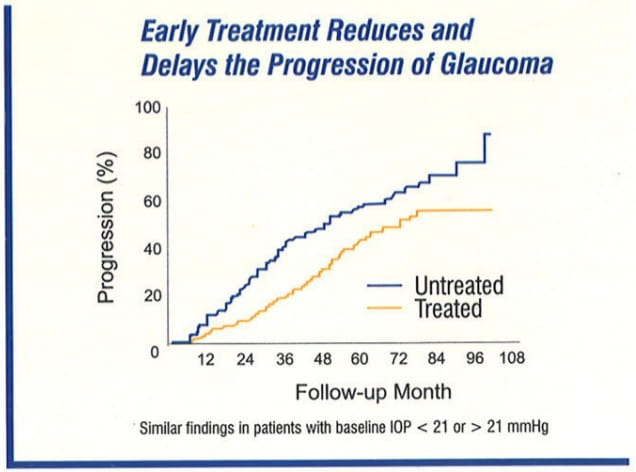
"What they found was that on average the intraocular pressure was reduced by 25% in those patients that were treated from a baseline of 20.6 mmHg down to 15.5 mmHg", Noecker said.
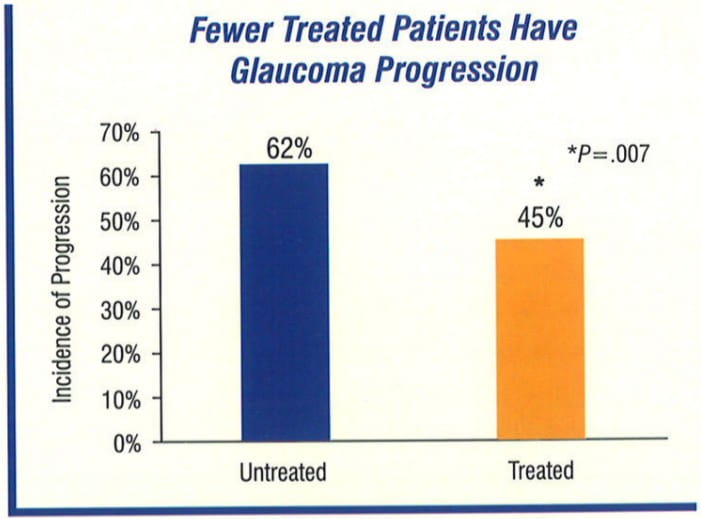
"Patients that were treated were less likely to have progression in their disease," he said. "The patients in this study were more mildly affected compared to those in other studies," Noecker said. Follow-up at five years was significant, according to Noecker, with risk of progression in the untreated vs. treated group at 62% vs. 45% respectively.
"A major take-away point from this study is that they were also able to show that for each millimetre of mercury decrease in the intraocular pressure the patients had an associated 10% decrease in their risk of glaucoma progression," Noecker said. "When we set target intraocular pressures, we need to stick with them because in many patients every millimetre matters when we're treating glaucoma."
The aim of the Collaborative Initial Glaucoma Treatment Study was to determine if newly diagnosed patients with open angle glaucoma are better treated initially with medication or filtration surgery. Three hundred and seven patients were randomized to the medication group, and 300 patients were randomized to the surgery group. Very aggressive pressure lowering was a hallmark of this study, according to Noecker.
"It was found that both treatment modalities lowered intraocular pressure," Noecker said. "Surgery lowered intraocular pressure more than medications, but they both lowered intraocular pressure very well. In the follow-up period at five years, there is actually no significant difference between the two treatment groups," he said.
The EMGT and CIGTS show that patients that have early visual field loss should be treated aggressively according to Noecker. "Being that both medical treatment and surgery effectively reduce IOP and the risk of progression, we have not changed our usual treatment approach. We still start off with medical treatment first for most patients," he said.
In conclusion, the CIGTS study showed that the newer medications do reduce IOP by 30-38% and, therefore, when treating a patient aggressively the newer medications should be used before surgery.
The Collaborative Normal Tension Glaucoma trial aimed to determine if lOP-lowering treatment is effective in reducing the progression of normal-tension glaucoma. One hundred and forty patients were randomized to receive either medication or surgery, with an endpoint of lowering IOP by 30% or to have no treatment.
"We found even in this patient group that does not have very high pressures, lowering IOP was beneficial," Noecker said. The untreated eyes had a 35% chance of progression compared to about 12% chance of progression in the treated group. "Once again, we saw that lowering IOP is important no matter what type of glaucoma the patients have," Noecker said.
The aim of the Advanced Glaucoma Intervention Study was to determine the effects of surgical and laser lOP-lowering procedures in glaucoma patients with IOP uncontrolled by medications. Seven hundred and eighty-nine eyes were randomized to either have laser therapy or incisional surgery. If neither of those attempts worked, a reverse procedure was performed followed by a trabeculectomy.
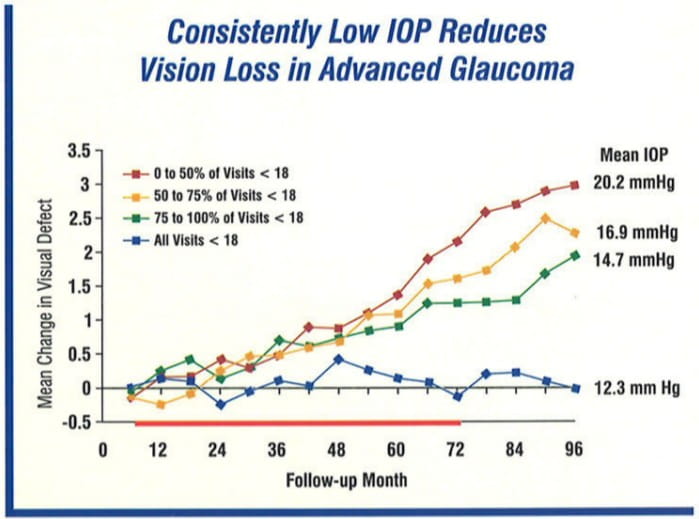
"The idea was to predict what would happen five years in the future based on the IOP following the series of initial interventions," Noecker said. "The associative part of the analysis looked back at how well controlled the patients' pressures were throughout the study." The study showed that those patients who achieved the lowest lOPs consistently also had the least chance for progression.
"A lot of the information that came out of these trials is intuitive," Noecker said. "Lowering IOP is a good thing whether the patients just have high pressure and is at risk for glaucoma, whether they are in the early or late phases of the disease, or even if they never had very high pressures."
1. Arch Ophthalmol. 2002;120:714-720.
2. Arch Ophthalmol. 2002;120:714-720.
3. Arch Ophthalmol. 2003 Jan;121(1):48-56.
4. Am J Ophthalmol, 126 (1998), pp. 498–505.
5. Curr Opin Ophthalmol. 2003 Apr;14(2):106-11.
6. Ophthalmology. 1998 Jul;105(7):1146-64