

Lamotrigine vs. Oxcarbazepine in Combination with Escitalopram in Patients with Co-existing Epilepsy and Depression


Introduction
Patients with epilepsy have a high incidence of depression due to long-term use of antiepileptic drugs (AED) and due to the adverse effect of the disease on the quality of life (QOL). Lamotrigine and oxcarbazepine, two effective AEDs have been used recently in patients with epilepsy and depression, with relatively few clinical applications. Escitalopram is a new antidepressant which achieves a better antidepressant effect. Nevertheless, not many studies have evaluated the efficacy of oxcarbazepine and lamotrigine in combination with escitalopram in epileptic patients.
Aim
- To compare the clinical efficacy of oxcarbazepine and lamotrigine in combination with escitalopram for treating patients with epilepsy and depressive disorder
- To determine the influence of these medications on the prognostic QOL of the patient
Patient Profile
- Patients with epilepsy and co-existing depression (n=108)
- All the study participants had disease (epilepsy) duration of at least 3 months and seizure frequency of at least 1 per month
Methods
Study Design
- Prospective study
Treatment Strategy
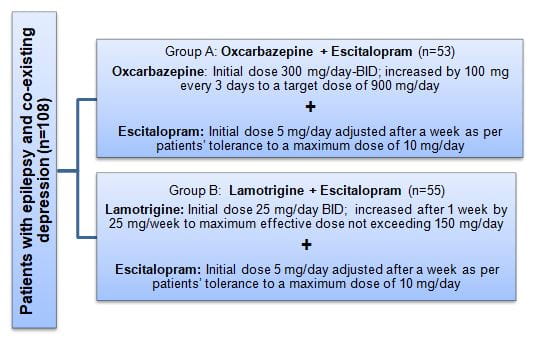
- Patients were treated as follows:
Outcomes
- Efficacy of the medications after 6-month treatment in terms of frequency and duration of epileptic seizure
- Depressive state of the patient at 6 months
- Quality of life in patients
- Adverse reactions
- One-year drug retention rate
Assessments
- Electroencephalogram (EEG)
- Hamilton Depression Rating (HAMD) score
- Montgomery?Asberg Depression Rating (MADRS) score
- The Quality of Life (QOL) in Epilepsy?Patients?Weighted 31p scoring system
Follow-up
- 1 year
Results
- Mean age of the study population was 33.9 years, 58 of them were females.
- The total treatment efficacy rate did not differ significantly between the two study groups. The frequency and duration of seizures decreased significantly 6 months post-treatment in both the study groups (Table 1)
|
Treatment Outcomes |
Group A |
Group B | ||
|
Pre-treatment |
6 months post-treatment |
Pre-treatment |
6 months post-treatment | |
|
Seizure Frequency |
3.21 times/month |
1.28 times/month |
3.18 times/month |
1.19 times/month |
|
Seizure Duration |
5.21 min |
3.03 min |
5.28 min |
3.07 min |
- The HAMD and MADRS scores improved in both the groups with a significantly greater improvement in group B as compared with group A (Table 2)
|
Scores |
Group A |
Group B | ||
|
Pre-treatment |
6 months post-treatment |
Pre-treatment |
6 months post-treatment | |
|
HAMD Score |
21.11 |
13.67 |
21.13 |
9.98 |
|
MADRS Score |
29.33 |
16.65 |
29.22 |
10.59 |
- Although the rate for epileptic discharges on EEG did not differ significantly pre- and post-treatment, the control rate was significantly higher in group B vs. group A
- With regards to the QOL, both treatments resulted in improved emotional, cognitive, social relationship, energy, health status, and overall QOL scores; with no significant between-group differences
- The incidence of adverse events was significantly lower in group B vs. group A (overall incidence of adverse events: 7.27% vs. 22.64%).
- Retention rates at 1 year were significantly higher in group B vs. group A (81.2% vs. 62.27%)
Conclusions
- Both oxcarbazepine and lamotrigine combined with escitalopram exhibited good efficacy in patients with epilepsy and co-existing depressive disorder, and may effectively improve the prognostic QOL of patients.
- The antidepressant effect and safety of lamotrigine in combination with escitalopram was superior to that of oxcarbazepine in combination with escitalopram.
Exp Ther Med. 2020 Dec;20(6):146. doi: 10.3892/etm.2020.9275.