

Lacosamide as First Add-on therapy for Focal-onset Epilepsy: The Real-World Data from LACONORTE Study

Introduction
Most of the epilepsy patients require a second antiepileptic drug (AED) for effective seizure control or to reduce the adverse events. Lacosamide (LCM), a third-generation AED selectively enhances sodium-channel slow inactivation and is recommended as monotherapy and adjunctive therapy in patients with focal onset seizures (FOS), at doses up to 400 mg/day. Nevertheless, in real life setting, LCM is used frequently in patients with less treatment-refractory epilepsies and often added to only one concomitant AED. Also, flexible dosing; as opposed to the fixed 400 mg/day not only achieves seizure control but minimizes AEs.
Aim
The LACONORTE study evaluated the efficacy and safety of LCM as first add-on therapy in the real-life setting
Patient Profile
- Adult patients with FOS on monotherapy with another AED who were started on LCM as first add-on therapy (n=73)
Methods
Study Design
- A multicenter, retrospective study with one year duration
Follow-up Visits
- Clinical data was obtained at 3, 6 and 12 months after initiating LCM or until discontinuation of LCM
Outcomes
Efficacy Outcomes
- Treatment responders (patients achieving at least 50% reduction in seizure frequency)
- Seizure freedom rates at the end of the 12-month period
Safety Outcomes
- Incidence and type of AEs
- Intensity of AEs (mild, moderate or severe) as per patient’s subjective perception of severity
- AEs leading to discontinuation of LCM
Results
- Mean age of the study population was 50.3 years, median duration of the epilepsy was 3.0 years, and 48.6% study population comprised of male patients. Twenty-two patients (30.1%) were aged ≥65 years.
- The mean LCM dosage during the maintenance phase was 211.4 mg/day and the median dosage was 200 mg/day (range 100–400 mg/day).
- At 1 year, 91.8% patients had at least 50% reduction in the number of seizures (responders), 64.4% patients attained seizure freedom at last visit. Nearly 79.5% patients responded to LCM treatment by 3 months (Figure 1).
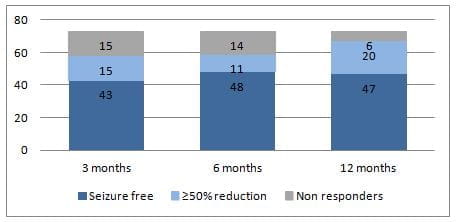
- Responder rate in patients with secondary generalized seizure was 97% and that in patients with focal seizures was 87.5%, moreover; 75.8% and 55.0% patients in these groups were seizure free, respectively.
- Response rate for patients aged < 65 years and ≥ 65 years was similar (92.2% and 90.9%) and 60.8% and 72.2% of these patients achieved seizure freedom.
- The proportion of patients converting to LCM monotherapy increased steadily during the follow-up and by end of the study, 18 patients (24.7%) had converted to LCM monotherapy. Nearly 83.3% patients remained seizure-free while on monotherapy.
- Adverse events were reported in 15 patients (20.5%) with most of the AEs being transient. The most common AEs included; dizziness, anxiety, headache, somnolence and memory complaints. Incidence of AEs was lower amongst patients aged ≥65 years vs. <65 years (13.6% vs. 23.5%).
- No severe AEs were reported during the study.
- Two patients withdrew from LCM therapy due to intolerance and one patient withdrew due to inefficacy. Neither the adverse events nor withdrawal seemed to be related to total dose or to escalating regimes.
- Seventy patients (95.9%) continued on LCM after the last visit (median dose 200 mg/day, ranging 100–400).
Conclusions
- This real-world study demonstrated LCM to be efficacious and safe when used as first add-on therapy for FOS.
- Lacosamide was well-tolerated by the study population with most adverse events being mild and/or transient.
- The results of the study seemed to be independent of the age, baseline AED and the type of seizure (with or without secondary generalization).
Epilepsy Res. 2018;145: 51–4.