Intravaginal Electrical Stimulation along with Bladder Training Improves Outcomes and Quality of Life in Women with Idiopathic OAB


Introduction
Along with medical therapies, conservative therapeutic options for the treatment of overactive bladder (OAB) and urgency urinary incontinence (UUI) include electrical stimulation (ES), pelvic floor muscle (PFM) and bladder training (BT). BT is strongly recommended for improvement in urinary incontinence in women and is the first-line therapy in adults with UUI. Intravaginal ES is a conservative therapeutic option in adults with OAB and UUI. Although BT and IVES are commonly used together in urogynecological rehabilitation especially in women with idiopathic OAB, no guidelines recommend this combination.
Aim
The efficacy of IVES+BT on incontinence-related quality of life (QoL) and clinical parameters in women with idiopathic OAB was evaluated in this study.
Method
Study Design
- Prospective randomized controlled trial
Patient Profile
- Women >18 years with confirmed diagnosis of idiopathic OAB
- Urodynamically confirmed detrusor overactivity
- Intolerant or unresponsive to antimuscarinics and discontinued atleast 4 weeks before enrollment
Treatment Strategy
- A total of 62 women with idiopathic OAB were randomized into two groups
- Group 1 (n=31) received BT alone
- Group 2 (n=31) received BT+IVES
- A total of 24 sessions of IVES was performed - 20 mins a day, thrice weekly for 8 weeks
Endpoints
- Incontinence severity assessed by 24-hour pad test
- PFM strength
- Frequency of voiding, nocturia, incontinence episodes and number of pads
- Symptom severity evaluated by OAB-V8 questionnaire
- Incontinence-related QoL using the IIQ-7 questionnaire
- Positive response rate
- Cure/improvement rate
- Treatment satisfaction using Likert scale
Results
- The clinical and urodynamic characteristics of both the groups were comparable at baseline
- Both the groups showed significant improvement in all parameters at the end of the treatment compared to baseline except PFM strength in Group 1 (p < 0.05).
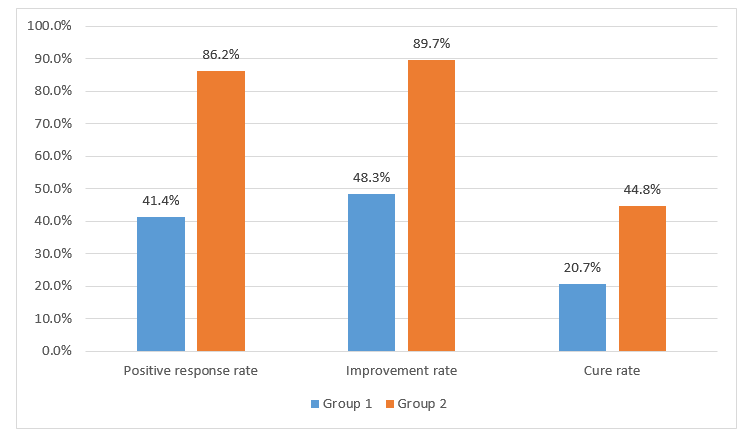
- Group 2 demonstrated significant improvements in incontinence severity, frequency of voiding, nocturia, incontinence episodes, number of pads, symptom severity, and QoL as compared to Group 1 (p < 0.05).
- the rates of treatment satisfaction, cure/improvement, and positive response were significantly higher in group 2 compared to Group 1 (p < 0.05) as seen in figure 1.
Conclusion
- Bladder training (BT) along with intravaginal electrical stimulation (IVES) significantly improved the clinical parameters as well as incontinence-related quality of life than BT alone in women with idiopathic overactive bladder.
Int Braz J Urol. Nov-Dec 2021;47(6):1150-1159.