




Intracameral Moxifloxacin for Endophthalmitis Prophylaxis following M-SICS- Findings from a Large-scale Indian Study

29 Jun, 20
Background
Manual, sutureless, small incision cataract surgery (M-SICS) is used widely in several developing countries, including India. Nevertheless, the surgical procedure is generally associated with higher rates of infectious post-operative endophthalmitis.
Aim
To compare the incidence of post-operative endophthalmitis before and after initiation of intracameral (IC) moxifloxacin administered for endophthalmitis prophylaxis in patients undergoing cataract surgery
Patient Profile
- Patients (116714 eyes) undergoing cataract surgery between February 15, 2014, and April 15, 2015, at the Madurai Aravind Eye Hospital (AEH)
- The study population was a mix of charity and private patients
Method
Study Design
- Retrospective, clinical registry-based study
Treatment Strategy
- Patients underwent one of the three surgical procedures; phacoemulsification, M-SICS, or manual large incision extracapsular cataract extraction
- All patients received the standard post-operative therapy
- Based on the use of IC moxifloxacin, the study population was categorized into three groups as follows:
- Group 1: Charity patients who did not receive IC moxifloxacin (n=37777)
- Group 2: Charity patients who received IC moxifloxacin prophylaxis (n=38160)
- Group 3: Private Patients who did not receive IC moxifloxacin (n=40777)
Outcomes
- Incidence of postoperative endophthalmitis before and after initiation of IC moxifloxacin within six weeks of cataract surgery
- Endophthalmitis treatment cost
Results
- Of the surgeries performed in the charity population during the 14-month period, 49.7% patients did not receive IC moxifloxacin (group 1) and 50.3% received IC moxifloxacin (group 2).
- M-SICS accounted for nearly 97% of the total cataract surgeries in the charity group, as compared to only 21% in the private patient group.
- Postoperative endophthalmitis was diagnosed in 30 eyes in group 1 (0.08%) and 6 eyes in group 2 (0.02%). The incidence of endophthalmitis in group 3 was significantly higher than that seen in group 2 (0.07%; 29 eyes; P for all < 0.0001) (figure 1).
Figure 1: Incidence of postoperative endophthalmitis in the study groups
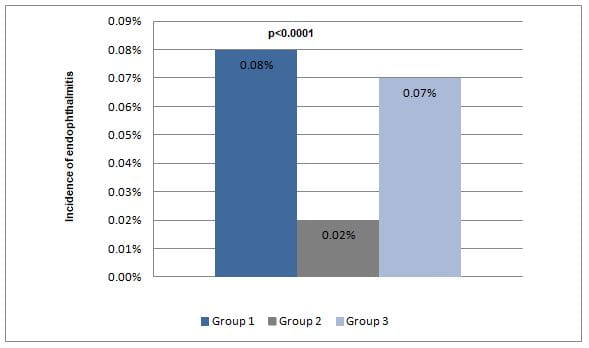
- Routine IC moxifloxacin prophylaxis significantly lowered the endophthalmitis rate in the charity population (group 2) compared with the private population (group 3).
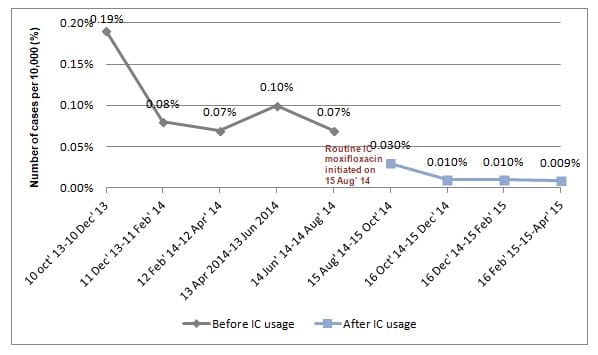
- Figure 2 depicts the reduction in incidence of the post-cataract endophthalmitis in the Madurai AEH charity population over time, including the 10 months immediately before and the 8 months immediately after routine initiation of direct IC moxifloxacin prophylaxis.
Figure 2: The incidence of endophthalmitis immediately before and after IC moxifloxacin treatment
- No adverse events attributed to IC moxifloxacin were observed in group 2.
- The total cost of treating the 30 patients with endophthalmitis in group 1 was virtually identical to the total combined cost of routine IC moxifloxacin prophylaxis and treatment of the 6 endophthalmitis cases in group 2.
Conclusions
- Routine IC moxifloxacin prophylaxis was associated with a highly significant, four-fold reduction in postoperative endophthalmitis in patients undergoing M-SICS.
- IC moxifloxacin was a cost-effective method for cutting down the incidence of infectious endophthalmitis in this higher-risk population of patients with cataract.
- IC antibiotic prophylaxis is recommended for patients with M-SICS.
Ophthalmology 2016;123:302-308.
Related Topics
More From Area Of Interest
You may also like

12 Oct, 26

21 Sep, 26
21 Sep, 26
21 Sep, 26

13 May, 26

17 Apr, 26
Latest Items
12 Oct, 26

12 Oct, 26
Journal Scans
8 Oct, 26

8 Oct, 26


